

Two Distinct Tools for Release: Parole vs. Resentencing
Authors

Media Contact
For general and media inquiries and to book our experts, please contact: pr@rstreet.org
When a person is in prison, they rarely—if ever—remain behind bars for every day of their imposed sentence. This is true for many reasons.
- Sentence Commuted: A person could be granted clemency, an executive action by a governor or president to commute a sentence by reducing, substituting, or ending it. This happens fairly infrequently.
- Sentence Overturned: A sentence may be overturned for reasons like police or prosecutor misconduct, improper or newly discovered evidence, or ineffective assistance of counsel. This is also relatively uncommon.
More often, early release from custody (or early transfer to an alternative, such as community supervision or a halfway house) happens in two primary ways.
- Good- or Earned-Time Credits Accrued: Good- or earned-time credits reduce time served for good behavior or successful program participation.
- Discretionary Parole Granted: Discretionary parole allows release under supervision before a person’s sentence is fully completed.
Currently, at least 33 states currently offer good-time credits, 34 states offer earned-time credits, and 35 states allow discretionary parole.
However, a different mechanism has become more widespread in recent years: resentencing.
A NEW, SEPARATE MECHANISM OF REVIEW
Broadly known as “second look” policies, resentencing ordinarily comes in the form of defendant- or prosecutor-initiated petitions and are typically restricted by criteria such as offense type, age at the time of offense, amount of time served, or membership in a specific population (e.g., veterans, survivors of abuse). These policies allow individuals to return to court for a new hearing in which a judge can re-evaluate a previously imposed sentence. In such cases, the judge may uphold the original sentence, reduce it, or modify it.
As of summer 2025, 15 states had enacted some form of resentencing statute.
One approach to resentencing policy that has gained traction is defendant-initiated resentencing, which does not require membership in a specific population. The District of Columbia plus six of those 15 states—Connecticut, Delaware, Florida, Maryland, North Dakota, and Oregon—have enacted such laws.
When considering this type of legislation, two natural questions emerge:
- How is the opportunity for a resentencing hearing meaningfully different from parole eligibility?
- Why is a resentencing hearing necessary if parole already exists?
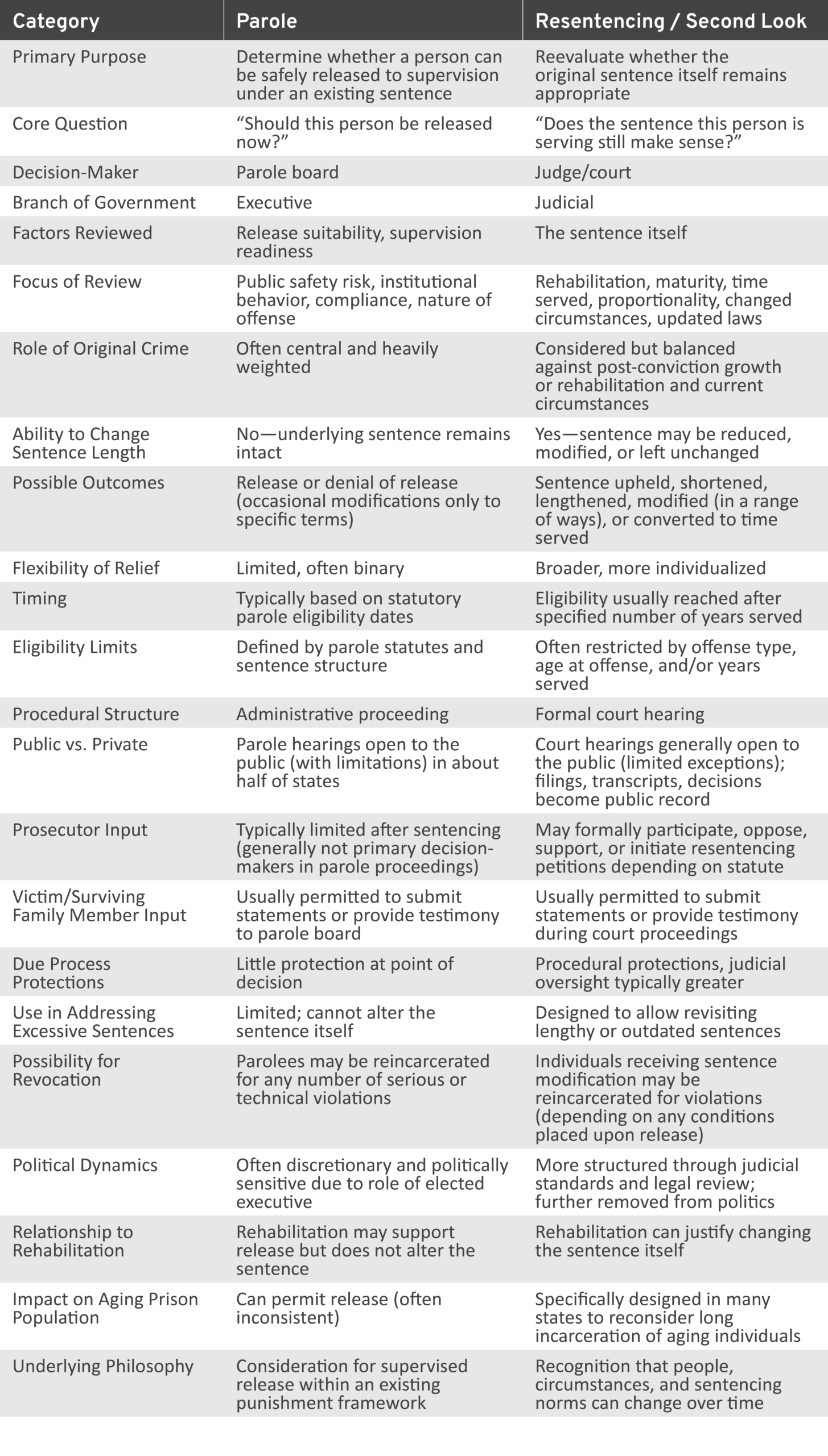
These questions underscore a few important realities. While parole and resentencing serve fundamentally different purposes, operate through different mechanisms, and often produce very different outcomes, both play an important role within the criminal justice system.
COMPARING PAROLE AND RESENTENCING
WHY BOTH MECHANISMS MATTER
Because parole and resentencing answer fundamentally different questions, the existence of one does not eliminate the need for the other. Properly constructed, both can (and should) coexist as tools that promote accountability, transparency, and effective governance.
Second look policies do not erase accountability, nor do they require release. They simply create a structured judicial process—complementary to but distinctive from parole—for evaluating whether continued incarceration remains necessary after years or decades have passed. A justice system confident in its sentences should also be confident enough to revisit them when circumstances materially change.
Furthermore, the opportunity for a resentencing hearing can serve as a powerful rehabilitative incentive from day one. Unlike many parole systems that focus heavily on the original offense, second look policies are explicitly designed to evaluate personal growth. Parole grant rates have declined across the board since 2019, leaving many incarcerated individuals with little hope that years of hard, transformative work will ever pay off.
By contrast, second look policies place rehabilitation, maturity, institutional conduct, educational and vocational achievement, and demonstrated progress at the center of the review process. That framework not only creates a more meaningful opportunity for release in appropriate cases, it also reinforces the idea that taking accountability and improving oneself while incarcerated can result in tangible benefits—a principle our systems should strive to instill.
TABLE SOURCES
- Journal of Criminal Law and Criminology
- Robina Institute of Criminal Law and Criminal Justice
- Prison Policy Initiative: Parole in Perspective Part 1
- Prison Policy Initiative: Parole in Perspective Part 2
- Council on State Governments
- Ella Baker Center for Human Rights
- Washington State Department of Corrections
- For the People: FAQ
- For the People: For Lawmakers
- Maryland Second Look: FAQ
- Maryland Second Look: Full FAQ