

Examining Serious Mental Illness in Healthcare and Criminal Justice Systems
Authors


Table of Contents
- Executive Summary
- Introduction
- Prevalence and Impact of Serious Mental Illness
- Deinstitutionalization and the Shift to Community Care
- Mental Healthcare Access and Crisis Care
- Civil Commitment and Involuntary Treatment
- Serious Mental Illness in the Criminal Justice System
- Key Challenges
- Conclusion
Media Contact
For general and media inquiries and to book our experts, please contact: pr@rstreet.org
The challenges surrounding serious mental illness have no single or simple solution. An effective approach must account for civil liberties, personal autonomy, stigma, resource constraints, medical needs, and public safety.
Executive Summary
Policy changes in the 1960s altered the care landscape for people with serious mental illness. Deinstitutionalization closed many state-run psychiatric hospitals with the intention of building systems that facilitated community-based treatment for those who had previously received care in hospitals. Unfortunately, the systems to deliver community-based care did not fully materialize, leaving many people without the resources they needed to manage their conditions.
The long shadow of deinstitutionalization is still evident today, as people with serious mental illness frequently encounter healthcare systems that are overburdened and unprepared to address their complex needs. For those deemed a danger to themselves or others, civil commitment with involuntary treatment is an option, but this solution presents ethical questions and is challenging in today’s overtaxed healthcare system.
People with serious mental illness are also overrepresented in the criminal justice system and experience higher rates of homelessness—a factor that can increase interactions with law enforcement for nonviolent, low-level offenses like disorderly conduct, loitering, or trespassing. Once a person with serious mental illness becomes involved with the criminal justice system, they encounter institutions that are not intended to address the health and social needs that may have led to this involvement. Although the criminal process can account for mental illness through competency evaluations and insanity defenses, those mechanisms answer legal questions about a defendant’s ability to stand trial or responsibility for an offense, not their underlying treatment needs.
Addressing these system failures begins with understanding where current responses break down. Doing so requires looking beyond individual systems to the points at which healthcare, civil commitment, and criminal justice intersect—and where people can fall through the gaps.
Introduction
Across the country, people are struggling with serious mental illness, and too many seek help from systems that fail them repeatedly. Although many people with mental illness manage work, families, and daily life without significant impairment, untreated serious mental illness can substantially impair functioning. It can distort reality, overwhelm judgment, strain relationships, make it impossible to maintain employment or housing, and leave a person unable to meet even basic needs.
Appropriate treatment can minimize the functional impairments that come with serious mental illness, but widespread barriers to accessing that treatment can lead to crisis situations. When a person in this situation poses a real or perceived danger to themselves or others, law enforcement often becomes involved. In worst-case scenarios, this can draw them into the criminal justice system, which is ill-equipped to address the complex needs of someone experiencing a psychiatric emergency.
The combination of an overburdened emergency healthcare system and a criminal justice system increasingly called upon to respond to psychiatric crises creates a patchwork response that fails many people in need. Before these issues can be fixed, however, they must be diagnosed. This paper takes a systems approach to examine gaps in healthcare and criminal justice systems that can fail people in mental health crises.
Prevalence and Impact of Serious Mental Illness
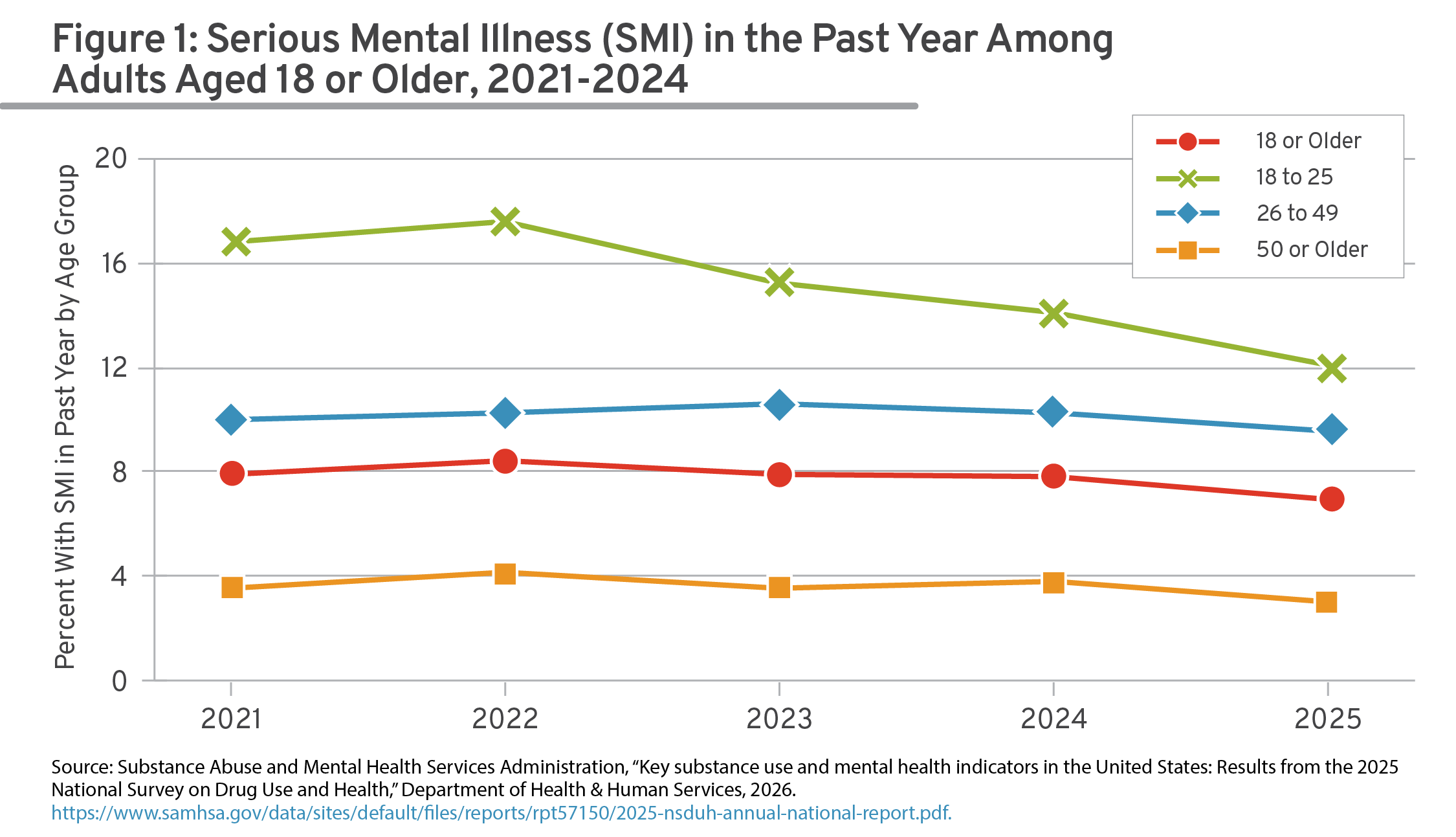
Serious mental illness is a general term for “a diagnosable mental, behavioral, or emotional disorder that causes serious functional impairment, substantially interfering with or limiting one or more major life activities.” Schizophrenia spectrum disorders, severe major depression, and severe bipolar disorder typically fall within this definition. Recent estimates suggest that about 14.6 million adults in the United States have serious mental illness, which translates to about 5.6 percent of the adult population. Since 2021, prevalence estimates of serious mental illness have declined among adults aged 18 and older; this broader figure is based on most age subgroups’ prevalence remaining stable and 18- to 25-year-olds’ declining (Figure 1). Another notable population-level difference is that serious mental illness is more common among women, who are also more likely to receive treatment than men.
In 2024, about 70.8 percent of people with serious mental illness received inpatient or outpatient treatment, participated in counseling, or used prescription medication for their illness in the past year. Serious mental illness, particularly when untreated, can lead to psychiatric emergencies, defined by the American Psychiatric Association as “an acute disturbance in thought, behavior, mood, or social relationship, which requires immediate intervention as defined by the patient, family, or social unit.”
Untreated serious mental illness comes at a high cost to affected individuals and society as a whole. It is associated with poorer physical health, worse financial and social circumstances, and impaired quality of life. These costs have been estimated in varying ways, depending on the populations assessed, the scope, and the methodology. Looking at the broader economy, one economic model considered the effects of mild and serious mental illness on consumption, labor markets, and financial asset allocation and estimated the annual U.S. cost at $282 billion. Another study that used a narrower, cohort-based approach estimated that the lifetime economic burden per person diagnosed with serious mental illness at age 25 would be $1.85 million, driven by 10 quality-adjusted life-years lost, higher medical costs, and lower earnings. Taking the entire U.S. cohort of 25-year-olds likely to have serious mental illness in 2017 into account, researchers calculated a total estimated economic burden of about $225 billion.
Deinstitutionalization and the Shift to Community Care
Through the first half of the 20th century, state hospitals provided most psychiatric care; however, the model was criticized for its inhumane conditions and high costs. To address these concerns, lawmakers implemented policy changes that decreased the number of state psychiatric hospital beds to encourage reintegrating people with mental illness into their communities. These changes marked the shift toward deinstitutionalization, which reshaped the mental healthcare landscape.
To support community-based care, the 1963 Community Mental Health Construction Act provided funding to states to build community mental health centers. Policymakers also created Medicaid and programs providing food and income support to help individuals with serious mental illness live outside institutional settings. However, only about half of the planned community mental health centers were built, leaving many people with serious mental illness without the resources and assistance they needed.
Mental Healthcare Access and Crisis Care
Accessing community mental healthcare can be difficult under optimal circumstances, but adding challenges like housing instability and lack of insurance can create further complications. The United States is currently facing a severe shortage of nearly all types of mental health providers. These shortages contribute to long wait times for appointments and difficulties finding a provider who accepts new patients. For uninsured or Medicaid patients, the average wait time for an appointment at a community mental health center or federally qualified health center is 10 weeks. Privately insured individuals face similarly long wait times.
When community-based mental healthcare is not accessible or available, emergency departments often become the default care setting, especially for psychiatric emergencies. In fact, data from 2019 shows that mental health disorders were the seventh most common primary diagnosis among patients visiting the emergency department. Although emergency departments can provide critical stabilization during a psychiatric crisis, their role is to address acute conditions, making them poorly suited to managing the underlying illnesses, which typically require long-term care. In many cases, psychiatric emergencies are more appropriately managed in an inpatient or intensive outpatient setting. However, in the wake of deinstitutionalization, the number of inpatient psychiatric beds has decreased substantially, creating a shortage. This limited capacity has contributed to increased “boarding” of psychiatric patients in emergency departments, leaving patients waiting hours or days to be transferred to an appropriate care setting.
Even when a patient can access inpatient psychiatric care, these facilities often do not provide long-term management of serious mental illness; rather, they stabilize and discharge patients quickly, with average inpatient stays of just five to six days. Stabilizing the patient typically means finding a medication that reduces the most severe symptoms causing the crisis.
The brevity of these stays is particularly troubling because it often takes longer than a week to determine how a psychiatric medication will affect a patient. Furthermore, about one-quarter of those with serious mental illness discontinue their medications within one week of discharge from inpatient care. This medication nonadherence is associated with a greater risk of relapse and future hospitalization. Without sustained support, people with serious mental illness—particularly those with limited social support or stressors like housing instability—often repeatedly cycle through crisis and short-term stabilization. This cycle represents a system failure that negatively affects patients because they are not receiving the longer-term support and care they need to sustain the stability they achieve after leaving inpatient care.
Civil Commitment and Involuntary Treatment
Civil commitment allows people who are experiencing severe psychiatric symptoms to be evaluated or treated without their consent under certain circumstances. Emergency psychiatric evaluations (sometimes known as psychiatric or involuntary holds), inpatient commitment, and assisted outpatient treatment (AOT) are the three primary types of civil commitment. Legal standards for civil commitment vary by state. Danger to oneself or others is a common criterion, but states define danger differently.
Emergency psychiatric evaluations often serve as the starting point for involuntary treatment. State law defines the maximum length of time a person can be held for evaluation—typically no longer than 72 hours. Although some states allow any adult to petition the court to initiate an emergency hold, others require initiation by law enforcement or healthcare providers, which often does not require a court order. The primary purpose of this form of civil commitment is to stabilize the patient and prevent harm. However, these goals cannot always be achieved before the maximum hold time is reached, and patients may be discharged before the risk of harm is resolved.
Involuntary hospitalization or inpatient commitment sometimes follows the initial emergency psychiatric evaluation and requires petitioning the court to order a person held for treatment against their objection. All states permit involuntary hospitalization if someone is a danger to themselves or others; some also allow it on grounds of “grave disability” or inability to meet basic survival needs. As with emergency evaluations, state law sets both the maximum initial length of involuntary hospitalization and the process for extending it if needed.
AOT is a form of civil commitment that mandates community-based treatment as an alternative to inpatient hospitalization. Examples include a judge ordering participation in a substance use program or a medication management program as a “step-down” after involuntary hospitalization or as a transition after incarceration. As of 2024, 47 states have laws authorizing some form of AOT, but program options, requirements, eligibility criteria, and enforcement strategies vary widely.
Civil commitment restricts a person’s autonomy, which creates challenging legal and ethical questions. Because of this, compelling treatment is reserved for situations in which alternative, less restrictive means of ensuring a person’s or the community’s safety are not options; in such cases, it is preferable to pursue the least restrictive form of civil commitment. Evidence about the effectiveness of involuntary treatment compared to voluntary treatment is limited and mixed. Some studies have found involuntary treatment to be associated with better clinical outcomes and fewer readmissions, whereas others have found no differences. However, involuntary treatment can be harmful to patients, producing feelings of psychological distress, powerlessness, and resentment, as well as loss of trust in caregivers, law enforcement, and the medical system. Additionally, although most evidence suggests that involuntary treatment has no effect on suicide or death risk compared with voluntary treatment, some research associates involuntary treatment with higher risks.
Challenges with data availability and inconsistent reporting methods make it difficult to quantify the number of people civilly committed each year by state. One study found that, among the jurisdictions with available data (32 states and Washington, D.C.), nine states and the District of Columbia had statistically significant increases in civil commitment from 2010 to 2022; none had statistically significant decreases.
Serious Mental Illness in the Criminal Justice System
Civil commitment is distinct from criminal justice system involvement, but the two intersect when law enforcement initiates emergency holds or when courts order treatment as part of a criminal or civil case. In addition, people with serious mental illness are substantially overrepresented in jails and prisons. Although data is limited and outdated, studies suggest that jails admit approximately 2 million people with serious mental illnesses each year nationwide, three-quarters of whom have a co-occurring substance use disorder. Estimates of the percentage of people in prison and jail with serious mental illness vary based on methodology and how mental illness is defined, but studies suggest that between 6 and 14 percent of those in prison and between 6 and 31 percent of those in jail meet the criteria for a serious mental illness. In fact, approximately 17 percent of pretrial detainees—a group that makes up a substantial share of the jail population—are thought to experience serious mental illness.
One of the more common ways individuals with these conditions enter the criminal justice system is via a crisis call to 911 from a family member, neighbor, or business owner. These calls typically result in a law-enforcement response; one analysis found that 21 to 38 percent of 911 calls were for mental health, substance use, homelessness, or other quality-of-life concerns. In some areas, specialized mental health resources are available, but 911 dispatchers do not always have the training needed to identify and route these calls appropriately. A 2021 survey of 37 agencies that respond to 911 calls across 27 states found that roughly two-thirds reported that their dispatchers had not received specialized behavioral-health crisis training.
Mental health training gaps extend into law enforcement. Many police agencies have established Crisis Intervention Team programs that bring together law enforcement and mental health professionals, but training is limited to select officers and is only a 40-hour curriculum. Some communities have developed co-responder programs, in which law enforcement and behavioral health professionals respond together, and community-responder programs, in which trained health or community-based professionals (e.g., clinicians, social workers, emergency medical technicians, or peer specialists) respond without law enforcement to appropriate calls. Both models, however, are still relatively rare.
At times, serious mental illness coincides with illegal behavior, often a low-level offense such as disorderly conduct, trespassing, public camping, or drug possession, although more serious conduct may also occur. Once officers arrive, a suspect experiencing paranoia, confusion, or intoxication may be unable to follow commands or may be perceived as defiant, increasing the risk of escalation, additional charges, or use of force. Estimates vary, but research suggests that roughly one-quarter to one-third of fatal police encounters involve a person experiencing mental illness or a mental health crisis.
A common misconception is that people with serious mental illness are prone to violence, but violence within this population is relatively uncommon. According to one study, serious mental illness alone accounts for only about 4 percent of community violence. Research on acts of mass violence also shows that perpetrators are rarely people with serious mental illness. Despite this reality, rare but highly publicized acts of violence involving a person with serious mental illness can reinforce stigma, which, in turn, can lead to increased symptoms, reluctance to seek treatment, and poorer treatment retention. Research on law-enforcement response to these situations is mixed. Some studies suggest that police officers view people with serious mental illness more sympathetically, whereas others document higher-than-expected rates of police use of force.
If a law-enforcement encounter results in arrest, serious mental illness can continue to shape next steps, particularly during pretrial release decisions. For example, a person may be detained because they cannot afford a cash bond, lack stable housing, or are perceived as dangerous due to erratic behavior in the courtroom. These circumstances are more common among individuals with serious mental illness, who face higher rates of poverty, unemployment, and homelessness than the general adult population. In fact, the prevalence of serious mental illness among people experiencing homelessness is about 22 percent—roughly four times the rate among all adults. People experiencing homelessness also face substantial delays in receiving treatment after symptoms emerge, if they receive treatment at all. Moreover, up to 90 percent of unhoused people with serious mental illness have been arrested at least once, up to 80 percent have been convicted of a crime, and up to 67 percent have been incarcerated. Pretrial detention can also cause individuals to miss behavioral health appointments, lose shelter beds, or miss medication doses. Those who are released may struggle to comply with release conditions because of their circumstances and these disruptions and may have their release revoked, returning them to detention.
Once a person enters the criminal justice system, mental illness may become relevant to several distinct legal standards. Competency and insanity, for example, are legal concepts that differ from a medical diagnosis of serious mental illness. Each legal standard has different implications for how a case proceeds and what protections apply to the defendant.
Competency to Stand Trial
The competency requirement is a constitutional protection that prohibits prosecuting a defendant who lacks the present ability to understand the proceedings against them or participate in their defense. This standard is rooted in the U.S. Supreme Court’s decision in Dusky v. United States and generally asks whether, because of a mental disease or defect, a defendant can understand the nature and consequences of the proceedings and assist properly in their defense, although specific definitions vary by state.
When the issue of competency is raised—most often by a defense attorney, though the judge or prosecutor can also raise it—the case pauses while the defendant is evaluated and, if deemed incompetent, may be ordered to receive services (e.g., medication, education) intended to restore competency before the prosecution can proceed. The restoration process can happen any time after charges have been filed and before sentencing. Services can be provided in inpatient or outpatient settings, and the process can be lengthy when systems lack treatment capacity and resources. National research estimates that courts order 25,000 to 50,000 competency evaluations each year, although experts believe this number to be much higher.
Most individuals are eventually restored to legal competency, but that finding often reflects only that they can understand the proceedings and assist counsel. It does not mean that their underlying mental illness or disability has been fully treated, nor does it guarantee continuing care once they return to court or the community. If competency cannot be restored within a reasonable time, the state must either release the individual or begin civil commitment proceedings; in most states, the charges are also dismissed.
Insanity Defense
Insanity, by contrast, concerns the defendant’s mental state at the time of the alleged offense. It is not a finding that the person is currently unable to understand trial proceedings, but rather an affirmative defense that can negate criminal culpability at the time the offense was committed. For example, a defendant who experienced psychosis at the time of an alleged offense may argue that their mental condition prevented them from understanding the nature and quality or wrongfulness of their actions. If established, the defense results in a verdict of “not guilty by reason of insanity.” Unlike an ordinary acquittal, it often results in an evaluation, commitment, and treatment before release. Although standards vary by state—and four states have abolished the insanity defense in favor of a mens rea approach—the defense generally requires proof that, because of a severe mental disease or defect at the time of the offense, the defendant could not appreciate the nature and quality or wrongfulness of the charged acts. The U.S. Supreme Court’s decision in Kahler v. Kansas confirmed that states have substantial discretion in defining the relationship between mental illness and criminal culpability.
A finding of not guilty by reason of insanity does not result in a criminal sentence, but it may lead to commitment based on the person’s present mental illness and dangerousness. The Supreme Court has held that a person found not guilty by reason of insanity may be confined beyond the maximum sentence that could have followed a conviction. That confinement, however, may continue only while the person remains both mentally ill and dangerous; once either basis no longer exists, the person must be released. Although research on the volume of insanity pleas is limited, one multistate study from 1991 found that the insanity defense was raised only in about 1 percent of felony cases, and approximately 26 percent of those pleas resulted in “not guilty by reason of insanity” acquittals. Related doctrines, including diminished capacity and heat-of-passion mitigation, can also affect criminal liability but generally do not excuse the conduct entirely. They may reduce the charge by challenging the required mental state or showing legally recognized provocation, but, unlike an insanity verdict, they typically do not trigger evaluation, commitment, or treatment.
Clinical Diagnosis and Criminal Justice Decisions
Serious mental illness, unlike competency or insanity, is not itself a legal standard in the criminal process. Rather, it is a clinical classification that can inform decisions at nearly every stage of justice-system involvement, including pretrial release, specialty-court eligibility, sentencing, supervision, and placement or treatment while incarcerated. For example, police may divert someone experiencing a psychiatric crisis to an emergency evaluation and stabilization (i.e., a strategy often referred to in the criminal justice field as a “psychiatric” or “72-hour” hold) instead of making an arrest. Courts and pretrial agencies may also consider a person’s mental health needs when setting pretrial release conditions or determining eligibility for specialty courts. At sentencing, serious mental illness may be considered as a mitigating factor or may inform supervision conditions. In jails and prisons, individuals may be screened or assessed for mental health needs, and those with serious mental conditions may be housed in specialized units with more intensive services or receive access to additional care.
Correctional facilities can further destabilize mental health. Symptoms that might be manageable in an inpatient or community outpatient setting can become disciplinary issues in jail or prison. For some individuals, untreated or poorly managed symptoms—such as night terrors, hallucination-driven responses, difficulty following staff directions, or episodic aggression—can place additional demands on correctional staff, disrupt housing units, and create safety concerns for others in custody. Access to treatment can be sporadic and limited to those with the most severe needs. In addition, solitary confinement, which is sometimes used for disciplinary or safety reasons (including in response to suicidal ideation), can exacerbate fear, sleep disruption, and psychiatric distress.
Correctional settings were neither intended nor resourced to deliver comprehensive mental health care. Yet they have become some of the nation’s largest providers of these services. Correctional officers are therefore often expected to manage people with serious mental illnesses in crowded, high-stress environments, despite having little to no specialized training. Persistent staffing shortages, aging facilities, overcrowding, and inadequate treatment capacity make that responsibility even more difficult.
Key Challenges
People with serious mental illness encounter an interconnected set of healthcare and criminal justice systems that are often ill-equipped to meet their complex needs, especially if they lack social and financial supports. Although targeted interventions and programs are needed within individual systems, several broader challenges emerge from this review. Examining these shared challenges clarifies the scope of the problem and where new approaches may be needed.
Data Gaps
Much of the available data on civil commitment and serious mental illness in the criminal justice system is limited or outdated. More reliable data, collected consistently and updated regularly, is needed to understand how frequently people with serious mental illness are civilly committed or encounter the criminal justice system, the circumstances that may lead to involvement, and the availability and effectiveness of interventions. Better data would help policymakers identify trends, compare outcomes across jurisdictions, and evaluate whether existing interventions are reducing repeated system contact. It would also help determine whether public resources are addressing underlying needs or simply shifting people between hospitals, jails, and shelters.
Insufficient Community-Based Capacity
Limited access to appropriate nonemergency, community-based services shifts responsibility to more costly systems that are already operating with limited capacity. Emergency departments and the criminal justice system have increasingly been tasked to respond to mental health needs, in part because the community-based services envisioned during deinstitutionalization did not fully materialize. However, these settings are neither intended nor equipped to address the ongoing complex medical and social needs of people struggling to manage their serious mental illness, and the added demand can further strain limited staffing and treatment capacity.
Fragmented Care
Approaches to serious mental illness are often fragmented, and many jurisdictions lack services that span different levels of need. When a person needs emergency intervention, communities may have few practical options beyond an emergency department, involuntary psychiatric hold, jail, or no intervention at all. Similar limitations persist after someone enters the healthcare or criminal justice systems because each is generally focused on a narrow legal or clinical function—de-escalating a crisis, addressing an immediate risk of harm, or restoring an individual to competency—rather than the person’s broad and ongoing needs. Many people are discharged from care or custody without further support, even when significant treatment needs remain.
Delayed Intervention
Healthcare and criminal justice systems tend to respond to serious mental illness only after it has become an emergency. A more effective approach would improve access to services and support before that point. Earlier intervention will not prevent every crisis, but it can reduce the likelihood of worsening symptoms and the reliance on high-cost, downstream services, such as hospitals and police. Building systems that identify emerging needs, maintain continuity of care, and respond before circumstances become acute could reduce the systems’ current reliance on crisis response and improve outcomes for people with serious mental illness and their communities.
Conclusion
The challenges surrounding serious mental illness have no single or simple solution. An effective approach must account for civil liberties, personal autonomy, stigma, resource constraints, medical needs, and public safety. Improving current standard responses requires understanding how existing systems operate, where they fall short, and how those shortcomings affect individuals, communities, and institutions.
Evidence suggests that existing systems are overburdened and inadequately designed, leaving people with few options when they are experiencing a crisis. As a result, emergency departments and law enforcement are frequently used as default responses to psychiatric emergencies, even though neither is designed or equipped to provide the specialized, long-term care many people need. Repeated reliance on these crisis systems can impede continuity of care and increase the risk of escalation, arrest, detention, or use of force.
These potential consequences underscore the need to strengthen earlier, community-based care and intervention. The costs of failing to do so go far beyond what can be measured in economic terms. When care is unavailable or inadequate, individuals suffer, as do their families, friends, communities, and public systems. A more effective response must balance the harms of unnecessary intervention against the equally real consequences of failing to act when intervention is needed.