
Low-Energy Fridays: Energy Affordability Check-In
Politicians—especially those facing reelection this year—are starting to hammer the energy affordability debate once again. There’s often a disconnect between political discourse and reality. But in the case of energy affordability, the data tells us that perhaps there is less hyperbole in these debates than usual. The following chart shows the change in prices for residential electricity, residential natural gas, and motor gasoline since 2019 (i.e., since before the COVID-19 pandemic).
Energy Price Change from 2019 (Indexed)
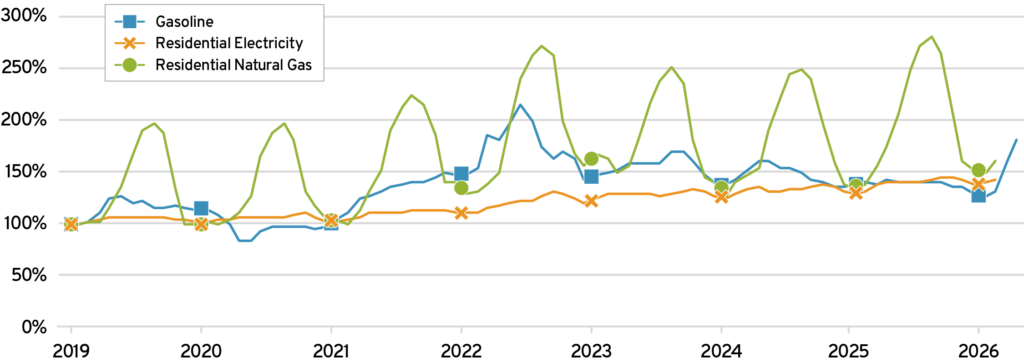
Source: U.S. Energy Information Administration Price Data (Gasoline, Electricity, Natural Gas)
Compared to January 2019, the latest data shows that gasoline prices are 81 percent higher, electricity prices 42 percent higher, and natural gas prices 61 percent higher. A few caveats are in order, though. First, the source data is not inflation adjusted, meaning price increases stemming from monetary policy and other factors are still included. Personal consumption expenditures (a metric of inflation) have increased 27 percent from 2019 to present day and should be weighed against this data. Second, much of the increase in gasoline prices has been driven by the Iran war and resulting supply disruptions. (Prices were “only” 30 percent higher in February of this year than in 2019.)
When it comes to affordability, we must also consider the other side of the equation—income. The data comparison here is a bit tricky, as more frequently reported earnings data may not include the full picture of a household’s income. Additionally, because income data is released every September for the previous year, we only have data up to 2024 for now. The real (inflation-adjusted) median household income in the United States was only 0.6 percent higher in 2024 than in 2019—though that is still an improvement, as it was down 4.5 percent in 2022.
The overall picture is that energy prices are rising faster than income. There was a particularly noteworthy period (around 2022) when energy prices rose rapidly as income fell. But compared to years past, energy costs are a bigger part of the squeeze Americans are feeling, and politicians are right to focus on it.
In terms of policy, there are only two fundamental solutions: make energy cheaper or increase Americans’ earnings. The former would require an increase in supply. My piece in Dispatch Energy last month noted that energy supply growth has been anemic. The overly politicized permitting environment, which introduces political risk to market entrants, is likely a big reason for that.
The income side is more important—and a lot trickier. While many variables affect household earnings, the most important is generally productivity. Workers who can produce more in less time can earn more money per hour of work. The immutable scarcity of time as a resource means that productivity is the path to improved living standards. For economists, the surest way to increase productivity is to increase investment. This means that to fix energy affordability issues, America must become a more attractive place to invest in.
In other words, the problem is that the rising cost of energy is outpacing improvement in living standards. While there’s no end to nitpicking debates—especially about specific technology types or interventions to aid them—the data trend goes beyond these temporary policy blips. Policymakers must determine whether their policy choices make America more productive or less productive.
Alternatively, policies that fail to appreciate tradeoffs are likely to make the situation worse. Even policy interventions that seem to reduce the cost of energy (e.g., subsidies) may not help, because the flip side of their impact can diminish income. This means affordability questions may simply shift to other types of consumption without solving the real issues of productivity.
The lesson is that current and future policymakers will face some serious challenges in the energy space. Energy scarcity has been significantly less of an issue since the United States’ massive increase in energy production, but it’s returning once again. Politicians also know they are often held accountable for energy costs—hence, why they care so much about pump prices. Given the rising political pressure to act, policymakers should be especially diligent about scrutinizing the effectiveness of their policies if they want to improve outcomes.