

The Juvenile Justice Resource Desert: Quantifying Rural-Metro Disparities and Opportunities in Florida
Author

This research was funded by the Annie E. Casey Foundation, and we thank them for their support; however, the findings and conclusions presented in this report are those of the author(s) alone, and do not necessarily reflect the opinions of the Foundation.
Table of Contents
- Executive Summary
- Introduction
- Florida’s Juvenile Justice Off-Ramps and Resource Deserts
- Measuring the Gap: Data and Methods
- Rural-Metro Disparities Across the System
- The Case for Pre-Arrest Delinquency Citation (PDC)
- Limitations
- Conclusion
- Appendix A: Panel Data Sources
- Appendix B: U.S. Department of Agriculture Rural-Urban Continuum Codes
- Appendix C: Regression Results
Media Contact
For general and media inquiries and to book our experts, please contact: pr@rstreet.org
Drawing on seven years of administrative data from all 20 of Florida’s judicial circuits (covering all 67 counties), this study measures rural-metro disparities at every stage of the state’s juvenile justice system, examines their causes, and identifies practical steps policymakers can take within existing institutional frameworks to address them.
Executive Summary
In rural America, geography can shape a young person’s experience in the juvenile justice system more than the underlying offense. The decarceration model that has produced lower levels of both juvenile crime and justice system involvement over the past 25 years relies on a dense rehabilitative ecosystem of behavioral health and diversion programs. Rural communities, where legal and mental health infrastructure is sparse, often lack the resources to support the justice system off-ramps that are available in metro areas. By applying a resource-desert framework to juvenile justice, this study contributes to a growing body of literature suggesting that system involvement has become a behavioral health backstop for rural youth. In these “justice resource deserts,” courts face a difficult choice: release at-risk youth without support or pull them deeper into the formal system.
Drawing on seven years of administrative data covering all 67 Florida counties, this longitudinal analysis of primary-source data reveals that rural youth in Florida experience more punitive outcomes at nearly every stage of the juvenile justice system. They are arrested 40 percent more often and committed to residential facilities at more than twice the rate of their metro counterparts.
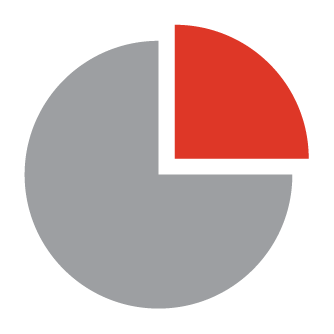
In Florida’s largest metro areas, seven out of 10 eligible youth receive pre-arrest deflection; in the most rural counties, only one in four do. This means that a child from Miami and a child from Madison County often experience two entirely different justice systems. Shrinking these resource deserts has the potential to improve youth justice outcomes and generate millions in savings in Florida and other states with significant rural populations.
Introduction
The United States does not have a single “juvenile justice system.” In reality, there are thousands of systems, administered county by county, shaped by local resources and policy decisions. This means that a young person’s ZIP code can drive their experience with the justice system—perhaps even more than the underlying offense. This is especially true in rural “juvenile justice resource deserts,” where legal and rehabilitative infrastructure is insufficient or nonexistent, leaving system involvement as the only option to deliver substance abuse treatment and other critical services.[1]
The conventional understanding of the rural-urban divide has shifted over time. In the early 1990s, academics posited that the formalized bureaucracy of metro juvenile courts produced higher rates of pretrial detention and harsher sentences than rural courts.[2] Subsequent studies have found that although some metro areas still have higher detention rates, the discrepancy on other metrics, such as arrest and probation rates have narrowed—or even reversed—suggesting that rural youth may actually face harsher consequences for the same offenses.[3] One study of 615,000 Louisiana children found that rural populations were more likely to have juvenile justice contact than metro ones, even after controlling for race, gender, poverty, school attendance, and prior justice involvement.[4]
The decarceration movement, which has reduced national youth detention rates by nearly 75 percent over the past 30 years, has historically been centered in large metro areas that have the concentrated municipal tax base required to support extensive behavioral health systems, public transportation networks, and diversion opportunities.[5]

Yet approximately 20 percent of the U.S. population lives in areas defined by the Census Bureau as “rural,” and these communities rarely have the legal, vocational, and mental health infrastructure found in metro areas.[6]
In states like Montana—where 90 percent of counties are designated mental health professional shortage areas—the justice system becomes the default; nationally, a recent bipartisan congressional investigation found that 75 juvenile detention facilities across 25 states were incarcerating children eligible for release solely because external mental health care was unavailable.[7] By failing to account for the distinct socioeconomic and cultural conditions of rural populations, we have unintentionally built “resource deserts” into the DNA of the juvenile justice system.[8]
Florida represents a microcosm of this structural national phenomenon. Stretching from dense metros like Miami and Jacksonville, to resource-challenged rural communities in the Panhandle and north and central regions, Florida’s pre-arrest delinquency citation (PDC) program offers a natural laboratory to determine how rural resource deserts affect justice outcomes. Drawing on seven years of administrative data from all 20 of Florida’s judicial circuits (covering all 67 counties), this study measures rural-metro disparities at every stage of the state’s juvenile justice system, examines their causes, and identifies practical steps policymakers can take within existing institutional frameworks to address them.
Florida’s Juvenile Justice Off-Ramps
One of the most common metaphors for the juvenile justice system is a highway with a series of off-ramps, each representing an opportunity to exit the system before the next, more consequential stage.[9] These include:
- Pre-arrest deflection—the first, least disruptive, and most cost-effective off-ramp. Law enforcement responds to a low-severity offense, like an in-school fight or first-time shoplifting, with a civil citation. Youth do not enter the formal system. In Florida, this option is called “pre-arrest delinquency citation” (PDC).[10]
- Post-arrest diversion—the second off-ramp, occurring after a formal arrest but before adjudication. Unlike deflection, the youth enters the system and generates a record.
- Probation—the third off-ramp, includes court-ordered curfew, school attendance, drug testing, or counseling. Community-based supervision takes the place of confinement, keeping the youth at home and in school.
- Residential commitment—the deepest stage of the juvenile system, reserved for the small fraction of cases that warrant out-of-home placement.
- Adult transfer—transitions youth out of the juvenile system and into the adult justice system.
In a well-functioning system, a young person receives the opportunity to take the earliest possible exit that public safety allows. Metro Florida courts have all of these off-ramps at their disposal—including sophisticated restorative justice and electronic monitoring programs—options that are underdeveloped or unavailable in rural areas.[11] In large part, this is because these areas lack the clinical and legal workforce needed for more resource-intensive programs.
Measuring the Gap: Data and Methods
Using Florida Department of Juvenile Justice records, U.S. Census demographics, and county-level health, legal, and economic indicators, we assembled a panel dataset covering all 67 Florida counties from fiscal years 2018-2019 through 2024-2025 (see Appendix A for data sources). We then classified counties as rural or metropolitan using the U.S. Department of Agriculture Rural-Urban Continuum Codes (see Appendix B). Using this dataset, we calculated descriptive statistics comparing disposition outcomes across rural and urban counties using volume-weighted rates and ratios.
To test whether observed rural-metro differences could be explained by underlying socioeconomic or demographic factors, we ran regression models with controls for child poverty, race, educational attainment, family structure, and unemployment (see Appendix C). Mental health workforce density (behavioral and mental health professionals per 100,000 residents) and legal workforce density (active Florida Bar members per 100,000 residents) were tested in separate models. All regressions were estimated using weighted least squares with standard errors clustered at the county level to account for within-county correlation in the error terms.
Rural-Metro Disparities Across the System
Our analysis revealed gaps in resource levels between rural and metro counties. On average, rural counties in Florida have just 58 mental health professionals per 100,000 residents, less than half the metro rate.[12] The gap is even larger for specialized providers, with rural counties averaging just six psychologists per 100,000 residents, versus 23 in metro counties. In addition, all 782 of the state’s pediatric psychiatric inpatient beds are located in metro counties, leaving no inpatient capacity outside major cities.[13]
The justice resource desert extends to the legal system as well. Metro counties have three times as many attorneys per capita as rural counties, and the density gap grows at the extremes: Completely rural counties have just 54 lawyers per 100,000 residents, whereas large metro counties have 435—an eight-fold difference.[14] In rural Glades County, a single lawyer serves 12,273 residents; in metro Miami-Dade, one lawyer serves 167.[15]
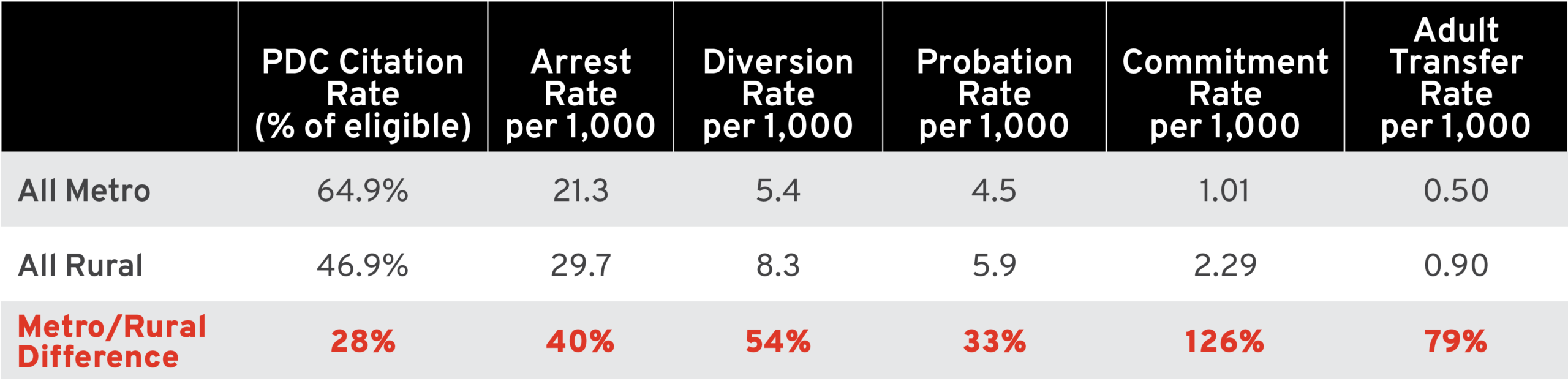
We also found that these resource disparities correlate with measurable differences in how rural and metro youth move through Florida’s justice system. Youth in rural Florida face deeper system involvement at every stage of Florida’s justice system (Table 1).[16] At the earliest off-ramp—PDC—the system routed out 28 percent fewer eligible youth in rural counties than in metro ones. In addition, Florida rural counties arrested 40 percent more youth per capita than metro counties, placed 33 percent more youth on probation, admitted 126 percent more youth to residential facilities, and transferred 79 percent more youth to adult court (Figure 1). The commit-to-arrest ratio (i.e., the share of arrested youth ultimately removed from their home and committed to a residential facility) was substantially higher in rural counties (7.7 percent) than metro counties (4.8 percent). Circuit 3, a seven-county, all-rural circuit in north central Florida, had the highest commit-to-arrest ratio in the state at 12.5 percent, nearly triple the all-metro circuit average of 4.5 percent.[17]
Table 1: Rates of Juvenile Justice Interventions in Florida, Rural vs. Metro
Source: R Street Institute analysis of dataset compiled from Appendix A sources, May 2026.
Figure 1: Overall Residential Commitments per 1,000 Youth, FY 2018-2019 to FY 2024-2025
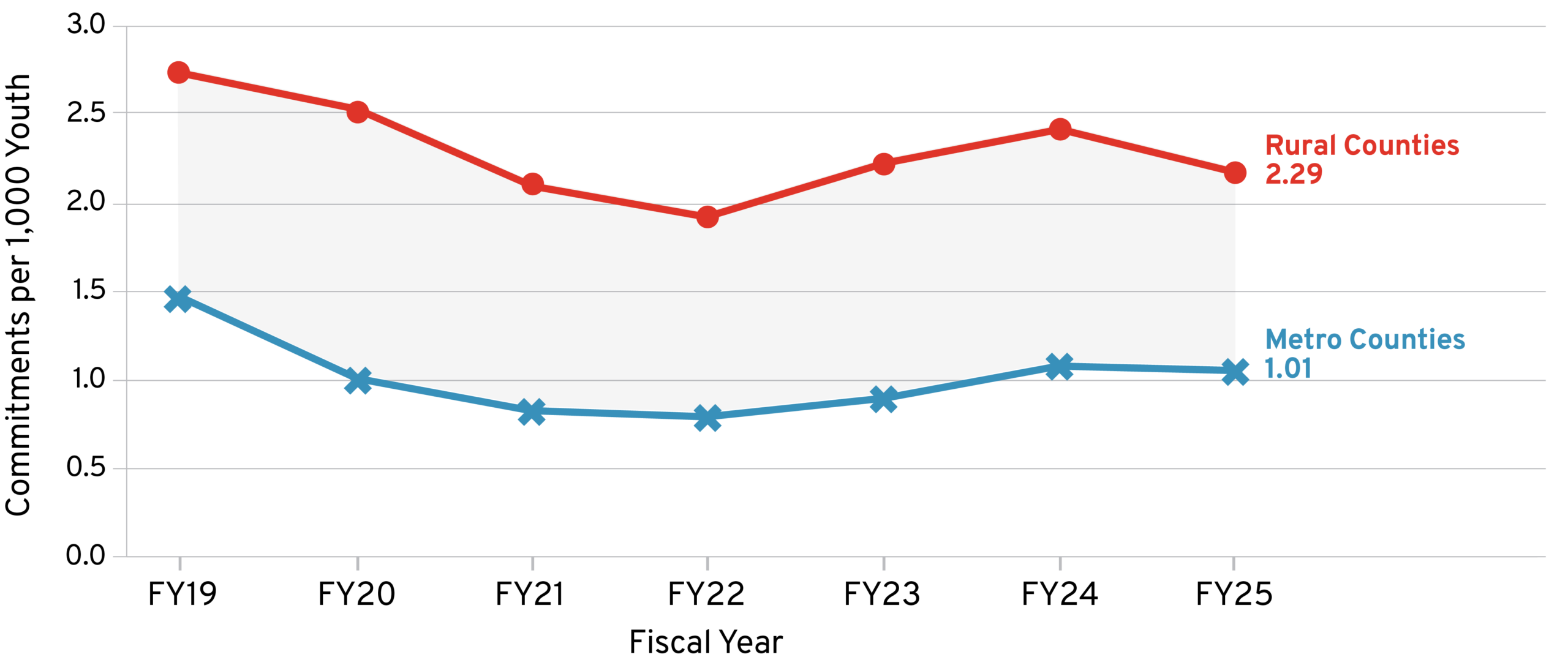
Descriptive comparisons across all 67 Florida counties, pooled across fiscal years 2018-19 through 2024-25, computed as volume-weighted rates.
Source: R Street Institute analysis of dataset compiled from Appendix A sources, May 2026.
Supervision without services, such as specialized behavioral healthcare, can quickly turn a technical violation into deeper system involvement.[18] For example, our analysis showed that the share of arrested youth placed on probation was essentially identical across Florida’s rural and metro counties (20 vs. 21 percent, respectively), but the share of youth on probation who were ultimately removed from home and admitted to residential facilities diverged sharply.[19] In metro counties, 23 out of every 100 youth on probation were placed in residential facilities, whereas, in rural counties, that figure was 39 out of 100—a disparity of 71 percent. Despite placing children on probation at similar rates, rural counties lack the resources that lead to successful completion, turning a less-severe disposition into a pathway to the most severe one.[20]
The rural-metro juvenile justice divide has both public safety and fiscal implications. The more contact youth have with the justice system, the higher their risk of negative life outcomes.[21] In addition, Florida’s residential detention system is one of the most expensive line items in its juvenile justice budget, and rural counties drive a disproportionate share of that expense.[22] Not only is the rural commitment rate more than twice the metro rate (2.29 per 1,000 vs. 1.01 per 1,000), but rural facilities cost about 35 percent more to operate.[23] At an average cost of $59,586 per rural commitment, bringing rural commitment rates in line with metro rates would keep 78 youth at home each year, producing $4.6 million in annual savings.[24]

The only stage where rural areas matched or exceeded metro areas is post-arrest diversion. Rural counties diverted more youth than metro areas, both per capita (8.3 versus 5.4 per 1,000) and as a share of total arrests (28 percent versus 25.5 percent).[25] This is because youth who would otherwise be given a citation in a large metro (avoiding arrest) are instead brought before a court and given diversion in rural areas.[26]
The two interventions serve an overlapping population of delinquent youth through different institutional actors: law enforcement for deflection and prosecutors and judges for diversion. Thus, inconsistencies in Florida’s statewide deflection program (i.e., PDC) have downstream effects that ripple through the rest of the system, a finding detailed in the next section.
Rural counties are characterized by lower incomes, less education, and more family disruption—the same forces that drive system contact generally. To determine whether these gaps reflect justice-system differences or other underlying conditions correlated with rural life, we ran regressions, progressively adding controls for child poverty, race, educational attainment, family structure, unemployment, mental health workforce density, and legal infrastructure.
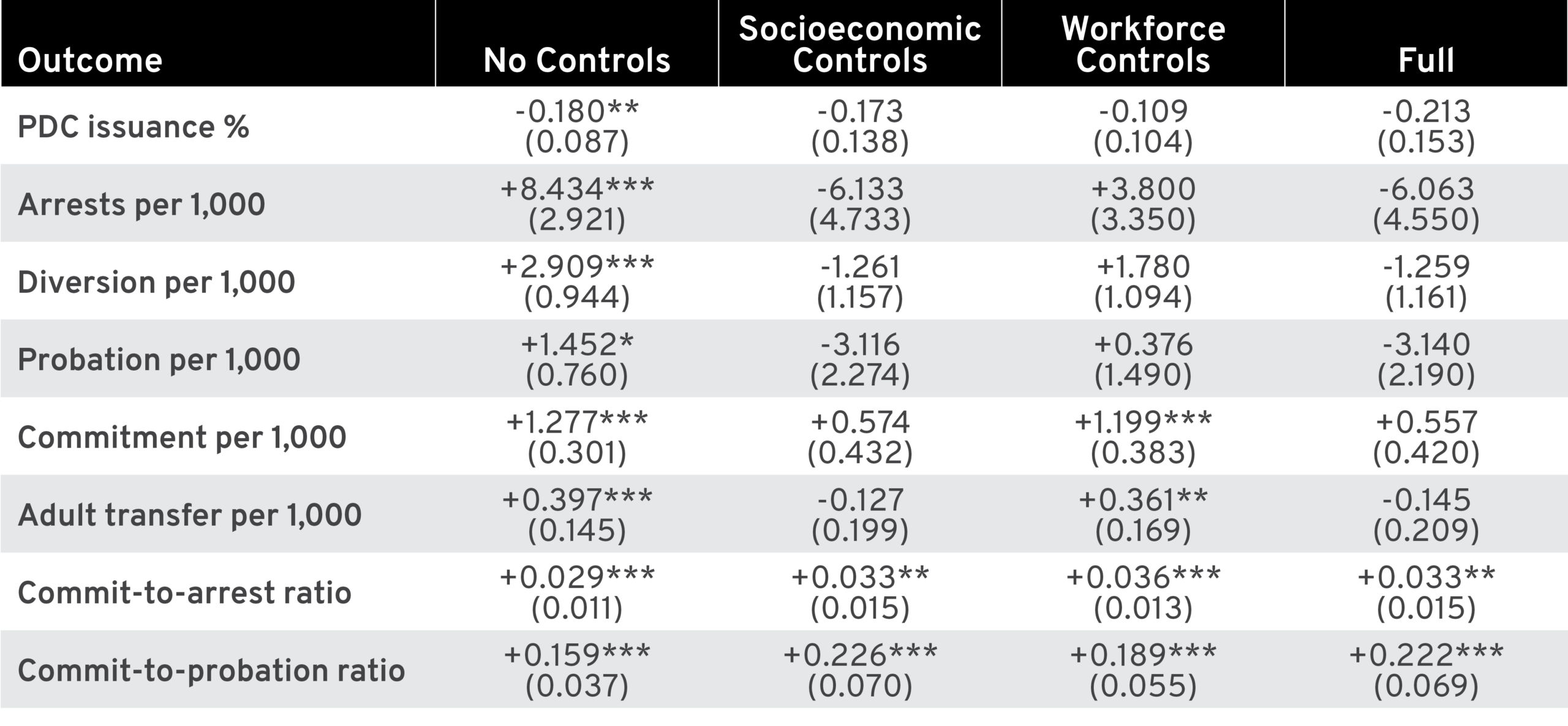
The regressions revealed two distinct findings. First, after accounting for those socioeconomic variables, per-capita rate gaps in arrest, diversion, probation, commitment, and adult transfer are not statistically separable from broader rural socioeconomic disadvantages.[27] However, the disposition ratios persisted under every specification, and, in some cases, widened with added controls: The commit-to-probation gap rose from roughly 70 percent under no controls, to nearly 100 percent in the full regression model. Even when compared to metro counties with similar poverty levels, education levels, and demographic composition, rural counties commit a larger share of arrested youth to residential facilities.[28] These disposition-ratio gaps appear to come from the system response itself, not from the underlying conditions of rural life, suggesting that policymakers can mitigate the impact of juvenile justice resource deserts with targeted policy reforms.[29]
The Case for Pre-Arrest Delinquency Citation (PDC)
Of the five off-ramps in Florida’s juvenile justice system, PDC is uniquely suited to a rural-metro analysis. Each of the state’s 20 judicial circuits designs and implements its own PDC program under a common statutory floor, while individual counties within each circuit retain operational discretion. This administrative structure produces a natural experiment—where the chief judge, state attorney, program design, and referral infrastructure are held constant—so that any remaining rural-metro gap cannot be attributed to program design. The analysis below first summarizes prior research on PDCs before presenting evidence of an ongoing rural-metro disparity both statewide and within-circuit.
Where it is used, PDC delivers measurable benefits. Research has shown that citation off-ramps reduce six-month recidivism by approximately 50 percent and three-year recidivism by 30 percent, compared to formal arrest.[30] Moreover, civil citations minimize net-widening and reduce overall system involvement.[31] In metro areas, such as Florida’s fourth circuit, officers issue PDCs in about 90 percent of cases, reducing juvenile arrests by more than 1,000 each year and resulting in almost $5 million in annual savings. This does not include the long-term savings of reduced recidivism, nor does it account for efficiencies gained by keeping officers in the field, rather than overseeing time-intensive arrest and booking processes. Despite these benefits, statewide utilization of PDC was just 65 percent in 2025.[32]
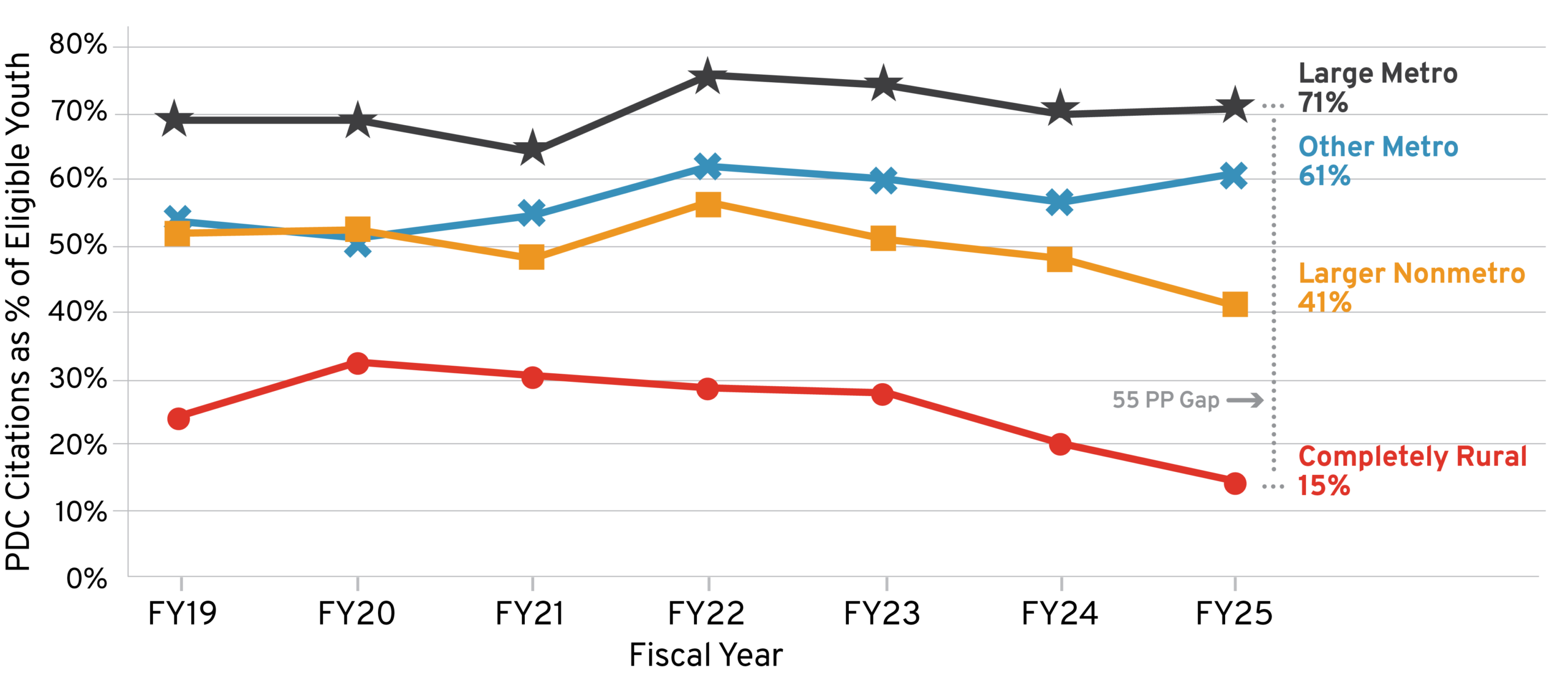
Our analysis confirmed that PDC program implementation in Florida reduces overall system involvement. Of the approximately 103,000 PDC-eligible juvenile encounters that occurred between fiscal years 2018-2019 and 2024-2025, counties that issued more citations arrested fewer youth per capita and committed fewer youth to residential facilities per capita (Table 2).[33] However, program implementation is uneven. In Florida’s largest metro counties, seven out of 10 eligible youth received a citation rather than an arrest; in the most rural counties, only one in four did (Figure 2). Across the seven-year sample period, 16 of Florida’s 22 rural counties issued citations to fewer than half of their PDC-eligible youth. In Lafayette County, the most rural area in the state, there were no citations issued at all. Overall, a deflection-eligible youth in rural Florida is nearly twice as likely to face arrest as a similarly situated youth in large metro areas.[34]
Table 2: Citation vs. Arrest Rates for Deflection-Eligible Youth by County Rurality, FY 2018-2019 to FY 2024-2025

Source: R Street Institute analysis of dataset compiled from Appendix A sources, May 2026.
Figure 2: Percentage of PDC-Eligible Youth in Florida Issued PDC, FY 2018-2019 to FY 2024-2025
Source: R Street Institute analysis of dataset compiled from Appendix A sources, May 2026.
Additionally, our research revealed that counties with more mental health professionals per capita issued PDCs at higher rates.[35] This finding held across multiple categories of mental health professionals, including licensed mental health counselors and licensed clinical social workers.[36] The pattern is intuitive: Because PDC citations typically require a mental health or counseling referral, counties with lower clinical capacity have fewer opportunities to use that off-ramp.
We also tested whether lawyer density (active Florida Bar members per 100,000 residents) could account for the rural-metro PDC gap. This analysis produced a less significant effect than mental health workforce density.[37] When both were included in a single model, only the mental health variable retained explanatory power.[38] Thus, the PDC disparity is more likely related to a clinical-workforce gap than a legal-infrastructure gap.
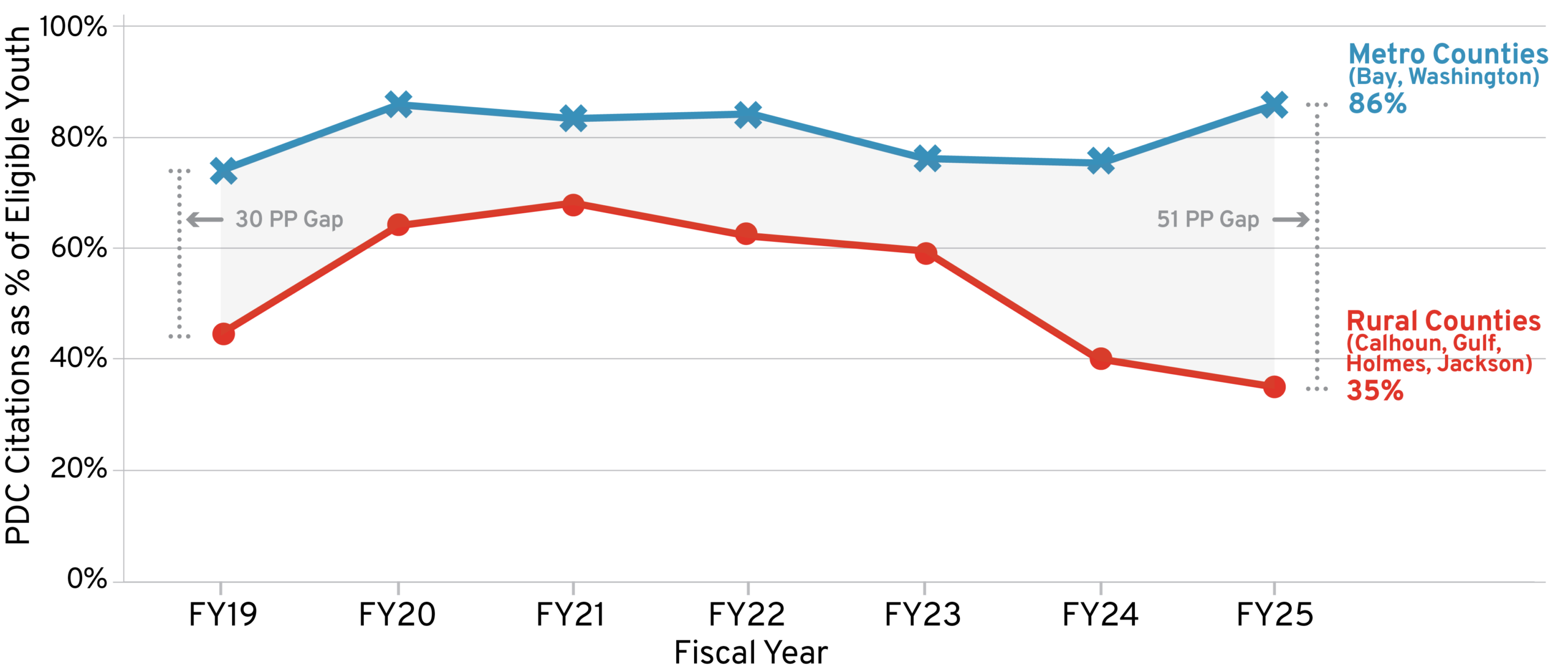
The within-circuit comparisons bear this out. In Circuit 14, for example, two metro counties (Bay and Washington) collectively issued PDCs to 86 percent of eligible youth (FY 2024-2025, Figure 3) and committed arrested youth 4.75 percent of the time, while four rural satellite counties (Calhoun, Gulf, Holmes, and Jackson) collectively issued PDCs to only 35 percent of eligible youth (FY 2024-2025) and committed arrested youth 8.63 percent of the time.[39] This means that under an identical legal and institutional deflection framework, officers in Circuit 14 offered eligible rural youth a PDC less than half as often as metro youth, yet the system committed them to residential facilities nearly twice as often as their metro counterparts. Ranking all 67 counties by PDC adoption reveals a stark rural-metro gradient, with metro counties concentrated at the top and rural counties clustered at the bottom (Table 3).
Figure 3: Percentage of PDC-Eligible Youth in Circuit 14 Issued PDC, FY 2018-2019 to FY 2024-2025
Source: R Street Institute analysis of dataset compiled from Appendix A sources, May 2026.
Table 3: Percent of Eligible Youth Issued Pre-Arrest Delinquency Citation (2018-25) By Florida County
County | Percent |
Metro Counties | |
Rural Counties | |
Pinellas | 96.60% |
Miami-Dade | 91.00% |
Clay | 88.50% |
Monroe | 85.80% |
Manatee | 84.00% |
Pasco | 82.20% |
Polk | 82.00% |
Bay | 80.50% |
Sarasota | 80.30% |
Washington | 79.50% |
Putnam | 79.10% |
Broward | 78.30% |
Duval | 78.20% |
Wakulla | 76.80% |
Seminole | 73.10% |
Hernando | 72.10% |
Collier | 71.80% |
Palm Beach | 67.70% |
Nassau | 66.40% |
Citrus | 65.60% |
St. Johns | 65.40% |
Martin | 65.20% |
Charlotte | 63.80% |
Jackson | 63.20% |
Holmes | 61.20% |
Hillsborough | 59.50% |
Hendry | 58.70% |
Indian River | 57.90% |
Volusia | 57.40% |
Leon | 56.40% |
Lee | 56.00% |
Calhoun | 53.40% |
Marion | 53.20% |
St. Lucie | 52.40% |
Flagler | 49.60% |
Orange | 49.50% |
Alachua | 45.20% |
Escambia | 44.70% |
Okeechobee | 43.40% |
Brevard | 42.80% |
Lake | 42.10% |
Jefferson | 38.10% |
Hardee | 37.70% |
Gadsden | 35.50% |
Liberty | 35.30% |
Suwannee | 34.80% |
Osceola | 27.20% |
Franklin | 25.80% |
Glades | 23.50% |
Columbia | 22.90% |
DeSoto | 22.40% |
Highlands | 22.20% |
Santa Rosa | 18.20% |
Gulf | 16.90% |
Baker | 16.50% |
Okaloosa | 12.90% |
Hamilton | 11.30% |
Union | 10.60% |
Levy | 7.80% |
Sumter | 7.30% |
Madison | 2.80% |
Dixie | 2.40% |
Walton | 1.60% |
Gilchrist | 1.10% |
Taylor | 1.10% |
Bradford | 0.00% |
Lafayette | NA |
Note: Volume-weighted sum of citations across fiscal years 2018-25 divided by sum of eligible youth. Lafayette had no tracked PDC-eligible youth across the period.
Limitations
First, we aggregated disposition outcomes in our dataset at the county level. Without individual case-level data, our panel captured the annual count of youth at each dispositional stage, not the progression of individuals from one stage to the next. As a result, the ratios presented here are of aggregate stage counts rather than individual-level observations. For example, a higher rural commit-to-probation ratio is consistent with higher rural probation failure rates, but it could also reflect differences in average probation duration or case composition.
Second, our regression controls captured observable demographic and socioeconomic factors at the county level, but did not account for differences in delinquency patterns. Rural youth may have faced arrest for a different mix of offenses than their metro counterparts in ways our county-level controls could not capture. Resolving these limitations would require tracking the delinquency histories for individual juveniles, which is beyond the scope of this study.
Finally, the mental health and legal variables tested captured workforce headcount but no other dimensions of resource scarcity, such as the availability and quality of detention alternatives. The persistence of the disposition-ratio gaps after these workforce controls is consistent with a resource desert hypothesis, but the analysis could not directly identify which dimensions of scarcity mattered most.
Recommendations
Successful youth rehabilitation requires consistent execution and adherence to program fidelity. Metro counties with larger law enforcement agencies and established provider networks have more opportunities, resources and capacity to divert youth successfully than rural counties. In large metro counties, PDC is an option that officers routinely use; in remote rural counties, even though the same statutory authorization exists, there is limited capacity to operationalize it.
Closing the gap requires building rural capacity—a goal that comes with real constraints. Federal and state budgets are limited, and rural workforce shortages show no sign of reversal, so a wholesale transformation of rural service delivery is unlikely. The recommendations below accept these realities rather than ignore them, identifying practical, high-leverage steps policymakers can take within existing institutional frameworks to bolster rural capacity and reduce the impact of juvenile justice resource deserts.
Legislative
- Current Florida law permits PDCs but does not presume it. Clarify in statute that deflection is the default for eligible youth absent a documented reason to arrest.
- Codify that no youth should be committed solely for a technical probation violation unless they have also received access to adequate community-based services.
- Authorize and fund mobile justice initiatives modeled on programs in South Carolina, Maine, and New Mexico, which physically deploy legal and therapeutic resources into isolated communities, reducing failure-to-appear rates.[40]
Operational
- Hire a state-funded rural PDC coordinator in every multi-county rural circuit to promote deflection, support the local provider network, track citations versus eligibility, and publish annual reports.
- Tie a portion of circuit court and local law enforcement funding to PDC adoption. Counties should structure this as a bonus for program uptake rather than a penalty for non-adoption. Agencies that have a defined PDC protocol, a provider memorandum of understanding, and demonstrated annual progress would get a boost in state aid.
- Create a PDC training module within the Florida Department of Law Enforcement’s existing officer training curriculum to emphasize the benefits of deflection. The marginal cost of adding a PDC module is near zero because the mandated training pipeline already exists.[41]
Regulatory
- Create a consortium-based rural service network, modeled on Florida’s existing Community-Based Care model for child welfare.[42] This approach has proven successful in Texas, where the Juvenile Justice Continuum of Care Project coordinates regional assessments and cross-county collaboration to address gaps in rural service delivery.[43]
- Remove regulatory barriers for telehealth and telejustice for juvenile justice cases. Online options accelerated during the pandemic, offering a viable, cost-effective method for bridging the distance between rural youth and specialized behavioral health and legal services. Removing remaining regulatory barriers would minimize expenditures on transit, security, and caseload management.[44]
- Require Medicaid to reimburse telehealth mental health services at parity with in-person care, removing financial barriers that limit rural youth access to behavioral health providers.
Conclusion
Resource deserts are defined by absence—the missing essentials that degrade human flourishing. Florida’s rural counties, like other remote areas around the country, lack the institutional scaffolding to support deflection and keep probation from becoming a fast track to detention. The findings in this policy study do not solve that underlying scarcity, but they do give policymakers the information necessary to narrow disparities at the pre-arrest deflection stage, which is the earliest and most cost-effective off-ramp in the juvenile justice system. The pervasive rural-metro juvenile justice gaps at later stages—post-arrest diversion, probation, residential commitment, and adult transfer—warrant further investigation and focused policy attention. Until that happens, geography will continue to shape the fate of young people in Florida and beyond.
Appendix A: Panel Data Sources
- “Comprehensive Accountability Report,” Florida Department of Juvenile Justice, last accessed April 2026. https://www.djj.state.fl.us/research/reports-and-data/research-reports/comprehensive-accountability-report.
- “Delinquency Profile,” Florida Department of Juvenile Justice, last accessed April 2026. https://www.djj.state.fl.us/research/reports-and-data/interactive-data-reports/delinquency-profile.
- “Prearrest Delinquency Citation,” Florida Department of Juvenile Justice, last accessed April 2026. https://www.djj.state.fl.us/research/reports-and-data/interactive-data-reports/prearrest-delinquency-citation.
- “Trial Courts – Circuit,” Florida Courts, last accessed April 2026. https://www.flcourts.gov/Florida-Courts/Trial-Courts-Circuit.
- Economic Research Service, “Rural-Urban Continuum Codes,” U.S. Department of Agriculture, last accessed April 2026. https://www.ers.usda.gov/data-products/rural-urban-continuum-codes.
- “American Community Survey,” United States Census Bureau, last accessed April 2026. https://data.census.gov/table.
- FLHealthCharts, “Mental and Behavioral Health Services,” Florida Department of Health, last accessed April 2026. https://www.flhealthcharts.gov/ChartsDashboards/rdPage.aspx?rdReport=SuicideBehavioralHealthProfile.BHServices.
- “Ratio of Residents to Bar Members by Florida County and Judicial Circuit,” The Florida Bar, 2023. https://www-media.floridabar.org/uploads/2023/08/2022-Ratio-of-Residents-to-Bar-Members-by-County-and-Judicial-Circuit.pdf.
Appendix B: U.S. Department of Agriculture Rural-Urban Continuum Codes
- Code 1: Large Metro
County in a metropolitan area of 1 million people or more. - Code 2: Metro
County in a metropolitan area of 250,000 to 999,999 people. - Code 3: Small Metro
County in a metropolitan area of fewer than 250,000 people.
- Codes 4-5: Large Rural
Nonmetropolitan county with urban population of 20,000 or more (RUCC 4 = adjacent to a metro area; RUCC 5 = non-adjacent) - Codes 6-7: Small Rural
Nonmetropolitan county with urban population of 5,000-19,999 (RUCC 6 = adjacent; RUCC 7 = non-adjacent) - Codes 8-9: Completely Rural
Nonmetropolitan county with urban population of fewer than 5,000 (RUCC 8 = adjacent; RUCC 9 = non-adjacent)
Appendix C: Regression Results
Rural-metro gaps in Florida juvenile justice outcomes, with and without controls
_______
Asterisks indicate statistical significance: *P < 0.10 • **P < 0.05 • ***P < 0.01
_______
Notes: Each cell equals the rural-metro gap on that outcome, after accounting for the influence of the factors listed in the column header. Each regression weights counties by the size of the relevant population—youth population for the rate outcomes, eligible youth for PDC, and arrest and probation counts for the ratios. The number below in parentheses is the standard error, a measure of how precise that estimate is (smaller means more precise). Socioeconomic controls include child poverty rate, percent white, percent without a high-school diploma, unemployment rate, and percent of families with children headed by a single parent. Workforce controls are mental health professionals per 100,000 residents and active Florida Bar members per 100,000 residents.
The sources included in this paper were verified and active at the time of publication.
[1] Kristina Childs et al., “Delinquency, substance use, and risky sexual behaviors among youth who are involved in the justice system and predominantly reside in rural communities: patterns and associated risk factors,” Journal of Crime and Justice 46:2 (2023), pp. 211-230. https://www.tandfonline.com/doi/full/10.1080/0735648X.2022.2103014.
[2] Barry C. Feld, “Justice by Geography: Urban, Suburban, and Rural Variations in Juvenile Justice Administration,” Journal of Criminal Law and Criminology 82:1 (1991), pp. 156-210. https://scholarship.law.umn.edu/faculty_articles/343.
[3] John A. Pupo and Steven N. Zane, “Assessing Variations in Juvenile Court Processing in Urban Versus Rural Courts: Revisiting ‘Justice by Geography,’” Youth Violence and Juvenile Justice 19:3 (October 2021), pp. 393-415. https://doi.org/10.1177/15412040211009585.
[4] Bret J. Blackmon et al., “Examining the Influence of Risk Factors Across Rural and Urban Communities,” Journal of the Society for Social Work and Research 7:4 (Winter 2016), pp. 615-638. https://doi.org/10.1086/689355.
[5] Joshua Rovner, “Youth Justice by the Numbers,” The Sentencing Project, Nov. 20, 2025. https://www.sentencingproject.org/policy-brief/youth-justice-by-the-numbers.
[6] Austin Sanders, “Rural Classifications – What is Rural?,” Economic Research Service, Feb.y 9, 2026. https://www.ers.usda.gov/topics/rural-economy-population/rural-classifications/what-is-rural.
[7] “The Critical Role of Primary Care in Supporting Montanans with Behavioral Health Needs,” Montana Healthcare Foundation, February 2024. https://mthf.org/wp-content/uploads/2024-PC-BH-Issue-Brief.pdf; Staff of Sen. Jon Ossoff and Rep. Jen Kiggans, Prolonged Incarceration of Children Due to Mental Health Care Shortages, U.S. Congress, Feb. 12, 2026. https://www.ossoff.senate.gov/wp-content/uploads/2026/02/26.02.12_Incarceration-of-Youth-Awaiting-Mental-Health-Services.pdf.
[8] Lacee A. Satcher, “(Un) Just Deserts: Examining Resource Deserts and the Continued Significance of Racism on Health in the Urban South,” Sociology of Race and Ethnicity 8:4 (2022), pp. 483-502. https://doi.org/10.1177/23326492221112424; Lacee A. Satcher, “Multiply-deserted areas: environmental racism and food, pharmacy, and greenspace access in the Urban South,” Environmental Sociology 8:3 (2022), pp. 279-291. https://www.tandfonline.com/doi/full/10.1080/23251042.2022.2031513.
[9] Todd Honeycutt et al., “Keeping Youth Out of the Deep End of the Juvenile Justice System: A Developmental Evaluation Overview of the Annie E. Casey Foundation’s Deep-End Reform,” Urban Institute, September 2020. https://www.urban.org/sites/default/files/publication/102766/keeping-youth-out-of-the-deep-end-of-the-juvenile-justice-system.pdf.
[10] Fla. Stat. § 985.12 (2025).
[11] “Service Continuum Analysis Report 2024,” Florida Department of Juvenile Justice, 2024. https://www.djj.state.fl.us/research/reports-and-data/research-reports/service-continuum-analysis/service-continuum-analysis-report-2024; “A Review of Restorative Justice Florida Office of Program Policy Analysis and Government Accountability, January 2020. https://oppaga.fl.gov/Products/ReportDetail?rn=20-02.
[12] “Mental and Behavioral Health Services,” FLHealthCharts, last accessed April 2026. https://www.flhealthcharts.gov/ChartsDashboards/rdPage.aspx?rdReport=SuicideBehavioralHealthProfile.BHServices.
[13] Ibid.
[14] “Ratio of Residents to Bar Members by Florida County and Judicial Circuit,” The Florida Bar, 2023. https://www-media.floridabar.org/uploads/2023/08/2022-Ratio-of-Residents-to-Bar-Members-by-County-and-Judicial-Circuit.pdf.
[15] Ibid.
[16] R Street Institute analysis of dataset compiled from Appendix A sources, May 2026.
[17] Ibid.
[18] Ashli J. Sheidow et al., “Capacity of Juvenile Probation Officers in Low-Resourced, Rural Settings to Deliver an Evidence-Based Substance Use Intervention to Adolescents,” Psychology of Addictive Behaviors 34:1 (Aug. 8, 2019), pp. 76-88. https://pmc.ncbi.nlm.nih.gov/articles/PMC7007313.
[19] R Street Institute analysis of dataset compiled from Appendix A sources, May 2026.
[20] Ibid.
[21] Anthony Petrosino et al., “Formal System Processing of Juveniles: Effects on Delinquency,” Campbell Systematic Reviews 6:1 (2010). https://journals.sagepub.com/doi/full/10.4073/csr.2010.1.
[22] Tachana Joseph, “FY 2025-26 Budget Summary: Corrections and Youth Justice,” Florida Policy Institute, Nov. 21, 2025. https://www.floridapolicy.org/posts/fy-2025-26-budget-summary-corrections-and-youth-justice.
[23] R Street Institute analysis of dataset compiled from Appendix A sources, May 2026.
[24] Ibid.
[25] Ibid.
[26] Ibid.
[27] R Street Institute analysis of regression results compiled in Appendix C, May 2026.
[28] Ibid.
[29] Ibid.
[30] Melissa Nadel et al., “An Assessment of the Effectiveness of Civil Citation as an Alternative to Arrest among Youth Apprehended by Law Enforcement,” National Institute of Justice, December 2019. https://www.ojp.gov/pdffiles1/nij/grants/254453.pdf; “Florida Explores Civil Citation Programs to Divert Incarceration,” Florida Association of Counties, 2022. https://www.fl-counties.com/wp-content/uploads/2022/11/Civil-Citation-Programs.pdf.
[31] Melissa R. Nadel et al., “Civil Citation: Diversion or Net Widening?,” Journal of Research in Crime and Delinquency 55:2 (Jan. 11, 2018), pp. 278-315. https://doi.org/10.1177/0022427817751571.
[32] “2025 Service Continuum Analysis Report,” Florida Department of Juvenile Justice, 2025. https://www.djj.state.fl.us/content/download/1298397/file/Service%20Continuum%20Report%202025.pdf?version=4.
[33] R Street Institute analysis of dataset compiled from Appendix A sources, May 2026.
[34] Ibid.
[35] R Street Institute analysis of regression results compiled in Appendix C, May 2026.
[36] Ibid.
[37] Ibid.
[38] Ibid.
[39] Ibid.
[40] Alexander Arroyo, “Vermont Legal Deserts: 2025 Report and Recommendations,” Vermont Supreme Court, 2025. https://www.vermontjudiciary.org/media/19570.
[41] “Criminal Justice Training Curriculum,” Florida Department of Law Enforcement, last accessed May 2026. https://www.fdle.state.fl.us/cjstc/curriculum; Fla. Stat. § 943.17 (2024).
[42] “Community-Based Care,” Florida Department of Children and Families, last accessed May 2026. https://www.myflfamilies.com/services/child-family/child-and-family-well-being/community-based-care; Fla. Stat. § 409.986 (2024).
[43] “Texas Juvenile Justice Continuum of Care,” Meadows Mental Health Policy Institute, last accessed June 17, 2026. https://mmhpi.org/project/texas-juvenile-justice-continuum-of-care.
[44] Marina Tolou-Shams et al., “Juvenile Justice, Technology and Family Separation: A Call to Prioritize Access to Family-Based Telehealth Treatment for Justice-Involved Adolescents’ Mental Health and Well-Being,” Frontiers in Digital Health 4 (May 22, 2022). https://doi.org/10.3389/fdgth.2022.867366; Esther Jie Tian et al., “The impacts of and outcomes from telehealth delivered in prisons: A systematic review,” PLoS One 16:5 (May 17, 2021). https://doi.org/10.1371/journal.pone.0251840.