

The R Street Institute's Election Policy 50-State Scorecard
Author

View the comprehensive
scorecard here.
Table of Contents
Media Contact
For general and media inquiries and to book our experts, please contact: pr@rstreet.org
Executive Summary
American elections are highly decentralized across the 50 states, which results in a wide variety of approaches to all aspects of election policy. These differences provide an opportunity for states to learn from each other and share best practices. This is especially valuable as election officials navigate the current environment, in which public trust in the process can swing based on election outcomes.
Public perceptions of elections are shaped by a number of factors, many of which are beyond the control of election officials and state policymakers. However, the policies that govern elections in a state are something that officials can control—or at least influence. This scorecard identifies and evaluates states on a set of policies that are especially important for conducting elections worthy of public trust. These include:
- Voter Eligibility: The right to vote is a central pillar of any functioning democracy. State policies play a vital role in ensuring that only U.S. citizens vote in U.S. elections, determining when younger Americans can sign up to vote, and deciding how voting rights are impacted after a criminal conviction.
- Voter Registration: Registering to vote is the starting point for most citizens who choose to engage in the democratic process. State policies that set registration deadlines and the methods used to register voters have important implications for making the process both easy to navigate and secure enough to ensure that only eligible citizens vote in U.S. elections.
- Voter List Maintenance: Ensuring the accuracy of voter rolls is one of the core responsibilities of election administrators, and doing this well requires access to reliable data. State policies that allow election officials to securely share data across state lines and utilize data from a wide range of sources provides a strong foundation for maintaining reliable lists of eligible voters.
- Verifying Voter Identity: Confirming the identity of an individual seeking to cast a ballot is a central part of administering elections, both in-person and by mail. Whether it is checking identification (ID), verifying signatures, or providing time for ballot curing, the policies state officials adopt help set the tone and expectations for identity verification.
- Voting Before Election Day: The growth of early voting is one of the most significant trends in U.S. elections over the past quarter century. Millions of U.S. citizens now vote early, either in person or by mail without needing a reason to do so. This trend makes it easier for voters to participate in the democratic process, but it also introduces complexities for election administrators.
- Tabulation and Audits: Counting votes and verifying the results are central to conducting a trustworthy election. Paper ballots play a critical role in this system, as they allow voters to verify their selections before casting their ballots and allow officials to conduct timely and transparent audits. At the same time, technology plays an essential role in delivering results quickly by tabulating ballots accurately and efficiently.
This scorecard addresses each of these topics in detail on a 50-state basis. Each state receives an overall star rating as well as a rating on its component scores, allowing for valuable comparison of the different approaches across states. Our scoring methodology evaluates states through the lens of secure and trustworthy elections that limit the amount of red tape that voters and election officials need to navigate to participate. Overall, the results suggest that states have a strong policy foundation that supports trustworthy elections, and the scorecard provides a path forward for ongoing improvement.
Introduction
The decentralization of U.S. elections across the 50 states produces a wide variety of approaches to different aspects of election policy. Overall, these differences strengthen the system—even as they produce the policy variation this scorecard is designed to evaluate—because they allow for experimentation and innovation that can either lead to new best practices or serve as cautionary tales on strategies to avoid. Importantly, the responsibility for making these policy decisions is delegated to the states, not concentrated in Washington, D.C.
The purpose of this scorecard is to evaluate each state on six aspects of election policy and the extent to which their policies contribute to trustworthy elections and minimize voting hurdles. Specifically, we assigned a score to each state in each of the following categories:
- Voter Eligibility
- Voter Registration
- Voter List Maintenance
- Verifying Voter Identity
- Voting Before Election Day
- Tabulation and Audits
The six categories focus on core elements of election administration; these scores are aggregated into a single score for each state. In addition, we also include a supplemental policy section that highlights three other important election topics outside the core function of administering a free and fair election: primaries, political speech protections, and election worker safety. This category is intended to be informational only and is therefore not factored into overall scores.
This report is structured into two main sections. The first section presents a brief overview of the scoring methodology, followed by a detailed explanation of the policy categories and how we grade states on the underlying policies that contribute to the overall score within each category. In addition, the first section includes summary 50-state results for each category. The second section presents state-by-state results, including links (verified for accuracy at the time of publication) to the relevant statutes and other sources that informed our scoring decisions.
Overall, the scorecard seeks to emphasize performance on an issue-by-issue basis over aggregate scoring across all issues. Although we do assign each state an overall score, the true value of the scorecard is in highlighting the existing strengths as well as opportunities for improvement across different policy areas in each state, all through the perspective of building trust in the process and minimizing red tape for voters. In addition, the scorecard’s reliance on state statutes demonstrates the central role that state lawmakers play in establishing the election rules that election officials are tasked with carrying out.
Scoring Methodology
This scorecard covers six core election policy categories and a supplemental policy category. Each category includes three specific election policies that served as the basis for our evaluation. For each policy, states could earn 2 points for full credit, 1 point for partial credit, or 0 points for no credit. At 2 points per policy, the total number of available points in each category was 6. Stars for each category were assigned based on the total number of points earned as a percent of the total points available across the three policies as outlined below. Overall star scores were determined by calculating the average star score for the 6 core categories and rounding to the nearest half percentage point.
All scores are based on the policies in place as of June 15, 2026. For the purpose of assigning scores for issues that are subject to ongoing legal proceedings, we measure states based on their enacted statutes or official policies until a final resolution of the matter is reached.
Scoring System for Star Assignments
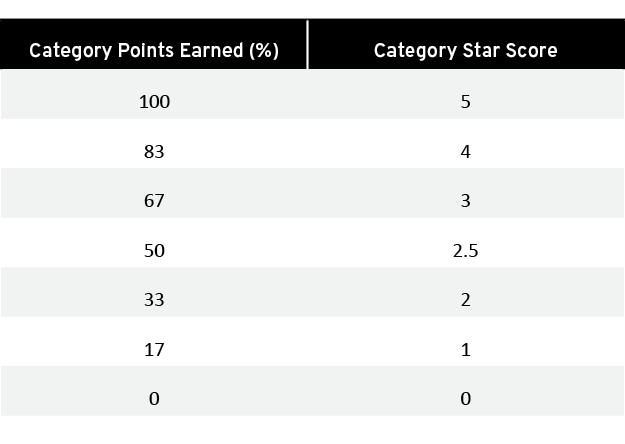
One important exception to the scoring described above is North Dakota, which is the only state that does not require voters to register. This means that Category 2, Category 3, and the “preregistration” topic in Category 1 are not applicable to North Dakota. Thus, North Dakota’s score is based on a smaller set of policies than the rest of the states.
Summary of Results
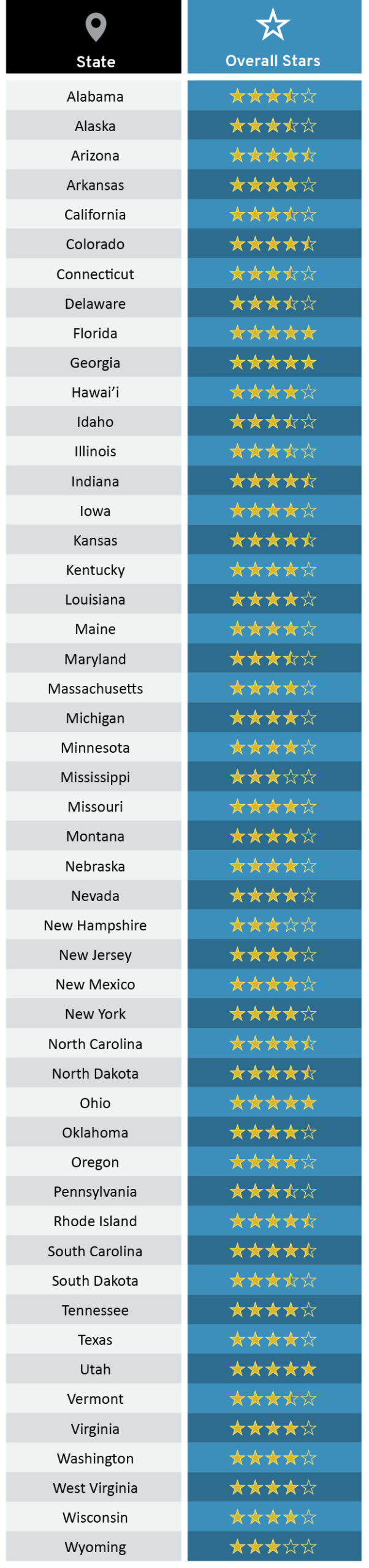
The following represents each state’s overall star rating. The results reveal meaningful variation across states, but also a broad policy foundation that supports trustworthy elections. Each overall star rating was calculated based on the scores earned across six detailed categories. Review the comprehensive Summary of Results here and how the overall stars were calculated.
Conclusion
Overall, this election policy scorecard supports the idea that the United States’ decentralized approach to elections is a strength of our system of governance. States performed strongly as a whole, with an average star rating of 4, and all states receiving at least 3 stars. Four states earned 5 stars: Florida, Georgia, Ohio, and Utah.
Across the main categories, average scores ranged from 3.1 for verifying voter identity to 4.5 stars for voter list maintenance. While these are strong results in aggregate, variations across categories identify potential opportunities for state-level improvements. The granular data presented on each state’s expanded score page offers a clear path to advance such changes.
Beyond their overall strong performance in the main election administration categories, states’ scores were consistently lower in the supplemental policy section, averaging 2.5 stars overall. Only one state, Georgia, earned 5 stars. Thus, while policymakers continue their efforts to improve the mechanics of elections, it is essential that they simultaneously focus on the foundational policies necessary for a durable democracy, including access to the ballot, protection of free speech, and the safety of all citizens who participate in the election process.
By providing a national perspective on the way the nation’s elections are structured and evaluating specific state election policies through a lens of security and voter convenience, this scorecard helps highlight best practices and identifies different paths to achieving an election system worthy of public trust.