

Impact of Decriminalizing Buprenorphine Diversion
Author

Table of Contents
Media Contact
For general and media inquiries and to book our experts, please contact: pr@rstreet.org
Decriminalizing the possession of diverted buprenorphine has received broad support from people who use substances as well as healthcare providers who treat patients struggling with OUD. This suggests that, over time, changes like these could help reduce stigma around the medication and serve as a tool to connect individuals to more formal treatment channels.
Introduction
In recent years, the United States has witnessed a dramatic decline in overdose deaths, but the nation continues to struggle with multiple crises related to the use of illicit opioids. Estimates suggest that between 2.5 million and over 6 million American adults live with opioid use disorder (OUD). Despite recent gains in the fight against overdose, tens of thousands of individuals still die from opioids each year. OUD and overdose have a ripple effect on entire communities: More than 40 percent of people in the United States now know someone who has died of an overdose. Furthermore, as OUD collides with rising rates of homelessness and an inadequate mental health and addiction treatment infrastructure, jurisdictions large and small are struggling with both real and perceived public safety threats associated with public drug use and open-air drug markets. Overall, OUD costs communities more than $1 trillion annually.
One of the most effective ways to reduce the risks associated with OUD in the short term and to reduce the demand for illicit opioids in the long term is through evidence-based treatment. The U.S. Food and Drug Administration (FDA) has approved three medications for opioid use disorder (MOUD): methadone, naltrexone, and buprenorphine. Of the three, buprenorphine has the best efficacy-to-access profile, making it a preferred treatment for many people living with OUD. However, access to this lifesaving medication remains insufficient, forcing some individuals to seek it out through medical diversion—the process of accessing or distributing a prescription medication outside of official, legal medical processes—to treat withdrawal symptoms or to self-medicate when formal options are unavailable.
Buprenorphine is a Schedule III substance under the U.S. Controlled Substances Act, making it illegal in most jurisdictions without a prescription, with possession or distribution subject to criminal penalties. In recent years, a handful of local and state governments have removed these penalties in recognition of the fact that most use of diverted buprenorphine is a form of self-medication and often leads to engagement with formal treatment services. This paper explains the history and efficacy of buprenorphine as a treatment for OUD, describes key decriminalization efforts, and evaluates the data on relevant health and social outcomes.
A Medication to Treat Opioid Use Disorder
Approved for the treatment of opioid use disorder in 2002, buprenorphine is a partial opioid agonist medication. It binds to the same opioid receptors in the brain as other opioids like fentanyl or heroin, and because it has a high affinity for these receptors, it can block or even displace competitors. Once attached to those receptors, buprenorphine can block cravings, which reduces illicit drug use. It also maintains a person’s tolerance, lowering their overdose risk should they return to opioid use even temporarily.
Buprenorphine also behaves differently than recreational opioids in several key ways. Because it is a partial agonist, it does not fully activate the receptors; this leads to a “ceiling effect,” meaning that, after a certain point, increasing the dose does not increase the drug’s effects. Consequently, buprenorphine is less likely to be used as an intoxicant or lead to respiratory depression and overdose compared to full agonists. This partial receptor activation does mean that induction with the medication is more likely than full agonist medications (i.e., methadone) to cause precipitated withdrawals in individuals who are opioid dependent, especially when doses are too low. In addition to being a partial agonist, buprenorphine takes effect gradually, and a single dose typically lasts for 24 to 36 hours. As a result, the medication provides a stable experience rather than the euphoric rush (or return to wellness) and withdrawal cycle that people dependent on heroin or fentanyl experience multiple times per day.
All of these factors—the craving reduction, the ceiling effect, the elimination of the rush/well-withdrawal cycle—make buprenorphine an effective and safe medication for many people living with OUD. It reduces illicit opioid use, overdose risk, and arrest risks while improving treatment retention and long-term health and social outcomes.
Accessing Buprenorphine
Despite buprenorphine’s solid safety and efficacy profile as a treatment for OUD, the medication remained heavily restricted for the first decade after its approval. In particular, for years, only physicians who received special training and a Drug Enforcement Administration (DEA) waiver could prescribe it. It is only within the past 10 years that lawmakers have gradually reduced many of these restrictions. Today, any prescriber—including pharmacists in some states—with a standard Schedule II through V DEA registration can prescribe buprenorphine via office or telehealth visits. Appendix (download here) highlights key federal policy changes over the years.
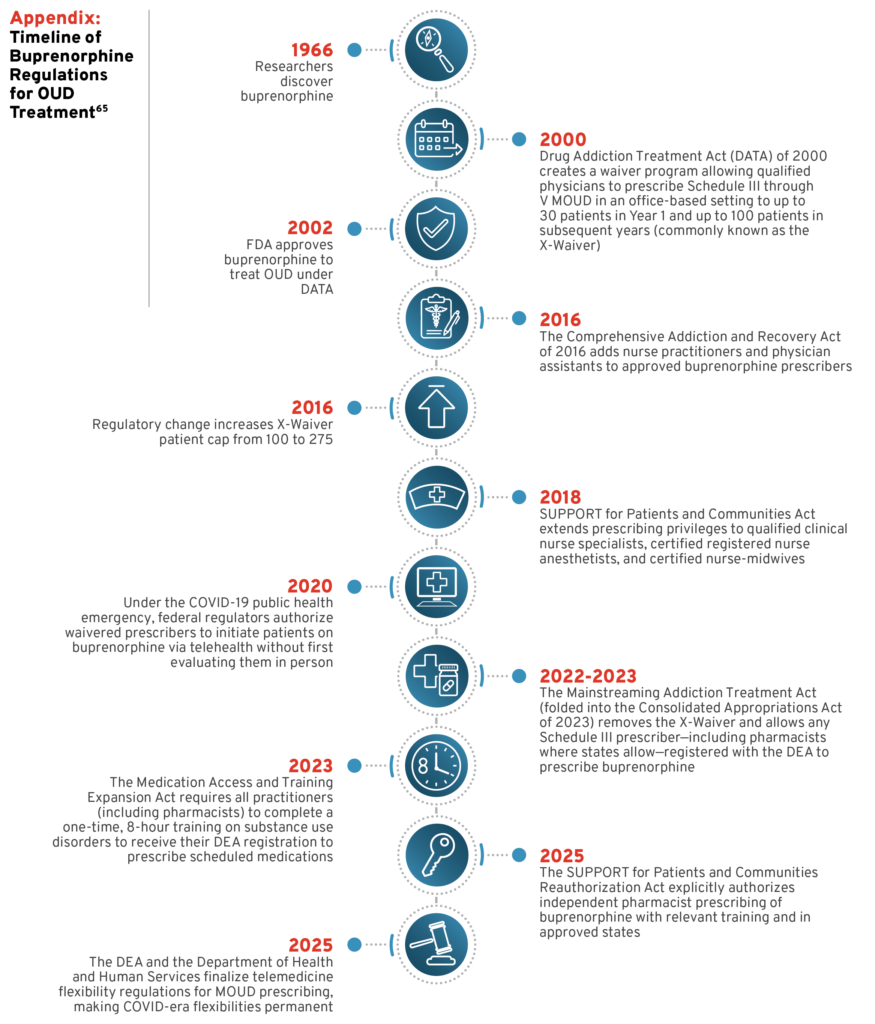
As lawmakers reduced restrictions on buprenorphine prescribing, the number of prescribers climbed. However, patients still experience a variety of access barriers, including cost, stigma, geographic isolation, and pharmacy dispensing limitations. Less than 20 percent of individuals with OUD receive an FDA-approved medication—buprenorphine or otherwise—to treat their addiction.
Diversion and the Treatment Gap
A consequence of this treatment gap is medication diversion, defined as accessing or distributing a prescription drug outside of formal medical channels. Approximately 30 out of every 100,000 buprenorphine prescriptions are diverted. This is roughly on par with the rate for opioid painkillers and much lower than antibiotics (about 5 percent of individuals report taking nonprescribed antibiotics and one-quarter report a willingness to take or share antibiotics without a prescription).
Reducing buprenorphine diversion and mitigating its associated risks requires understanding individuals’ underlying motivations. Research demonstrates that most people who use diverted buprenorphine—between 60 and 90 percent—do so for therapeutic purposes, such as avoiding withdrawal symptoms, initiating or bridging gaps in treatment when formal treatment is unavailable or inaccessible, or reducing their use of illicit opioids. Others use it to self-medicate physical pain or mental health conditions. Of note, the majority of individuals who obtain buprenorphine through informal channels report that they would have preferred to go through a clinician, suggesting that most diversion results from treatment gaps.
Some evidence also suggests that buprenorphine diversion produces additional benefits for those with OUD. Specifically, diverted buprenorphine can serve as a gateway to formal treatment. One study found that 18.4 percent of patients newly enrolled in telehealth MOUD reported using diverted buprenorphine previously. In addition, modeling research has shown that increased buprenorphine diversion in a community can decrease the rate of overdose fatalities.
Decriminalizing Possession of
Diverted Buprenorphine
Although diverted buprenorphine serves a therapeutic purpose for many people with OUD, the majority of the country criminalizes the practice. Since 2018, however, several jurisdictions have taken steps to change this. Some have directed prosecutors and law enforcement to use discretion, whereas others have either enacted legislation specifically permitting the possession and use of small quantities of diverted buprenorphine or decriminalized controlled substance possession more broadly. The sections below describe key policies jurisdictions have implemented to decriminalize diverted buprenorphine.
Chittenden County, Vermont
In June 2018, the Burlington chief of police and the Chittenden County state’s attorney stopped arresting and prosecuting individuals in possession of misdemeanor amounts of diverted buprenorphine. This made Vermont’s Chittenden County the first in the United States to de facto decriminalize possession of a controlled substance in response to the opioid overdose crisis. When interviewed, they cited three important motivations for this policy change:
…first, to correct the error of criminalizing a person struggling with opioid addiction for possessing an effective means to treat it, second, to reduce stigma against the use of partial agonist medications to treat OUD, and third, to compensate for a serious gap in medication-assisted treatment capacity.
They implemented the diversion policy alongside several simultaneous interventions: low-barrier buprenorphine access via their syringe services program and the local medical center’s emergency department, expanded MOUD access for incarcerated people, elimination of the regional MOUD waitlist, and broad distribution of the overdose reversal medication naloxone.

May 2026 Status: This local policy directly informed Vermont’s 2021 statewide legislation; therefore, it is no longer a standalone measure.
Philadelphia, Pennsylvania
On Jan. 28, 2020, inspired by the Chittenden County precedent, Philadelphia District Attorney Larry Krasner announced that his office would cease prosecuting individuals charged solely with possession of buprenorphine-based medications and withdraw cases in which buprenorphine possession was the only charge. However, the office continued to prosecute cases involving intent to distribute the medication. Krasner cited the evidence base supporting buprenorphine and the contradiction of the city’s simultaneous embrace of public health campaigns and criminalization of medication possession.
May 2026 Status: This policy is based on prosecutorial discretion, not legislation, so it is subject to change with district attorney leadership. As of May 2026, Krasner remains in office, and the policy remains intact.
Washtenaw County, Michigan
Washtenaw County Prosecutor Eli Savit announced in January 2021 that his office would no longer prosecute people in possession of small amounts of diverted buprenorphine. Instead, these individuals would be referred to community recovery resources. Under this policy, the office continued prosecuting large-scale and for-profit distributors of diverted buprenorphine as well as manufacturers or distributors of illicit drug mixes containing buprenorphine. Savit described the policy as a public health response aimed at reducing overdose deaths.
May 2026 Status: This policy is based on prosecutorial discretion, not legislation, so it is subject to change. As of May 2026, Savit is still the Washtenaw County prosecutor, and the policy continues.
Vermont
In June 2021, Gov. Phil Scott signed H.225 (Act 46), making Vermont the first state in the nation to legislatively remove criminal penalties for possession of diverted buprenorphine. Under the law, adults aged 21 and older who hold up to 224 milligrams—roughly a two-week supply—of the medication without a prescription will face only civil consequences, including referral to diversion programs. When originally passed in 2021, H.225 included a two-year sunset provision requiring the legislature to evaluate the policy’s effects to continue it. In addition, Gov. Scott issued an executive order establishing a task force to assess impact before any renewal decision. In 2023, the Vermont Legislature passed H.222, an overdose response bill that increased MOUD access, expanded harm reduction programs, bolstered recovery housing, and made diverted buprenorphine decriminalization permanent.
May 2026 Status: This policy remains in law.
Rhode Island
Just one month after Vermont first decriminalized diverted buprenorphine, Rhode Island Gov. Daniel McKee signed S.0065A and H.6328 into law, removing buprenorphine from the state’s list of controlled substances subject to criminal penalties. No civil penalties or diversion programs were enacted as part of this legislation. Rather, Rhode Island lawmakers treated the law as a pragmatic tool that would allow residents with OUD to “choose buprenorphine over heroin.” The state has broadly embraced harm reduction via a variety of other policies as well.
May 2026 Status: This policy remains in law.
Outcomes
Research evaluating the efforts to decriminalize possession of diverted buprenorphine remains limited. To date, Vermont is the most-studied real-world example within the United States.
In 2018, after Chittenden County officials stopped prosecuting buprenorphine possession, the region’s overdose deaths fell roughly 50 percent from their 2017 peak. Notably, this occurred at the same time that deaths rose by 20 percent in the rest of Vermont. While this association is promising, because the county decriminalized buprenorphine while implementing a number of other harm reduction interventions, it is not clear whether this buprenorphine-specific action had an independent effect or to what magnitude.
State-level buprenorphine decriminalization was well accepted in Vermont. One study found that 80 percent of its 474 participants—all people who used illicit opioids or received OUD treatment within the past 90 days—supported decriminalization. A survey of 117 buprenorphine prescribers found that 91 percent supported the policy. The research among people who used drugs also found that a majority had previously used nonprescribed buprenorphine, and, consistent with prior research, most did so to manage withdrawal symptoms and avoid illicit opioids.
Contrary to predictions based on the Chittenden County experience and earlier modeling research, Vermont’s statewide decriminalization of diverted buprenorphine did not reduce overdose deaths at the state-population level. This is possibly because the policy was not well-known among community residents: Only 28 percent of individuals surveyed were aware of it. However, the researchers found no evidence of adverse consequences following the change. In particular, although some worried that allowing the use of diverted buprenorphine would discourage people with OUD from seeking formal treatment, data from Vermont does not support that concern. Only 4 percent of providers reported prescribing to fewer patients following decriminalization. Similarly, only 4 percent of individuals with OUD who were aware of the decriminalization policy reported that the policy change drove them to take more diverted buprenorphine.
Policy Implications
The real-world examples discussed in this paper provide insight into what buprenorphine decriminalizing policies could and perhaps should look like. Most of the efforts were implemented as part of a broader health approach to OUD and the overdose crisis, not as standalone measures. While this makes it difficult to parse their effects on immediate health outcomes, it demonstrates how such policies might fit within broader health agendas. It is clear from the highlighted case studies that most people continue to use diverted buprenorphine to self-medicate and that the practice signals a need for access to low-threshold care. In addition, concerns that these types of policies would discourage treatment engagement did not appear to materialize. Further, pairing decriminalization with other low-threshold health programs can optimize its benefits.
Decriminalizing the possession of diverted buprenorphine has received broad support from people who use substances as well as healthcare providers who treat patients struggling with OUD. This suggests that, over time, changes like these could help reduce stigma around the medication and serve as a tool to connect individuals to more formal treatment channels. The fact that the programs have not been associated with adverse outcomes and have remained in place suggests that support remains intact years after implementation, allowing the time needed for the often-slow cultural shifts that could eventually reduce stigma.
Conclusion
Contextualizing the limited research on jurisdictions that have decriminalized diverted buprenorphine suggests that the approach is promising and unlikely to cause harm, but it will not have a significant impact on its own. To close the treatment gap, lawmakers should implement buprenorphine decriminalization policies alongside harm reduction and other public health policies. Some key policies that can increase buprenorphine uptake include: authorizing telehealth prescribing, expanding pharmacist scope of practice, implementing low-barrier buprenorphine induction programs, and removing insurance preauthorization requirements.
Creating a comprehensive policy structure will help improve access to OUD treatment while also reducing the stigma that can make individuals hesitant to seek treatment, providers reluctant to prescribe buprenorphine, and pharmacists unwilling to stock or dispense the medication. Thus, formal treatment channels will become not only more available and accessible but also, over time, more appealing, ultimately reducing the demand for diverted buprenorphine and breaking the cycle of often unintended but very real harms.