

Georgia’s Criminal Justice Crossroads: Opportunities for Pre-Arrest, Pretrial, and Post-Conviction Change in the Peach State
Nov 18, 2025
Authors

Jillian Snider
Resident Senior Fellow, Criminal Justice and Civil Liberties

Lisel Petis
Policy Director, Criminal Justice and Civil Liberties

Sarah Anderson
Associate Director, Criminal Justice and Civil Liberties
Media Contact
For general and media inquiries and to book our experts, please contact: pr@rstreet.org
Criminal Justice System Profile
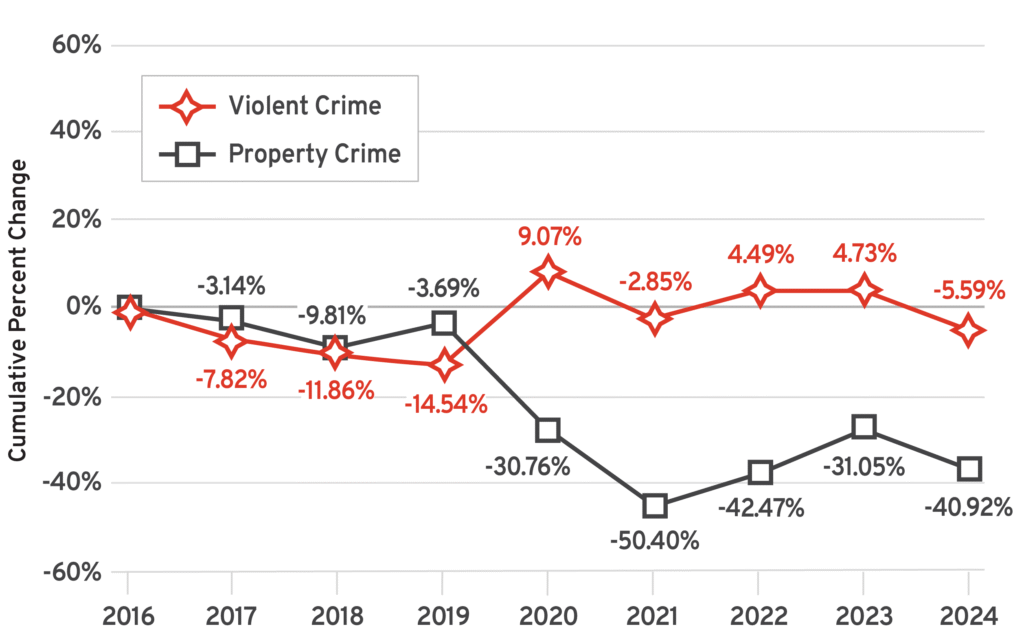
Recent Crime Trends
Current Criminal Justice Spending (Per Capita, FY 2021)
Courts: $100-$150
Corrections: $150-$250
Police: $300
27%
Community Supervision Population (2023)
356,000
Violent Crime Clearance Rates (2024)
33%
Current Incarcerated Population/Rate
Jail and prison populations (2023) Total ~95,000
Incarceration rate per 100,000 (2024) 881 (7th/50)
Strengths to Build On
- Under former Gov. Nathan Deal, Georgia was one of the first red states to implement smart-on-crime policy initiatives. Sentencing revisions, parole eligibility expansion, probation modifications, reduced barriers to reentry, and a juvenile system overhaul improved its criminal justice system and paved the way for other red states to similarly modernize theirs.
- The Georgia Bureau of Investigation Cold Case Specialty Unit—staffed with investigators, analysts, and digital forensics experts—was established in 2023 to increase law enforcement’s ability to solve crimes. The unit expanded in FY 2025 to increase forensic science staffing and reduce a 38,000-item evidence backlog to get justice for victims.
- Passed with broad bipartisan support and enacted earlier this year, Georgia’s Survivor Justice Act allows judges to consider evidence of domestic violence or abuse in self-defense and coercion claims as well as when determining a sentence after conviction. It also offers a narrow path to resentence incarcerated survivors.
Persistent Challenges
- Personnel shortages in Georgia police departments is a critical, ongoing issue that undermines public confidence in police. The state’s officer-per-capita rate fell below the national average in 2023, and severe understaffing is seen across a variety of jurisdictions, such as Bibb County, Hinesville, and Fort Gaines. This problem prevents law enforcement from policing effectively, let alone solving crimes.
- Statewide data infrastructure is lacking, leaving policymakers without foundational information needed to guide or evaluate criminal justice policies and practices. For example, despite a recommendation from the Georgia Council on Criminal Justice Reform 2019 pretrial committee, the state still does not track or report how often people miss court, who is affected, or what factors contribute to those absences.
- With the nation’s seventh-highest incarceration rate, Georgia struggles with overcrowding and safety concerns in its carceral system. This has put it under federal scrutiny for dangerous, unsanitary, and unconstitutional conditions that can be ascribed, in part, to its struggles with correctional staff retention. More recent numbers show that 34 state prisons in Georgia have reached “emergency levels” of understaffing and that 82.7 percent of new hires leave within their first year of employment.
Practical Solutions
- To improve public confidence in police, Georgia should build on its existing body-worn camera retention statute by adopting uniform statewide minimum standards for camera activation and footage management. Clear, consistent policies on when cameras must be turned on, how data are stored, and how footage can be reviewed would also support officer accountability and ensure fairness across all agencies without imposing unnecessary mandates.
- As Georgia implements its new statewide court case management system, policymakers should ensure it captures and publicly shares key data—such as court appearance rates, pretrial detention, and case outcomes—in a consistent and accessible format. Building this into the system now would lay the groundwork for more informed policy decisions for a safer and fairer justice system. The system should also proactively support automated court reminders, which have been shown to reduce failures to appear significantly, conserving public resources lost on unnecessary warrants and jail stays.
- To free the state from federal scrutiny and improve conditions for both staff and inmates, it is urgent for Georgia policymakers to address current prison conditions. First, the state can address prison understaffing with innovative new programs and hiring practices. Second, they must ensure that people who do not need to be incarcerated can access safe paths to early release (particularly the elderly or terminally ill). While on paper, Georgia offers medical reprieve and parole due to disability or advanced age, analysis shows that it is largely inaccessible and therefore limited in its impact. Finally, establishing clearer criteria for parole and making information about process, policies, and other important criteria publicly available would improve the efficacy of programs that safely reduce prison populations.
For More Information
Check out our Criminal Justice Crossroads series on Georgia: