

Exploring Ways to Build the Behavioral Health Middle-Skills Workforce: Aligning State Regulation, Training Pathways, and Workforce Pell
Authors


Table of Contents
- Executive Summary
- Introduction
- The U.S. Behavioral Healthcare Gap and the Role of Middle-Skills Workers
- Exploring How States Define and Regulate Middle-Skills
- Policy Implications
- Conclusion
Media Contact
For general and media inquiries and to book our experts, please contact: pr@rstreet.org
The United States is grappling with an ongoing behavioral health crisis as a growing need for mental health and SUD treatment collides with current and projected workforce shortages. Middle-skills pathways can play an important role in addressing this problem by extending the reach of care and expanding the capacity of the professional workforce.
Executive Summary
In recent years, state and federal lawmakers have developed programs aimed at facilitating access to middle-skills career pathways across a wide range of in-demand industries. The recently implemented Workforce Pell Grant Program adds a new source of public support for these efforts.
Because middle-skills jobs require education beyond high school but less than a four-year degree, they have the potential to address workforce shortages rapidly while providing new economic opportunities. These pathways may be particularly valuable in behavioral healthcare, where persistent workforce shortages continue to limit access to care, especially in rural communities. However, public investment will yield real-world benefits only if states define and regulate middle-skills behavioral healthcare jobs in ways that facilitate rather than hinder entry into the labor market.
This study describes current behavioral health needs and workforce shortages in the United States and examines how six “high-need” states define and regulate four middle-skills behavioral healthcare occupations. It then considers how the occupational requirements for these roles align with state workforce investments and the Workforce Pell Grant Program. Key points from this analysis include:
- The U.S. behavioral health crisis is intersecting with a behavioral healthcare workforce shortage, driving a growing gap in access to care.
- Though many of the job titles are relatively new, middle-skills behavioral healthcare workers—sometimes referred to as “paraprofessionals”—are currently underrepresented in the behavioral healthcare workforce but have the potential to extend and expand care.
- Although licensing is not a common way to regulate middle-skills behavioral healthcare jobs, certification is often required for Medicaid reimbursement, making the associated training requirements functionally binding for workers who provide reimbursable services.
- States have established different titles, scopes of practice, and recommended or required qualifications for similar middle-skills jobs, which can hinder worker entry to the job market or mobility across state lines.
- Training requirements for certification do not always align with the requirements associated with funding, especially Workforce Pell.
- Workforce Pell’s data-reporting and performance requirements may be particularly challenging for new training pathways and programs serving rural areas to meet.
Public investment in middle-skills training has the potential to expand access to behavioral healthcare while also creating economic opportunity. To realize those gains, states should build stackable training pathways that reflect local workforce needs, reduce unnecessary regulatory barriers, and use Workforce Pell to complement—not dictate—their broader workforce strategies.
Introduction
In July 2026, the Workforce Pell Grant Program became fully operational, allowing eligible students to use Pell funding for qualified short-term training programs. The program, focused on rapid training that prepares individuals for in-demand positions, joins a growing number of government efforts to close the nation’s workforce shortages and expand access to career opportunities.
Behavioral healthcare is one area in which these efforts have the potential to have a direct, rapid benefit for both workers and communities, especially in rural areas. The United States is grappling with an ongoing behavioral health crisis alongside considerable shortages in care providers. Middle-skills jobs—those that require more training than a high school diploma but less than a four-year degree—have the potential to help fill those gaps, and state and federal efforts are increasingly working to build this workforce. By targeting a rapid training pathway for entry-level positions, Workforce Pell grants aim to complement and extend existing opportunities, growing the workforce quickly and sustainably.
However, government investments in these career pathways are only meaningful if they actively facilitate workforce entry and development in ways that effectively address consumer and community needs. Lawmakers must build frameworks that consider real-world workforce gaps and needs—often across disparate geographic communities—existing training resources, and Workforce Pell eligibility requirements. When it comes to the important goal of expanding the behavioral healthcare workforce, many middle-skills pathways, sometimes referred to as “paraprofessional” positions, are relatively new and inconsistently defined and regulated across states.
To inform lawmakers’ ongoing efforts, this paper describes the state of behavioral healthcare access in the United States, explains the potential of middle-skills jobs in filling access gaps, and draws on our analysis of ways that six purposively selected states define, regulate, and fund several middle-skills behavioral health pathways to highlight challenges.
The U.S. Behavioral Healthcare Gap and the Role of Middle-Skills Workers
“Behavioral health” is a term that can be applied to a range of issues and conditions, including mental health conditions, substance use disorders (SUDs), life crises, and physical symptoms caused by stress. Many different categories of professionals and paraprofessionals treat these types of conditions or extend access to that care by supporting or enhancing targeted services like counseling. To understand where middle-skills workers can be most helpful in this sector, we must consider the scale of behavioral health needs in the United States, current workforce shortages limiting access to care, and the ways this category of worker can extend the reach of existing providers.
Behavioral Health Needs in the United States
Behavioral health is a significant concern in the United States. Recent surveys consistently find that nearly one-quarter of U.S. adults (more than 60 million) experience mental health issues and nearly one in five (more than 46 million) have an SUD. In 2025, almost one in 10 adults in the United States experienced a mental health crisis. Behavioral health conditions also disproportionately affect rural Americans, who face poorer health outcomes and are more likely than residents of metropolitan areas to have a severe mental illness.
Left untreated, behavioral health issues can affect individuals and their broader communities. At their most extreme, they can lead to early death; more than 1 million Americans have died of a drug overdose since 2000, and tens of thousands continue to die annually. As of 2023, more than 40 percent of adults in the United States knew someone who had died of an overdose. In 2024, almost 50,000 Americans died by suicide, 2.2 million attempted suicide, and more than 14 million reported considering suicide in the past year.
Untreated behavioral health conditions are also associated with additional health risks, from injection-related infectious diseases and complications like HIV and endocarditis to long-term health conditions such as cardiovascular disease and chronic pain. Individuals with untreated behavioral health conditions are also more likely to experience relationship problems, struggle to maintain employment, experience homelessness, or be arrested and incarcerated. For those living with both an SUD and a mental health condition—approximately 21.2 million U.S. adults—care challenges are even more complex.
In addition, the expenses associated with untreated behavioral health issues extend beyond the individuals living with the conditions. Experts have calculated that untreated SUD costs the United States more than $400 billion annually in combined social, healthcare, and criminal justice expenses. An Indiana study similarly estimated that untreated mental illness cost the state $4.2 billion in 2019 in indirect costs (e.g., lost productivity), healthcare expenses (e.g., emergency department visits), and direct nonhealthcare costs (e.g., homelessness response and criminal justice system interactions).
Although most Americans experiencing a behavioral health issue say they would be comfortable talking to a professional, many who seek help do not receive it. On average, only about 20 percent of those struggling with substance use and just over 52 percent of those with mental health conditions receive treatment. This leaves tens of millions of individuals who would benefit from behavioral healthcare without the resources that could improve or save their lives. Stigma, time constraints, and fears around losing custody or jeopardizing employment prevent many people from seeking care. And even those who do seek it face structural barriers to care, shaped by issues such as cost, provider availability, and fragmented care systems.
Behavioral Healthcare Workforce Shortages
The U.S. behavioral healthcare workforce includes an estimated 1.2 million individuals across a wide range of professions, from social workers and psychiatrists to addiction counselors and peer-support specialists. Even so, ongoing workforce shortages continue to limit access to care and negatively affect its quality: More than 122 million individuals in the United States currently live in a Mental Health Professional Shortage Area. Based on current need, the nation’s behavioral health workforce is expected to face a shortage of hundreds of thousands of counseling professionals by 2038, including:
- 77,050 addiction counselors
- 99,780 mental health counselors
- 99,840 psychologists
- 43,810 psychiatrists
- 33,840 marriage and family therapists
- 39,680 school counselors
- 95,230 addiction paraprofessionals
As striking as these estimates are, they may underestimate the scope of the problem. Eighty-three percent of behavioral health providers reported experiencing burnout in 2023, and the supply of psychiatrists is declining despite growing demand. In addition, many projections only count individuals who are currently receiving or have actively sought treatment, leading some experts to theorize that shortage estimates would appear even more pronounced if they included those who could benefit from care but have not yet engaged with it. Shortages of middle-skills behavioral health workers are particularly difficult to quantify because many of these career pathways are new. What is clear, however, is that the United States has a large gap between the need for behavioral health treatment and access to care.
Behavioral healthcare workforce shortages are especially acute and difficult to address in rural communities. As of December 2025, approximately 70 percent of Mental Health Professional Shortage Areas were in rural communities, and 89 percent of rural census tracts carried the designation. Scholars have estimated that at least 65 percent of nonmetropolitan counties in the United States lack a psychiatrist, and in most rural areas, people struggling with behavioral health issues have to travel 30 miles or more to reach care facilities.
The behavioral healthcare workforce shortage in rural communities stems in part from broader challenges these remote regions face in attracting health-related investment and recruiting and retaining care providers. Several factors discourage providers from serving rural communities, including geographic isolation, poor infrastructure, low reimbursement rates, underfunded facilities unable to provide competitive pay, and limited training and continuing education opportunities.
There is no single solution to the plethora of behavioral healthcare workforce challenges. Governments hoping to address ongoing and projected shortages and improve access to care will need to pursue a range of policy solutions, especially in rural areas. Chief among these are policies that facilitate workforce expansion in meaningful ways. Specifically, policies that support and grow middle-skills behavioral health paraprofessional roles are particularly well positioned to extend the reach of care relatively quickly and create career opportunities within underserved communities. These positions often leverage the skills and local knowledge of individuals already based in the community or with lived experience to provide services that “complement and extend the reach” of licensed providers with more training.
The Importance of Middle-Skills Jobs
The term “behavioral health services” typically brings counseling sessions and psychiatric medication management to mind, but a number of complementary services can help round out care, increase access, and improve outcomes for individuals engaged with behavioral health services. These include screening, case management, referral to treatment, connection to care and social services, and peer support. For the most part, counseling and prescribing are restricted to individuals who have undergone considerable training and hold at least a bachelor’s degree, but many supportive roles require less specialized training and formal education. Yet these roles are used less extensively in behavioral health than in other healthcare settings; physicians in the United States have an average of seven individuals providing supportive services and dentists have an average of four, but mental health professionals average 0.22 support workers per practitioner.
Because many behavioral healthcare middle-skills positions are relatively new, states tend to define the roles inconsistently, and their effects remain understudied. For example, one study identified nearly 100 distinct job titles across the 36 states that defined and regulated behavioral healthcare paraprofessional roles in 2025. Many roles had similar scopes of practice across states, but titles and regulatory requirements differed. Research on more established behavioral health paraprofessionals, such as community health workers and peer-support specialists, shows that these workers can help close access gaps. Emerging research also suggests that expanding these roles has the potential not just to improve access to care, but to improve outcomes and reduce costs.
Beyond extending care, behavioral health middle-skills job pathways can provide workers with sustainable economic opportunities. An analysis of the healthcare sector suggests that workers with an associate’s degree earn an average of $42.58 per hour, while nondegree paraprofessionals earn an estimated $18.63 per hour, compared to roughly $20 to $25 per hour across sectors for individuals with similar education levels. Furthermore, research shows that individuals who obtain a middle-skills credential—even in low-paying sectors—earn significantly more after earning the credential than they did before. This increased earning potential can make middle-skills jobs viable career pathways, especially when workers can build from entry-level positions by stacking credentials, experience, and training.
These pathways may especially benefit populations that have historically faced more barriers in the labor market, including individuals in recovery, women, and people living in rural areas. Because some behavioral health jobs leverage—or even require—lived experience (e.g., peer-support roles), individuals in recovery have a unique opportunity to turn a background that might typically create an employment barrier (e.g., history of SUD, a long-term mental health condition) into valuable experience and perspective and a natural point of entry into a rewarding career. Women may also benefit from a greater availability of these complementary roles, as they currently make up the majority of behavioral healthcare workers at almost every level of training and education. Finally, some middle-skills behavioral healthcare jobs (e.g., community health workers) require deep local knowledge, which makes those living in or with close connections to rural and underserved communities uniquely qualified.
Exploring How States Define and Regulate Middle-Skills Behavioral Health Jobs
State and federal governments are increasingly investing in middle-skills behavioral healthcare jobs, signaling that they recognize the value of these positions. However, to optimize these workforce investments, roles must have clear definitions, balanced regulations, and reasonable training requirements.
To assess how state definitions, licensing, and regulation may affect this workforce landscape, we selected a sample of states as case studies, examined their current approach to these roles, and contextualized them alongside the existing literature on occupational regulation and the requirements for key, relevant funding streams, including Workforce Pell eligibility. The following section outlines the methodology we used and discusses three key areas that we believe will enhance investments in this space: having consistent titles for similar jobs, having reasonable training and certification requirements, and aligning training requirements with available funding program requirements.
Methodology
To help inform government efforts to expand the behavioral healthcare workforce and provide economic opportunities by facilitating access to middle-skills pathways, we examined six “high-need” states’ definitions and regulations of several behavioral health job categories. We operationalized “high-need” as states that recent assessments revealed to have both significant behavioral health needs and inadequate access to behavioral healthcare resources. To increase geographic and political variation, we selected the states with the largest relative gap between need and access in each of the four main census regions. Because the states that struggled the most with these issues were heavily concentrated in the West and South, we selected two states from each of these regions and one state each in the less affected Midwest and Northeast regions. The resulting six states included in this discussion were:
- Midwest: South Dakota (ranked 38th)
- West: Nevada (ranked 51st) and Arizona (ranked 50th)
- Northeast: Rhode Island (ranked 24th)
- South: Alabama (ranked 49th) and West Virginia (ranked 46th)
We then identified several middle-skills behavioral health jobs and narrowed our focus to four that were nationally recognized or had similar definitions or scopes of practice across our six study states. For each of these jobs, we assessed state job titles, definitions, and regulations by reviewing state law, regulatory definitions, relevant agency descriptions of positions, and, where relevant, news or professional organization media. The four positions that met our criteria for middle-skills behavioral health jobs and that all six of our study states addressed in some capacity were:
- Peer-Support Specialist (sometimes referred to as Recovery Coach)
- Certified Addiction Counselor
- Psychiatric Technician (alternately called Mental Health or Behavioral Health Technician or Associate)
- Community Health Worker
Findings: State Definitions
Consistent with previous research, our analysis revealed that states define and regulate these emerging roles and career pathways differently.
- Peer-Support Specialist. This role appeared to be the most clearly and consistently defined and regulated. The job requires lived experience, certification is voluntary, and certification training generally ranges from about 40 to 60 hours. Of note, South Dakota’s recent recognition and regulation of Peer-Support Specialists brought new criminal-record scrutiny to workers in this role. Although the state’s law does not prohibit people with felony convictions from working in behavioral health fields, it does give certifying boards the right to remove credentials based on a conviction, should they see fit, thus adding a potential barrier for many of those most likely to have relevant lived experience.
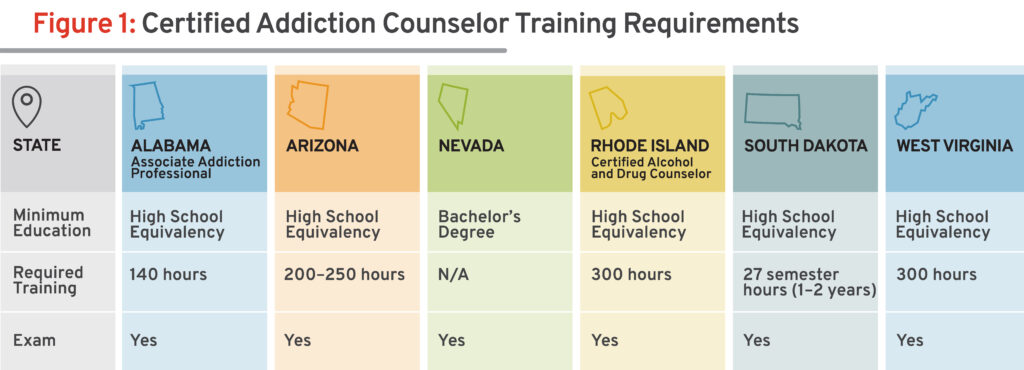
- Certified Addiction Counselor. Training requirements varied more substantially for addiction counselors (Figure 1). Rhode Island’s Certified Alcohol and Drug Counselor requires 300 hours of training beyond high school equivalency, whereas South Dakota’s equivalent credential (a Certified Addiction Counselor) requires 27 semester hours, or roughly one to two years, of coursework beyond high school equivalency. Meanwhile, although most of Alabama’s SUD counseling positions require a bachelor’s degree or higher, the state’s Associate Addiction Professional credential requires only a high school diploma or equivalent and 140 additional hours of training.
- Psychiatric Technician. States define this role—also called a Behavioral Health Technician or Psychiatric Technician—broadly but similarly. For example, Arizona defined the role as “an individual who is not a Behavioral Health Professional who provides behavioral health services” and who works under the supervision of a behavioral health professional. None of the six states imposed title-specific regulations on Mental Health Technicians, although states often provided training recommendations. For example, in Alabama, the role requires a high school diploma or equivalent, with employers providing all necessary training on the job, whereas in Nevada, it requires a year of relevant work experience.
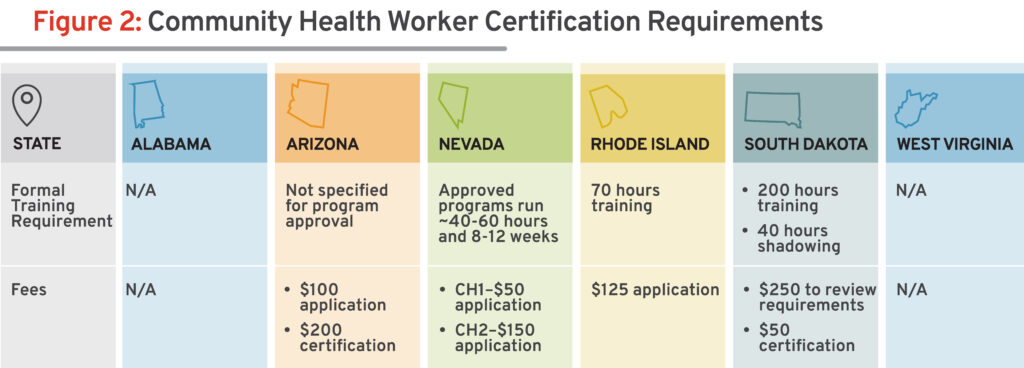
- Community Health Worker. Even these roles, which are nationally recognized and often reimbursed through Medicaid, were not consistently regulated across jurisdictions. Alabama and West Virginia do not require or recognize any statewide certification of Community Health Workers and do not reimburse these services through Medicaid. In contrast, Arizona, Nevada, Rhode Island, and South Dakota require that Community Health Workers be certified for their services to qualify for Medicaid reimbursement but do not require certification to provide services. Certification requirements also differ (Figure 2).
Findings: Licensing and Certification
Occupational regulations such as licensing (state-mandated and enforced credentialing that provides the exclusive right to provide certain services) and certification (voluntary credentialing that protects a title but does not confer an exclusive right to provide services) were developed to preserve public health and safety. As occupational licensing has expanded beyond public health and safety occupations—and as associated training mandates have extended into more subjective “quality” metrics—research has found that these requirements can deter qualified individuals from entering the job market or pursuing certain roles. In particular, time to certification or licensure can prevent individuals from seeking out certain jobs. This exacerbates workforce shortages, potentially drives up costs to consumers, and prevents individuals from accessing economic opportunity, especially in lower-wage occupations.
Although larger studies have found that about one-third of paraprofessional behavioral healthcare jobs require a license, none of the roles examined in our six-state analysis required licensure. Instead, consistent with other research, middle-skills jobs were more likely to offer voluntary certification pathways and to operate in conjunction with licensed providers. The explicit link between certification and Medicaid billing may serve as de facto licensing, however, and training requirements may therefore be similarly binding.
Findings: Funding Alignment
Licensing and certifying these positions is not inherently beneficial or problematic. What is most critical to assess is how these training and qualification requirements affect workforce entry, as well as how they interact with other factors like training-program funding. Two sources of funding that are particularly relevant to this analysis are existing state investments in middle-skills behavioral health training and the highly publicized but narrowly structured Workforce Pell Grant Program.
- State Support for Middle-Skills Pathways. All six of the states included in this study have established funding or training programs to help residents prepare for middle-skills jobs, including those in the healthcare sector. For example, South Dakota provides full scholarships for students entering high-need programs at the state’s technical colleges. These funds can be used to pay for tuition, fees, books, technology, and required tools. The state also awards grants to school districts and nonprofit training providers to support career and technical education equipment, programs, and partnerships that align secondary education with postsecondary programs and workforce needs. These efforts have built a robust system of one- to two-year educational programs to train licensed practical nurses, civil engineering technicians, electricians, and more.
In 2022, Arizona committed more than $30 million to create workforce accelerator programs at community colleges and support the expansion of education-to-workforce pathways through other state initiatives, such as connecting high school students with industry-aligned education and work-based learning.
Similarly, a Nevada initiative supports customized recruitment and training programs developed by education providers and employers. The program helps new or expanding businesses develop the workers they need and has recently funded community-college curricula in advanced manufacturing, automotive technology, healthcare, mining, and other technical fields.
In Rhode Island, an employer-driven initiative brings employers, education providers, and community organizations together to design sector-specific training programs, while a worker-training program reimburses employers for the costs of upskilling current workers. The programs cover jobs in healthcare, construction, marine trades, manufacturing, and other industries. The state reports that these programs have trained, upskilled, or placed more than 43,500 workers at approximately 6,000 businesses since their inception. The governor’s FY 2026 proposal called for a total investment of $14 million to train approximately 3,000 more.
West Virginia funds a “last-dollar” financial-aid program that covers remaining tuition and mandatory fees for eligible certificate and associate-degree programs in high-demand fields at participating public institutions “after federal and state grants have been applied.”
In Alabama, a scholarship program provides grants of up to $4,500 for tuition, fees, books, and supplies associated with eligible community-college training. Programs may be credit or noncredit, must generally be completed within two semesters, and must prepare students for in-demand careers in their region. Alabama provided approximately $1 million for the program in its FY 2025 education budget.
- Aligning Programs with Workforce Pell. An important investment source in middle-skills jobs that states will be responsible for implementing in the coming months and years is the federal Workforce Pell Grant Program, which Congress enacted in 2025 and which went into effect in July 2026. The program expands federal Pell Grant eligibility to certain short-term workforce-training programs. Like traditional Pell Grants, Workforce Pell provides need-based aid that students generally do not have to repay, and students must satisfy the usual Pell eligibility requirements, including completing the Free Application for Federal Student Aid and remaining within the lifetime Pell limit.
The two Pell Grant programs differ, however, in the type and length of training they fund. Traditional Pell Grants generally support certificate and degree programs that require a minimum of 15 weeks (600 hours) of training or that stack onto an existing associate’s degree. Workforce Pell creates a new pathway for shorter-term programs lasting 8 to 14 weeks (150-599 hours) that previously fell below the normal instructional-length requirements. Workforce Pell grants also come with strict mandates that programs must meet certain earnings and job placement metrics and lead to stackable, industry-recognized credentials.
Although these requirements are intended to ensure that shorter-term programs provide students with useful credentials and measurable returns on investments, they may limit the number of educational programs initially able or willing to participate. Many existing programs are too long or too short to be eligible. For example, “short term” under Alabama law is much broader than “short term” under Workforce Pell. A program completed within two semesters may last longer than 14 weeks, whereas a rapid credential course may provide fewer than 150 hours or last less than 8 weeks.
These hour requirements—especially at the low end of the threshold where there are not as many alternative funding resources—may limit the grants’ utility for entry-level positions. As detailed previously, this challenge was evident in our review of behavioral healthcare positions across states as well. None of the Peer-Support Specialist roles would satisfy Workforce Pell requirements, as the 40- to 60-hour training standard falls short of the 150-hour minimum. Because the Peer-Support Specialist has the potential to be such an important entry-level position, both in terms of extending behavioral healthcare and in terms of providing a career pathway for a vulnerable population, this mismatch represents a significant missed opportunity. Similarly, entry-level Addiction Counselor roles align with Workforce Pell in some states but not all. Programs designed to meet Rhode Island’s, West Virginia’s, or Arizona’s Certified Addiction Counselor requirements would likely qualify. However, Alabama programs offering training for the Associate Addiction Professional could be too short, as the state requires only 140 hours for certification, and programs tailored to meet South Dakota’s requirements would be too long, as the state requires 27 semester hours, which is the equivalent of one to two years. Although South Dakota does recognize a more entry-level version of this position (Addiction Counselor Trainee), it requires only on-the-job experience, leaving a large education gap between it and the next step. In theory, though, this is exactly the type of education gap that should be filled by a new, stackable Workforce Pell-eligible program in the state.
- Meeting Workforce Pell Outcomes Requirements. In addition to needing to assess and possibly develop Workforce Pell-eligible training programs, another potential alignment challenge comes with Workforce Pell outcomes requirements. States and institutions must track data on program completion, job placement, and earnings (including value added) and meet specified performance requirements. This may require many programs to develop new systems for data collection, management, and assessment.
Even with robust data systems in place, some programs may struggle to meet set criteria designed to ensure return on investment. These mandates represent a well-intentioned attempt to protect student time and federal dollars, but they may be challenging for rural programs to meet because of relatively high per-student costs. This could be especially difficult if states must develop new programs to satisfy eligibility requirements—further spreading an already limited student base—rather than applying the funds to established pathways. Other challenges that are likely to have an outsized impact on rural programs are the 70 percent verified job placement rate and the “value added” earnings minimum. The small cohorts that could be typical in rural programs mean that the outcomes of one or two students could cause large swings in program data. In addition, rural programs tend to experience more transient graduating populations, making it difficult to verify job placement. Finally, lower wages in rural areas mean that job retention would be difficult, as would be demonstrating that graduates earn sufficiently high wages.
Policy Implications
Most states are not relying exclusively on Workforce Pell to drive their response to workforce shortages, especially in the behavioral healthcare space. Nonetheless, given the importance of entry-level paraprofessionals in quickly filling workforce and access gaps, the program has the potential to make a difference, especially in rural areas. As of August 31, 2026, 29 states were accepting applications for Workforce Pell, five had fully launched programs, and most others were still establishing their application and funding systems. For example, South Dakota has already established an application process through which institutions can seek state approval for Workforce Pell programs. Its labor-market form requires institutions to connect a proposed program to occupational demand, wages, and employer needs. Meanwhile, Nevada is implementing Workforce Pell in phases. Its first phase is limited to institutions in the Nevada System of Higher Education, while a later phase is expected to consider a broader group of noncredit programs. This approach simplifies the initial review but delays access for private or nontraditional providers.
As states continue developing their Workforce Pell processes and assessing programs for eligibility, they will need to align them with the program’s federal requirements. However, Workforce Pell will not operate in isolation. Lawmakers wanting to optimize the potential of the new program will want to ensure that it complements rather than conflicts with existing funding mechanisms, serves their state’s behavioral healthcare needs, and creates career pathways that are appealing for residents of their communities. This means:
- Building Workforce Pell–eligible training programs to fill gaps between “experience only” roles or those with less than the required 150 hours and roles that require lengthier training commitments;
- Developing more cross-state consistency across emerging job titles, scopes of practice, and certification requirements to help mitigate potential mobility barriers for workers and better inform consumers and employers;
- Bolstering behavioral healthcare infrastructure—for example, via mobile units, integration with general healthcare, or telehealth permissions—to help address ongoing recruitment and retention issues that disproportionately affect care access in rural communities and that could derail states’ Workforce Pell assessment efforts.
Conclusion
The United States is grappling with an ongoing behavioral health crisis as a growing need for mental health and SUD treatment collides with current and projected workforce shortages. Middle-skills pathways can play an important role in addressing this problem by extending the reach of care, expanding the capacity of the professional workforce, and leveraging local knowledge and lived experience to act as important connectors and supporters.
In recent years, state and federal governments have invested heavily in these roles in the behavioral healthcare sector and beyond. Consequently, many states have built training systems around these investments, developing curricula, establishing industry partnerships, and even defining emerging professions. This has resulted in a wide variety of job definitions and regulatory requirements, especially for newer, emerging positions. The latest federal investment in this space—Workforce Pell—could reduce the cost of entering middle-skills careers, especially for students who cannot afford a traditional two-year program. It could also complement existing state initiatives by allowing state scholarship or workforce dollars to be used for equipment, supportive services, or remaining expenses rather than carrying the entire cost of training.
However, states must reconcile two different approaches to workforce development. State programs are often designed around flexibility: Employers identify a need, and a college or training provider responds with a program of whatever length and format is appropriate. Some states have developed systems around these models. Workforce Pell imposes a much narrower federal structure and may require the development of new programs and systems for collecting and evaluating data.
Therefore, to make the most of this opportunity, states cannot lose sight of their particular needs and should treat Workforce Pell as one part of a more comprehensive policy response that seeks to increase the workforce and benefit consumers. In the context of behavioral healthcare, this means defining new career paths to align with needs and training resources, avoiding regulation that inadvertently discourages job entry, and addressing structural challenges that hinder workforce retention and/or limit care access. By taking this wide lens, lawmakers can build systems that address their unique workforce needs, support early-career workers, facilitate career advancement, and prioritize high-quality, sustainable behavioral healthcare.