
Without Major Reforms, There’s No Excuse for Year-Round E15
The ability to bypass air quality restrictions and sell gasoline with 15 percent ethanol E15 (fuel that is 15 percent ethanol, 85 percent gasoline) year-round has been a long-held goal for corn growers and ethanol producers. High gas prices–largely due to conflict with Iran–are the latest excuse to shoehorn more corn into our fuel tanks, but the supposed cost savings are unlikely to dent affordability woes.
This won’t be the first flimsy rationale for the 20-year-old Renewable Fuel Standard (RFS) regime, first implemented in 2005 then expanded in 2007. Previous justifications for corn ethanol subsidies have been proven wrong, and there’s little reason to assume this time will be different. Year-round E15 is a poor substitute for fundamental RFS reform.
Ethanol Excuse #1: Energy Independence and National Security
As the name states, one goal of 2007’s “Energy Independence and Security Act”, was to decrease U.S. reliance on oil imports to bolster national security Notably, this occurred during the wars in Iraq and Afghanistan.
Over the last 20 years, the RFS percentage standard (volume percent of total gasoline sales) has more than quintupled, from 2.78 percent to 14.3 percent (on the lower bound of the forecast). But as current gas prices attest, the corn ethanol mandate has not insulated consumers from the consequences of global events. The domestic gasoline market is further complicated by a number of other variables like refinery capacity and technology. Despite aggressive efforts to boost biofuel demand, it constitutes only 6 percent of total transportation energy with little effect on petroleum markets.
The domestic shale oil boom impacted crude imports far more significantly than increasing corn ethanol volumes. Likewise, improved fuel efficiency, electric vehicles, and changing driving habits have flattened gasoline consumption, contributing to declining imports.
Ethanol Excuse #2: Environmental Benefits
RFS advocates originally claimed that fuels derived from renewable sources, like corn ethanol or soy biodiesel, would reduce greenhouse emissions. However, the Environmental Protection Agency (EPA) finds that corn ethanol production has higher emission rates than gasoline. Other research asserts that the “carbon intensity of corn ethanol produced under the RFS is no less than gasoline and likely at least 24% higher,” primarily due to land use conversion. Even under the most favorable assumptions, RSI research found that, “the RFS is an inefficient emission abatement tool that costs notably more than alternative abatement policies.”
RFS has also exacerbated water quality issues caused by fertilizer and top soil runoff, costing taxpayers hundreds of millions of dollars and lost jobs.
Notably, former lawmaker, Rep. Henry Waxman (D-Calif.), was an original cosponsor of the 2007 RFS expansion, but when its harmful effects became evident, he pivoted to reforming the policy he once championed–first while still in Congress and later in retirement. Waxman, who staked his career and reputation on protecting the environment, may be the only member of Congress to freely admit, “We made a mistake.”
Ethanol Excuse #3: Failure to Launch
Despite being more than 90 years old, the corn ethanol industry was described as in its “infancy” during the early RFS debates of 2005-2007. Defenders argued ethanol was a nascent industry in need of protection and access against a “Big Oil monopoly” that locked ethanol producers out of the marketplace through anticompetitive practices. However, ethanol was already the preferred gasoline octane additive with rising demand for decades at the time mandates were secured.
Though the “infant industry” fallacy is typically relevant in international trade contexts, the same basic arguments apply here. 31 years before the RFS, legislators argued that ethanol production should be considered an infant industry and granted special protections. Starting with the “Energy Tax Act of 1978”–and continuing through today–Congress launched a spree of preferential tax treatments, subsidies, and even tariffs against imported ethanol, all to give the neonate industry a leg up. Though economists warned that corn ethanol fails the infant industry test, and was determined to be a mature industry by the Government Accountability Office well over a decade ago, producers continue to demand special treatment to continue artificially boosting ethanol consumption.
Admittedly, the corn ethanol industry was smaller in 2005, producing what was then a record 4 billion gallons, and importing 136 million gallons. By 2025, production leapt to 16.49 billion gallons with more than 2 billion of that exported abroad. This kind of exponential development should be off the growth chart for an infant industry, which, by definition, is expected to graduate from the swaddling stage as temporary protections expire and the industry can stand on its own two feet. The same cannot be said of corn ethanol which is still treated like a baby. In addition to the RFS and the potential for year-round E15, the industry continues to enjoy trade barriers against ethanol imports, the recently extended 45Z clean fuel production tax credit, numerous loans and other incentives, and the 2026 volume obligation rule indicated new restrictions on renewable fuel imports beginning in 2028.
Sadly, experts note that coddled infant industries never truly grow up. In the case of ethanol, the infant has become a freeloader as increasing volumes and other safeguards are deployed to maintain consumption.
Ethanol Excuse #4: Rural Community Lifeline
E15 “is essential to growing rural economies” and “a chance for Congress to show that it cares about the long-term success of rural communities,” according to a corn-state lawmaker and a corporate lobbyist, both beneficiaries of ethanol expansion. This is a common refrain from ethanol backers who point to the jobs and economic activity they say comes only from forcing more gallons of ethanol into our fuels. This perspective ignores longstanding population trends and leans into dated stereotypes about rural Americans.
First, it’s important to know who rural Americans are. The U.S. Census defines all populations outside an urban area as rural, or 97 percent of the entire U.S. [see Image 1]. The term “urban,” or not rural, casts an extremely wide net, comprising communities with more than 2,000 houses and more than 5,000 people. Those sparsely populated areas though can still be economically or geographically tied to metro areas, making a precise delineation hard to achieve. In Lies of the Land: Seeing Rural America for What It Is–And Isn’t by Professor Steven Conn, he explains that it is difficult to squeeze all the characteristics, desires, and habits of “rural Americans” into one tidy box. In many regards, a rural American in the woods of Maine is as far from a rural denizen of the Oklahoma panhandle as the earth is from the moon.
Not everything that is “not urban” is a farm. Rural expanses are full of industry, manufacturing, military bases, prisons, and more recently, data centers. Rural areas are also where Americans put the smelliest, most unsightly industries like resource extraction or feedlots and livestock processing–two industries that would be hurt if more corn is diverted to the fuel supply.
Image 1: Screenshot of U.S. Rural Land from 2010 U.S. Census*

*Hawaii and Alaska not pictured, but entirely blue if you visit the source. Source: U.S. Census.
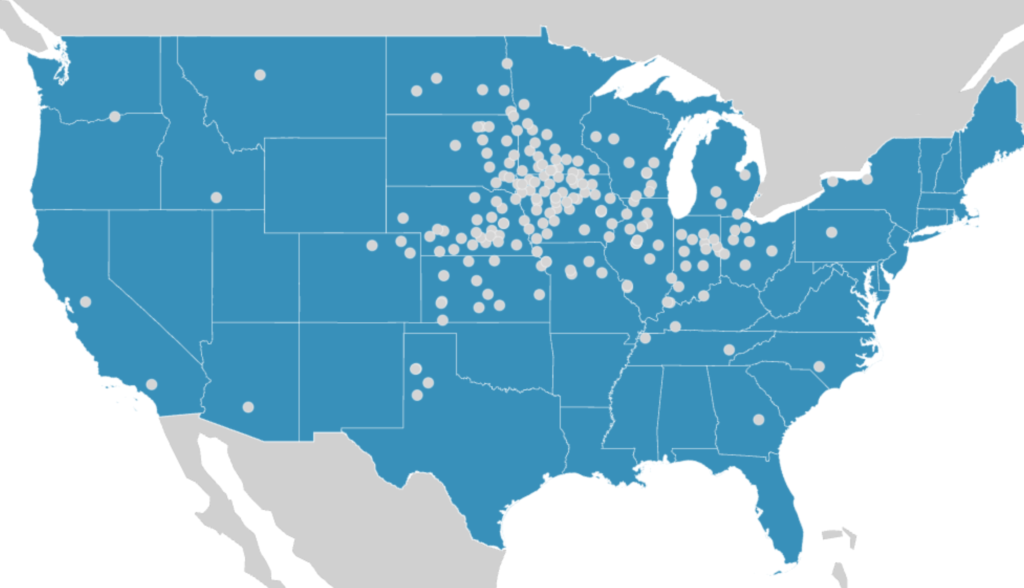
Image 2: Screenshot of Ethanol Plant Map
Source: Ethanol Producer Magazine
In essence, rural America is no monolith. Not everyone is a farmer; agriculture makes up only 6 percent of rural jobs. And not all rural communities benefit from ethanol production [see image 2].
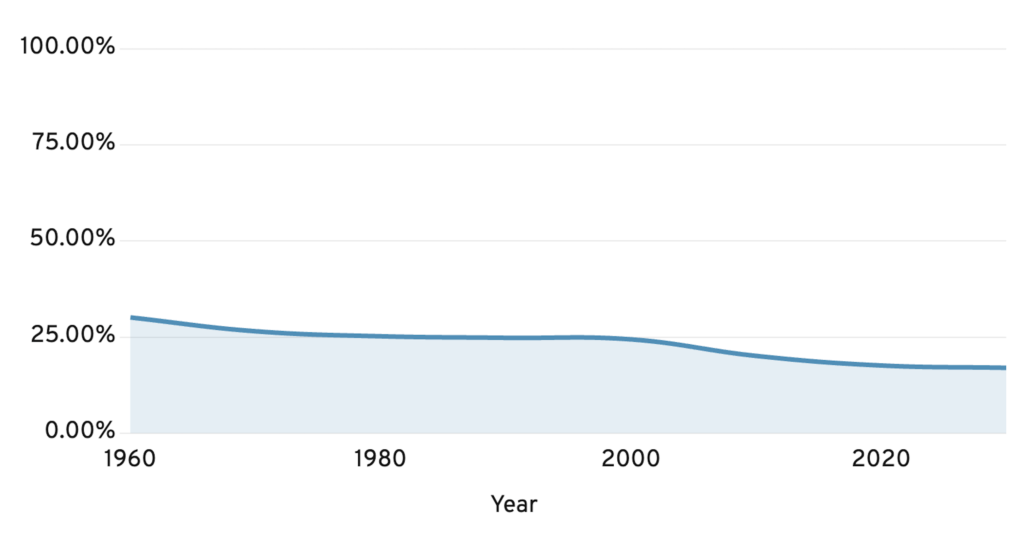
Second, so far ethanol production–from field to gas pump–has not been the windfall for rural communities that ethanol advocates describe. Region-to-region growth and decline is not uniform across rural areas, but overall rural populations have been on a downward trend for decades [see Figure 1].
Figure 1: Rural Population as a Percentage of Total U.S. Population
Source: https://www.macrotrends.net/datasets/global-metrics/countries/usa/united-states/rural-population
Figure 2 highlights data particularly relevant to the ethanol/biofuels industries from the beginning of the RFS–which gave producers a big initial boost–to 2022, the most recent year for which data from the U.S. Department of Agriculture’s (USDA) Census of Agriculture is available. From 2007, when the RFS was expanded, to 2022 rural populations continued to decline. Total farms fell. The number of farms that grew corn and soy fell. Median rural household incomes stayed below overall median household incomes and by a similar margin over the 15-year span.
Though some call the RFS the “single biggest positive program for rural America,” the data shows no major impact to the collective American rural community. Instead, corn ethanol has been a gold mine for some farmers in some rural areas, with median farm household income outpacing other households at an accelerating rate between 2007 and 2022. Though total farms, including farms growing corn and soy, dwindled, so too did total crop acres. This demonstrates that though some farms have been swallowed by consolidation, the big, exciting story of American farming isn’t one of decline, in dire need of federal intervention, but of almost ridiculous efficiency. Fewer commodity growers, on less land, have been generating record breaking harvests thanks to increased yields and improved technology.
If anything, this underappreciated success story should demonstrate that U.S. farm industry ingenuity and exceptionalism doesn’t need a Washington mandate to shift responsibility for their prosperity or the future of their communities onto other Americans.
Figure 2: Rural (Nonmetropolitan) Data Overview
| Year | 2007 | 2022 |
| Rural Americans as a percentage of total population | 19.73% | 16.92% |
| Total Farms | 2,204,792 | 1,900,487 |
| Corn for Grain Farms | 347,760 | 289,382 |
| Soy for Beans Farms | 279,110 | 270,851 |
| Relative Incomes | Farm Household income: $86,322 Median household income: $73,010 Median rural household income: $45,816 | Farm household income: $98,015 Median household income: $79,500 Median rural household income: $55,960 |
Ethanol Excuse #5: Consumer freedom!
The House-passed year-round E15 bill, is called the “The Nationwide Consumer and Fuel Retailer Choice Act of 2026,” to promote the fiction that authorizing year-round sales of E15 is about releasing a nation of drivers–no doubt pleading for more ethanol in their fuel–from the shackles of unfair air quality regulations. Advocates suggest that expanding access to E15 is simply about options, as if the marketplace for transportation fuels were the snack aisle with varieties of potato chips and not a highly regimented enterprise with strict rules dictating what fuels from what energy sources or materials producers must blend.
In a free market, drivers should be able to purchase their preferred fuel regardless of ethanol content. But RFS blending rules are out of step with consumer demand. Former RSI senior fellow Philip Rossetti explains, “…parts of the world that do not have mandates for ethanol consumption but that also have high gasoline prices, like Europe, do not blend ethanol into their fuel supplies at the same rate as the United States. This indicates that the RFS is forcing a greater consumption of ethanol than the market would normally pursue.”
So long as government plays a significant role, enforcing an increasingly unworkable ethanol mandate, “choice” has no practical meaning for consumers.
Ethanol Excuse #6: Cost Savings
Professed cost savings for consumers is the driving ethanol excuse of the day with ethanol producers promising savings of 10 to 30 cents per gallon, which would be an amazing windfall for consumers dealing with higher costs on everything from energy, to shelter, and food. Unfortunately, year round E15 is not a solution to our ongoing affordability crisis.
According to the EPA’s latest RFS rule, by nearly every measure increased ethanol is an added cost, both directly and indirectly, for consumers:
- Higher ethanol blends cost more to produce (see Table 2), undermining potential savings.
Table 2: Total Gasoline Costs
| Year | E10 cost/gallon | E15 cost/gallon |
| 2026 | $2.20 | $2.32 |
| 2027 | $2.14 | $2.27 |
Table 3: Other Costs from Higher Ethanol Blends
| Gas Station Infrastructure | $537 million in taxpayer funded grants for 2025. |
| Food expenditures | $2.65-3.19 billion (relative to no RFS baseline) |
| Lower gas mileage | The more ethanol displaces gasoline, the more frequently drivers have to fill the tank. |
| Environmental Harm | See Excuse #2. |
| Consumer restrictions | E15 is not suitable for all vehicles and can harm small engines like boats, motorcycles, and outdoor equipment. |
| Net Societal Benefit | -$17.9 billion (2026); -$20.8 billion (2027) |
| Congressional Budget Office (CBO) | $2.3 billion |
- Greater ethanol volumes require additional infrastructure for most gas stations, such as underground tanks and dispensers capable of withstanding the more corrosive fuel. For retailers, the vast majority of whom are small businesses with fewer than 20 employees, this can be a significant financial burden–particularly for a product with razor thin margins. To help defray this cost, the Department of Agriculture offers taxpayer funded grants to private businesses via the Higher Blends Infrastructure Incentive Program or HBIIP, which distributed $537 million in 2025.
- Increased ethanol blends raise the cost of every part of the food chain from livestock feed to transportation. Corn comprises 95 percent of livestock feedgrains, with about 40 percent of the annual total corn harvest going to cattle, hogs, and poultry–even more, 45 percent goes into gas tanks. Food costs have shot up nearly 30 percent since before the pandemic and continue to rise.
- Ethanol has a lower fuel economy than gasoline, by about one-third. As ethanol blends climb, the worsening gas mileage becomes more apparent, cancelling out potential savings from a “cheaper” fuel source.
- E15 isn’t for everyone. Not all vehicles can use blends greater than E10, and E15 is banned entirely for boats, motorcycles, and snowmobiles. E15 can also damage gasoline powered outdoor equipment like chainsaws, lawn mowers, or leaf blowers.
- EPA calculates the “societal benefit” of the current RFS rule by assigning a modest positive impact to energy security ($361-438 million), from which it subtracts the societal cost–pegged at a staggering $18.24 billion and $21.24 billion for 2026 and 2027 respectively, to arrive at a massive negative impact on society. This doesn’t include figures like higher food costs or any gains for ethanol producing communities. The EPA rightly characterizes this as a simple wealth “transfer” from consumers straight to the pockets of ethanol producers.
- CBO estimates that the year-round E15 bill would add $2.3 billion to the debt due to a poorly structured change to the current Small Refinery Exemption (SRE) process that would shift biofuel demand away from soy-based biodiesels toward corn-based ethanol–a move that could trigger federal farm subsidies as a result of lower prices.
It’s important to remember that these new costs come on top of more than $55 billion in subsidy payments for 2026 to the commodity growers who provide feedstocks for ethanol. In 2025 this included $40 billion in ad hoc disaster aid, 11.9 billion in crop insurance payments, and millions more for other programs. Some of these payments could become dramatically more generous due to reference price hikes in the One Big Beautiful Bill Act; part of $66 billion in agriculture subsidies over the next ten years.
Taken together, this is a crushing burden consumers are expected to bear on behalf of the ethanol industry, all for unlikely to materialize hypothetical savings.
Conclusion: RFS Excuses Are Running on Fumes
Ethanol apologists claim year-round E15 is necessary because “We just need to have a level playing field so that the industry can compete within the market.” It does not reflect well on a product to demand this degree of market manipulation. Across multiple factors, the scales are tipped in their favor, from mandates to subsidies that both encourage overproduction American drivers are expected to resolve.
Decision makers and consumers should be wary of Big Ethanol’s promises. Past excuses for the outsized role of the federal government in transportation fuels have proved unfounded time and time again. Americans have already accrued significant debt–some of it on behalf of the wealthy agribusinesses behind the push for more corn in our gas tanks–and cannot keep shouldering the weight of this status quo. American farmers are exceptionally productive, but neither our economy nor our checkbooks can sustain this success without significant changes.