The Knowledge in this Room
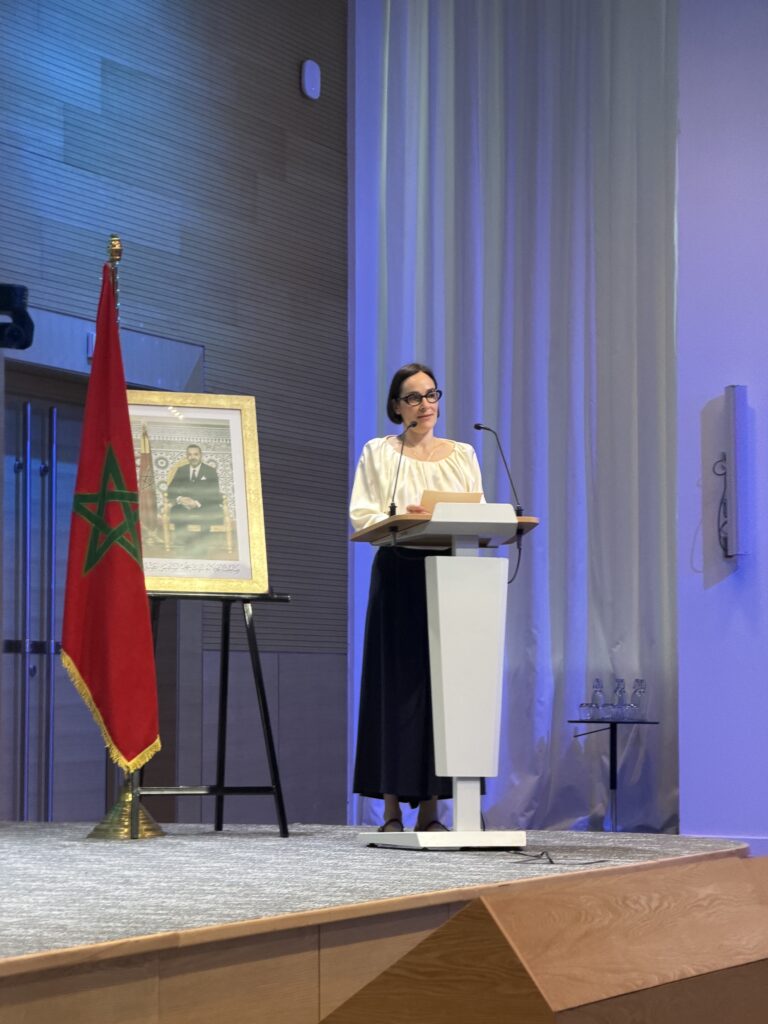
Transcript of RSI Executive Director, Erica Schoder’s speech at the OTT Conference in Rabat, Morocco, May 2026
The question, and the provocation.
Hello everyone. I’m going to talk about an obscure subject today. Artificial Intelligence.
Everyone in knowledge work is asking what to do about AI. It’s undoubtedly changing how we work.
But the most useful thing it’s doing right now is shining a light on where the value of our work actually comes from. And once you see that, everything from our business model to our daily workflows looks different.
So let me start here: can you have a think tank without people?
If that sounds like a wild question, I’d like to shift responsibility to a colleague from within this community, Joscha Wirtz, who made this provocation as far back as 2024. As provocations go, it was a good one. It lingered. But it didn’t fully land for me until late last year, when agent capabilities matured. AI agents aren’t just helping with our work. They can ostensibly produce what we produce. The research, the drafting, the outreach. The human who used to be in every step of that process can now be absent from all of it.
So, this begs the question, can you have a think tank without people?
I think the answer is no, we can’t have a think tank without people. But the reason might surprise you. And understanding why changes what we do next.
The answer is about knowledge. So let me tell you what I’ve learned about knowledge.
Two kinds of knowledge.
There is knowledge that exists. In our heads. It’s expressed in documents, in data. It’s also the judgment we’ve built over years of practice. You’ve brought that knowledge with you into this room. Your hard-won understanding of your domain, the expertise and experience you carry. That knowledge is real and it is valuable.
And there is knowledge that emerges from encounter. Over the course of these few days we are going to produce knowledge that doesn’t exist yet. In conversations, in disagreements, in the friction between your perspective and someone else’s. Especially when something is at stake for both of you. That knowledge will not be in anyone’s head until the encounter produces it.
Many of you already know this and we have been circling round it for years, in this community. Encounter, between humans, produces valuable knowledge. AI is what’s finally forcing us to say why — and to design for it.
At the last OTT conference in Johannesburg, Senzie Bengu, a researcher at the Institute for Security Studies, co-led a workshop. Chairs in a circle, no slides. And she opened with something I think about often. She said: all the knowledge we need is in this room.
At the time it felt like permission to stop gathering evidence and leverage my own experience and expertise. But as the year wore on, I realized this was a precise claim about knowledge. The knowledge we need is in this room because it doesn’t exist yet. It will be produced here, in the encounter between us. Not before.
What this means for AI.
So where does AI fit in this picture?
AI is remarkably good at working with knowledge that exists. Finding it, synthesizing it, analyzing it. If you need to compare regulatory frameworks across twelve jurisdictions, or a hundred or thousands of jurisdictions, AI has the potential to do that faster, and at greater scale, than our team can.
But choosing which comparison matters. Deciding which evidence to bring into the room and how it should be weighed. That is already encounter work. It happens between people with stakes in the outcome. The encounter is an act of constitution. What counts as evidence gets decided here, with our credibility staked on the answer.
AI can augment an encounter. But it cannot stand in for humans in one. The encounter changes us and changes the outcome. The human needs to be in it. And I don’t mean physically in a room. I mean engaged with someone whose consequences are entangled with yours when something has to be decided. That can happen across a table or across a continent. It can happen in real time or across months of working through a problem together.
When it comes to emerging knowledge, between humans, there is nothing for AI to surface, because the encounter hasn’t happened yet.
The stock depends on the flow.
Now, I want to tell you how the two kinds of knowledge are connected.
The judgment you carry into this room was built by doing. The policy expert who can sense when a coalition will hold learned that by building coalitions that didn’t. That judgment was built through encounter, over years, between people with real stakes. It is part of the stock of knowledge that already exists. And it is extraordinary.
But that stock needs replenishment. That judgment stays sharp because you keep having encounters. When the encounters stop, the judgment erodes.
AI draws on the stock of knowledge that humans built. The part built through encounter is the part that needs replenishment. If the encounters stop happening, the stock depletes.
That gives us a design specification. When AI handles the information processing, design deliberately for the encounters that build human judgment.
The everyday work of deciding together.
Think about what we actually do. We bring people together who have something at stake. Your version of this looks different from mine. But I think you’ll recognize the work.
At the R Street Institute we love to bring people together who disagree. Maybe it’s what we call strange bedfellows who have fundamentally different values but can agree on one specific outcome. Or, sometimes it’s people who fundamentally agree on values and principles but disagree on how to get somewhere. Let me give you an example. We built a coalition called the Civic Right. Conservative leaders, working to defend democratic norms from within their own movement, at a time when defending democratic norms was controversial on the right. The knowledge produced in those rooms, across two dozen convenings, over two years, was not just a set of policy recommendations. It was a community that could hold a position together that none of them could hold alone. That knowledge of what they could live with, what they could eventually agree on, was produced in the encounter.
That is the everyday work of producing knowledge, inside our organizations and with the people we serve. It is a capacity we build and sometimes neglect. We learn it by doing. We practice it every day.
The knowledge that matters most for this work is produced between people with real stakes. People who are accountable for decisions and their consequences, who face each other and come out different.
In fourteen years I can’t recall a single time a brief alone changed a legislator’s mind. What I can recall is the brief that sparked a question, which led to a conversation, which led to the shift. The brief opened the door. The encounter did the work.
But a policymaker can now tell an AI agent: find me the strongest case for this position, draft the coalition letter, identify the partners. They get exactly the information that they asked for. What they don’t get is the encounter that would have changed what they were asking for. They get a flat, frictionless deliverable. But they lose a workable outcome.
The question for every institution in this room is: Where was friction productive, how do we make sure to design for it?
Where the value actually lives.
So back to the provocation. Can you have a think tank without people?
We’ve positioned ourselves around evidence. AI arrives and does evidence remarkably well. So if anyone can produce the evidence, what are we for?
And to be honest, who read the 500-page report? We’ve been arguing about that at this conference for years.
So what was working? The encounters, the decision points woven all through its production. Not the report alone. The encounters all around it.
At our best, think tanks create evidence-informed encounters where people with stakes work through what they can act on. AI makes the evidence base deeper and faster. That means every encounter starts from a higher baseline. People walk into the room better equipped. The encounter does not replace the analysis. The analysis raises the quality of the encounter.
But the encounter is also inside the production of the evidence itself. The question we decide to ask. The framing we choose. That is encounter work, and it happens long before any convening takes place.
So here’s the test. Imagine AI had written our last white paper overnight. Let’s assume it’s good. The evidence is sound. Now ask: would the work succeed? Would it be impactful?
No. You get a technically sound report that nobody implements, because nobody was taken along.
We say the work matters because the analysis is right. But the analysis alone isn’t what endures. What endures is what the process built. The analyst whose judgment was sharpened by the evidence. The staffer who built trust with our team over six months. The stakeholders who, through consultation, changed the framing of the problem. None of those people come out of that the same. Their capacity to act together on the next challenge didn’t exist before the encounter and wouldn’t exist without it.
The process forms judgment. It builds trust. And it produces knowledge you can actually govern with. That knowledge only exists because people with stakes were in the encounter.
AI can get you ahead of people. It cannot get you ahead of the need for them.
The encounter isn’t the overhead around the real work. The encounter is where the real work happens.
That is the value. And that is why you cannot have a think tank without people.
Designing for it.
So what do we do with that?
First: make the invisible product visible and build demand for it. We produce value for our stakeholders we don’t currently name and capture.
Our funders need to see it. The people we work with need to see it. Right now, they experience the deliverable. They don’t see the encounters all around. From shaping the evidence to carrying it into the room where decisions get made, every step produced knowledge, judgment, and trust between people with stakes.
And here’s what makes this urgent. A think tank that uses AI to produce more papers, faster, looks healthier. But the encounters were embedded in the process of making those papers. If we don’t identify those sites of knowledge production, those decision points where new knowledge emerges, we could lose them. And we won’t notice, because the paper is visible and the rest isn’t.
Here’s one way to start. Take your last completed project. Imagine AI had produced the final deliverable overnight. Now ask: what is missing when AI does it alone? Make that list. That list is the invisible product.
Second: stop treating AI as an adoption question and start treating it as a design question.
Think about a junior colleague. Maybe a researcher, maybe a comms lead. This person spends two years learning to do the work by being in the work. Arguing about what the evidence means, figuring out how to carry it to the right audience.
All of this happens in encounters.
So, as we integrate AI into our work, we need to ask: which encounters do we want to keep? And which ones do we need to redesign?
Some of you will do this diagnostic and conclude that the right response is to not adopt these tools, for reasons that make sense in your context. Others will find that AI creates the opportunity to redesign encounters that weren’t working, to bring in voices that were never at the table, to bring new kinds of evidence to bear on questions we couldn’t have asked before.
What we each do with it will look different. I say this as someone working through it with my own organization. The design questions are the hardest. They’re also the ones that matter most, because we are designing what comes next.
Back to the room.
Which brings me back to this room.
Institutions like think tanks matter because AI cannot stake its name on what information means. We can.
But there is a kind of trust that institutional credibility alone cannot produce. The trust between people, who have worked through something hard together, and come out the other side with a shared understanding of what they can live with. That trust was built in the encounter. It didn’t exist before.
Producing that judgment and that knowledge and that trust is a choice we make deliberately. That is the choice in front of every institution in this room.
The most important knowledge we’ll produce this week isn’t in our heads, waiting to be shared. If it were, we could just stop right now. you could survey us all and synthesize our expertise. And I’m sure AI could do that quite well.
Instead the knowledge we need this week will be produced here in the encounters between us. That knowledge simply doesn’t exist yet.
Everything I’ve said today, I’ve been sensemaking from the knowledge this community has produced over years of encounter with one another.
That is why I’m confident that all the knowledge we need is in this room.
This conference is a knowledge-producing event. And this talk is the occasion for the first encounter. So let’s get started. Who wants to go first?