
Separating Private Selections from Public Elections Part 3: How could a privatized-party system affect general elections?
This is the final installment in a three-part series on improving America’s candidate selection system by privatizing political parties. Read the series overview and see other posts here.
Part 2 of this series discussed privatizing political parties by ending taxpayer funding for party nominations, eliminating legal privileges, and ensuring equitable access to the general-election ballot. This final piece explains how elections could function in such an environment. States should remain free to choose the electoral methods that work best for them, provided they foster genuine competition in the general election and produce a clear winner, even from a crowded field.
While no state currently uses the privatized-party system described in this series, several states—including Louisiana, California, Washington, and Alaska—utilize individual elements that demonstrate how it could work. Their experiences offer useful road maps for separating private candidate selection from public elections.
Equal Access to the General-Election Ballot
Once privatized, parties would be free to select their preferred candidates in whatever way they wish, whether through primaries, caucuses, conventions, party committees, superdelegates, or another method. While those contests would determine which candidates received their parties’ endorsements, they would not determine who qualified for the public ballot.
Instead, states would establish a uniform standard, such as a signature threshold, for access to the general election. Every candidate would have to meet that standard, whether nominated by a major party, endorsed by a smaller political organization, or running without party support. The threshold should be high enough to prevent frivolous candidacies without becoming so demanding that only established parties and well-funded candidates could satisfy it.
One alternative to signature gathering is a refundable filing fee. In the United Kingdom, candidates for Parliament must pay a £500 deposit. The money is returned if the candidate receives more than 5 percent of the valid vote. A similar system could provide an accessible route to the ballot while discouraging candidates with no meaningful support. States could also allow candidates to choose between collecting signatures and paying a refundable fee.
Sore-loser laws, which prevent candidates who lose a party primary from reappearing on the general-election ballot as independents or nominees of another party, should also be eliminated. Anyone who meets the uniform qualification standard may compete in the general election, including multiple candidates affiliated with the same party. A candidate who fails to receive a party’s endorsement could still appeal directly to voters. This would reduce the power of a party nomination to a legal gatekeeping device, particularly in places where one party is so dominant that winning its nomination is effectively equivalent to winning office. Under this system, ballot design would become especially important to ensure that party endorsements carry weight without excluding competition.
Ballot Design for Informed Voting
A privatized-party system paired with thoughtful ballot design could allow for increased competition while giving voters meaningful information needed to distinguish among candidates.
On the ballot, candidates could state their partisan preference, if any, and provide a brief self-description, such as fiscal conservative, public school teacher, or progressive. States should establish neutral rules governing the length and content of these descriptions so that election administrators do not have to judge the accuracy of a candidate’s political beliefs.
Partisan preference should also be clearly distinguished from party endorsement. Candidates could describe their own political identity, but parties should be permitted to indicate separately which candidate, if any, holds their official endorsement. This would preserve the party’s ability to communicate with voters without giving its preferred candidate automatic ballot access.
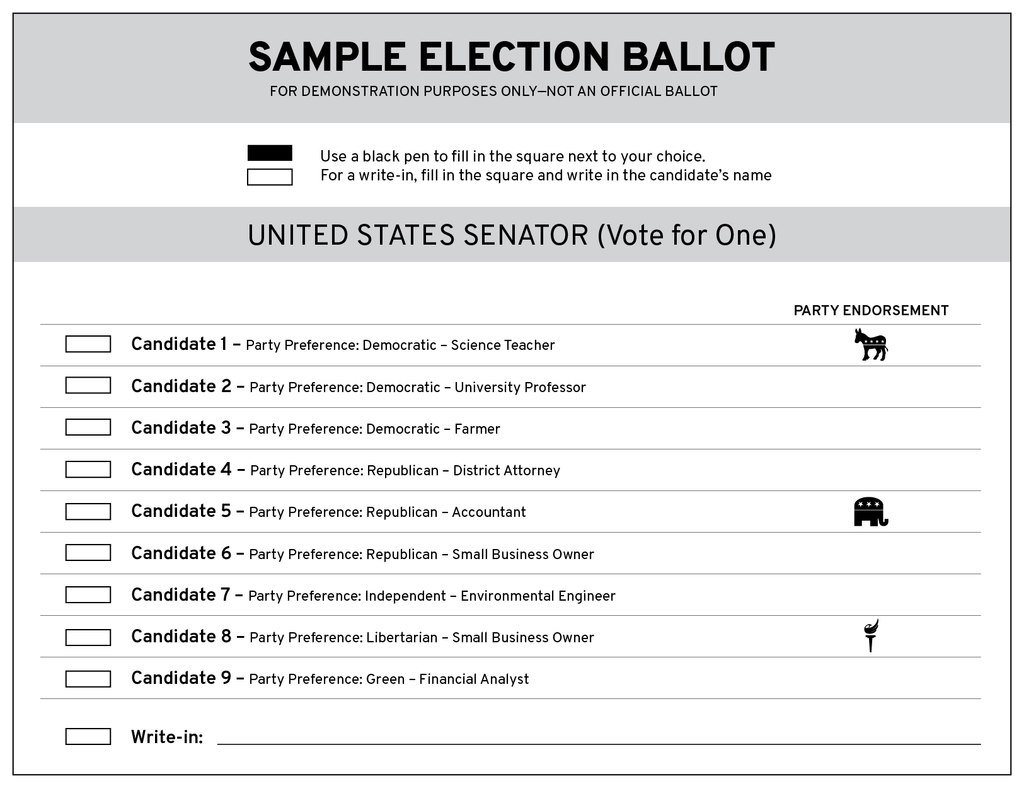
States that wish to do so could also permit multiple parties or civil-society organizations to endorse the same candidate on the ballot. Known as fusion voting, this practice would allow organizations to demonstrate their support while maintaining their own identities. Whatever approach a state adopts, the governing principle should be that party labels provide information rather than privileged access to the election.
Producing a Clear Winner
A larger and more competitive field creates another challenge for election institutions: A candidate might win office with only a small plurality of the vote, allowing them to succeed without broad popular support. To address this problem, states would need a method for narrowing the field or determining which candidate has majority support. Fortunately, legislators have several models from which to choose.
The most straightforward is Louisiana’s traditional system. Louisiana places all candidates for an office on a single ballot, regardless of party affiliation. If one candidate wins a majority in the first round, then that candidate is elected. Otherwise, the top two vote-getters advance to a runoff that determines the winner. This model demonstrates how a crowded general-election field can shrink to two candidates without a small plurality determining the winner.
California and Washington use a related but distinct approach. All candidates appear together in a publicly administered primary, with the top two advancing to the general election regardless of party affiliation. Unlike in Louisiana, a candidate generally cannot win outright in the first round simply by receiving a majority. Under a privatized-party system, this initial contest would function only as a qualifying round for the general election.
Alaska advances four candidates from an all-candidate primary and uses ranked-choice voting in the general election. Voters rank the candidates in order of preference. If no candidate receives a majority of first-choice votes, then the candidate with the fewest votes is eliminated and those ballots transferred to each voter’s next-ranked candidate. The process continues until one candidate receives a majority.
Each model addresses the problem differently:
- Louisiana guarantees a majority winner through a second election.
- California and Washington narrow the field before the general election.
- Alaska preserves more choices in the general election and uses an instant runoff to identify a majority winner.
These approaches also carry different costs and trade-offs. A conventional runoff is simple to understand but requires another election. A top-two system guarantees a manageable ballot but may exclude broadly acceptable candidates before turnout reaches general-election levels. Ranked-choice voting avoids a separate runoff but asks voters to adopt a less familiar process.
Elections and Federalism
States can and should adapt these models to their local circumstances, allowing the strengths of American federalism to prevail. One state might advance three candidates to a general election and hold a conventional runoff if no one wins a majority. Another might avoid a runoff whenever the first-round leader receives more than 40 percent of the vote and finishes at least 10 percentage points ahead of the second-place candidate. A third might place every qualified candidate directly on the general-election ballot and use ranked-choice voting to determine the winner.
States would need to balance several goals: preserving voter choice, keeping ballots manageable, limiting election costs, producing a clear winner, and ensuring that the decisive election attracts broad participation. No single system will resolve every tension, and different states may reasonably reach different conclusions. State legislatures should function as the laboratories of democracy they are meant to be.
Conclusion
Under a privatized-party system, candidate selection would be clearly separated from the public electoral process. Parties would choose whom to endorse, and voters would choose whom to elect. The general election, where participation is broadest, should be the decisive stage of an election.
States would remain free to design ballots and election systems that fit their own political cultures, but every system would follow the same basic principles: equal access, meaningful information, genuine competition, and a clear winner. Privatizing political parties offers a path toward restoring that distinction and strengthening the American republic.