
Modernizing Virginia’s Court Notification System to Reduce Failures to Appear
Many missed court appearances happen not out of defiance, but because people simply forget or misunderstand the process. Yet under Virginia’s current system, defendants must proactively opt in to receive hearing reminders—often by completing multiple steps that can be hard to find and easy to overlook. Consequently, participation is minimal. Enrollment rates as low as 2 percent in states with similar systems have left many without timely notice of their obligations.
SB475 and HB885 would address this problem by modernizing Virginia’s court notification system. Automated court reminders offer a practical and proven alternative. By using contact information collected at first contact—typically during arrest or citation—courts can send brief, timely messages about upcoming hearings and the consequences of not attending. Studies consistently show that these systems reduce failure-to-appear (FTA) rates by 20 to 40 percent, with some reporting reductions as great as 60 percent.
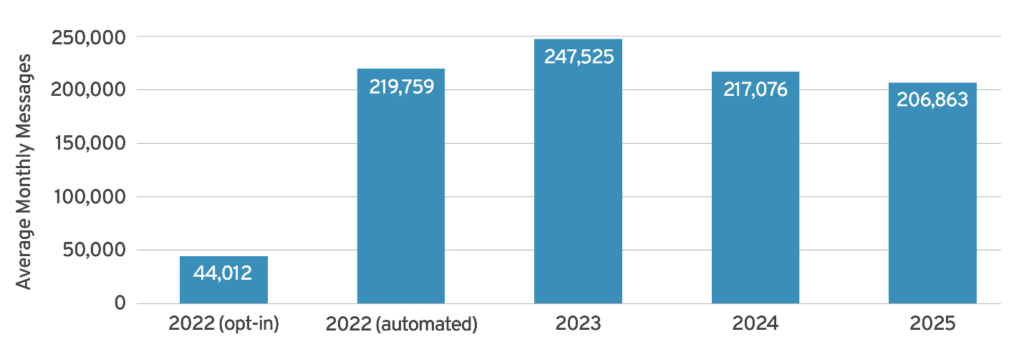
As an example, the following chart shows the average monthly enrollment in Colorado’s court reminder program both before and after automated text reminders were implemented in 2022.
Colorado Opt-in vs. Automated Reminders
Source: https://www.coloradojudicial.gov/text-reminder.
Reminders are not only common at this point—they are expected. Most businesses now provide automatic courtesy notifications, such as for dental appointments or dinner reservations. But unlike missing an appointment, failing to appear in court can have severe consequences. A simple oversight can lead to arrest and detention, costing the justice system an estimated $1,496 per FTA. Automated reminders offer a low-cost, high-impact way to reduce these disruptions and save court and law enforcement resources.
How many missed court dates will this actually prevent in Virginia?
Roughly 11,000 individuals are charged with FTA in Virginia each year. But that figure understates the problem, as it counts only formal charges while excluding cases that lead to capias (bench warrant), driver’s license suspension, or trial in absentia instead. The true number of missed court appearances is likely far higher. Even using conservative estimates, automated court reminders could help ensure that approximately 2,200 to 4,400 additional Virginians appear in court each year.
What evidence do we have from other states to prove this works?
Automated court reminders have consistently reduced FTAs in jurisdictions across the country. For example, a text-message pilot program in New York City reduced criminal court FTAs by 26 percent. Comparable results include a 25 percent reduction in bench warrants for nonappearance in Hennepin County, Minnesota, and a 34 percent reduction in FTAs in Jefferson County, Colorado. More recently, a randomized controlled study out of California found that individuals who received court reminders experienced a 20 percent reduction in pretrial incarceration.
States that have adopted automated court reminder systems—including Arizona, Colorado, Indiana, New Hampshire, New Mexico, and Texas—offer examples of how reminders can be integrated into court operations. Reminder programs can generally be implemented using existing court scheduling systems or low-cost vendors, with evidence suggesting a cost of only a fraction of a dollar per case and savings generated by reducing missed appearances.
Are we sure automated reminders do not shift responsibility away from the defendant?
Automated court reminders do not replace personal responsibility; rather, they support it. Studies consistently show these reminders reduce FTA rates by nearly a third (or more). That means more people showing up, engaging with the legal process, and resolving their cases. Rather than shifting responsibility, reminders remove avoidable challenges and help defendants follow through on their obligations. They benefit victims as well by reducing delays, minimizing case disruptions, and helping ensure timely resolution.
How can we ensure defendants do not face increased legal exposure?
Helping people appear in court reduces FTA charges, bench warrants, and the cascading consequences that often follow. Legislation also prevents law enforcement and other government agencies from using phone numbers collected for court reminders in any investigative, intelligence, or enforcement capacity. This protects defendants from new legal exposure and ensures that reminder systems serve only their intended administrative purpose.
What is the cost to implement and maintain this system statewide compared to what we spend now on the consequences of failing to appear?
Virginia has already taken steps to modernize court communications through the Case Alert Subscription System (CASS), which provides email and text updates about case events. While expanding CASS into a comprehensive automated reminder system would require upgrades, the existing infrastructure offers a strong foundation.
Courts would still need resources to support implementation, and cost estimates vary. Many jurisdictions have used vendor-based solutions, such as eCourtDate or similar services, to reduce development burdens and control costs. Available data indicates that states have paid between $35,000 and $600,000 to implement full reminder systems, including upgrades and vendor services.
Ongoing costs are low. Studies show text message reminders can cost under $1 per case while saving the system millions by reducing hearing delays, bench warrant executions, and jail use.