
Finding oases in America’s “news deserts,” a view from Georgia
Ask any journalist who worked in the 1980s and 1990s, and they’re likely to nostalgically recall those times as media’s heyday. Newsrooms were bustling with life and at times chaotic. Consumers hung on journalists’ every word, and the business of news was booming.
“In 1990, we were heading into the salad days of American newspapering,” remarked Mike King, a former Atlanta Journal-Constitution editor. “You had to (screw) up to not make a lot of money. And we made a lot of money. Next to selling drugs on the street, it was the most profitable thing you could do.”
While King’s statement is imbued with more than a hint of hyperbole, it is one that countless others can understand. The industry was flush with cash. In 1999, for example, newspapers reported an average profit margin of 22.2%. Yet with the rise of the digital age, the economic foundation sustaining journalism began to disintegrate. While news outlets continued to thrive in the early digital era, their prosperous coexistence proved temporary. I spoke with three Georgia-based newspaper editors—Clay Neely, Carlton Fletcher, and Joshua Wilson—to learn more about their experiences with the changing landscape.
“In hindsight, I think we were willfully ignorant of what was coming—there was an arrogance to it, an unwillingness to adapt. It’s easy to put that on news leaders alone, but the truth is our industry was ripe for the taking,” Joshua Wilson, former executive editor of The Macon Melody, noted in a recent interview.
What followed was a steep decline in revenue for local news—a slide that continues to this day. People increasingly placed their classifieds online and advertisers purchased social media, search engine and other forms of internet ads, rather than with newspapers. Meanwhile, e-commerce undermined brick-and-mortar stores, which in turn could no longer sponsor newspaper ads at the same rate. Readers also began terminating newspaper subscriptions and opted to get their news online. Together, these trends upended local news’ centuries-old business model, leaving the industry exposed to the cold calculus of economics and needing to innovate.
The digital revolution ravaged the ranks of local news across the nation, and Georgia outlets have not been spared from this. However, thousands of innovative outfits in Georgia and elsewhere have defied the odds and continue to deliver the news. They have done so, in large part, not by depending on government assistance but by adapting their business models. While there is no panacea to fix the current crisis, their examples can provide a blueprint for preserving the civic good of local news.
Legacy media’s tailspin
In retrospect, the results of the digital age’s emergence should have been just as easily predicted as they are stunning. According to Northwestern University’s Medill Local News Initiative, nearly 40% of all newspapers in the United States disappeared from 2005 to 2025, including some notable closures in Georgia. They are among the nearly 3,500 American papers that no longer exist and cannot employ industry professionals. In 2005, there were around 365,500 people working in the newspaper business. By 2024, that number shrank to only 91,550.
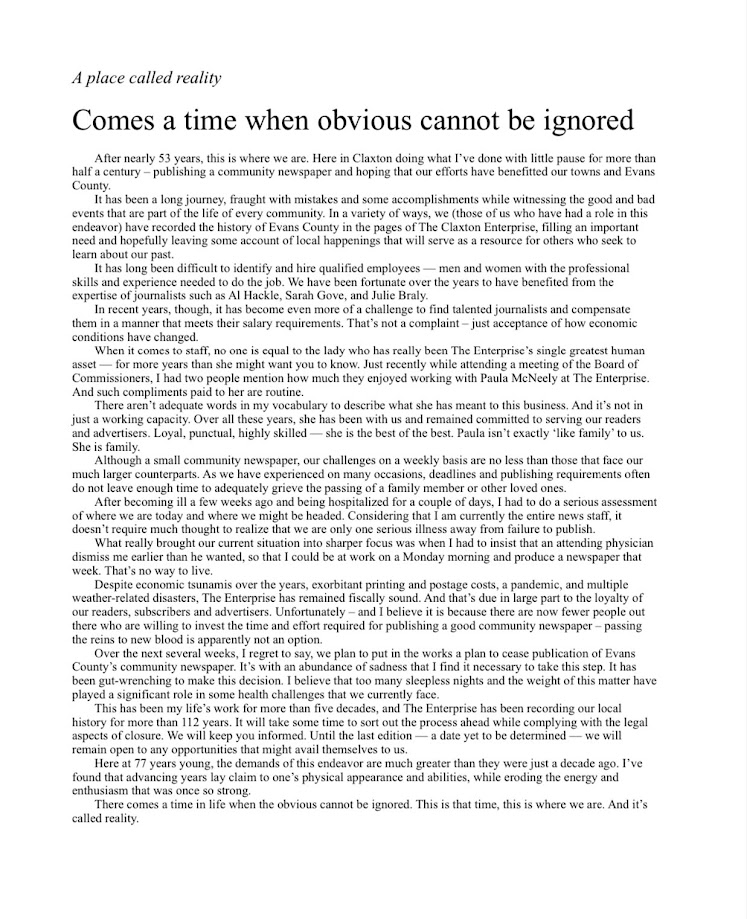
The number of full-time journalists in particular has fallen by 75% since 2002, creating a deficit of around 30,000 journalists. The pain is felt at large and small outfits alike, even in the Peach State. “The newspaper for which I work once had a newsroom of 30-40 reporters,” Carlton Fletcher, editor of the Albany Herald recalled in a discussion about media’s transformation. “Now, we have three.” Meanwhile, the Atlanta Journal-Constitution’s newsroom has shrunk by more than 60%.
The collapse of large segments of legacy media has also created vast “news deserts” where local news is hard to come by. As of 2025, 1,737 counties were without a local news outlet or only had one. Of Georgia’s 159 counties, 16 have no local news outlets and the overwhelming majority of its counties have only one source. Nationally, some 50 million Americans live in a county with severely diminished or no access whatsoever to local news.
Some states are worse than others. Georgia, for instance, has the dubious distinction of having more residents—5 million—living in one of these underserved counties than any other state. Texas, North Carolina, and Kentucky follow with 4 million, 2.9 million and 2.38 million, respectively. Not-so-surprisingly, rural areas account for nearly 80% of news deserts.
Many more outlets will vanish too, and recent research has identified some predictive indicators. Those located in large population centers are more likely to survive, as are those in areas experiencing economic growth, according to an article published in Journalism & Mass Communication Quarterly. Meanwhile, newspapers in communities with growing populations and higher levels of racial diversity are often more likely to struggle to remain in business.
This comes despite some promising polling numbers. While trust in mass media has fallen to a record low—only 28% of Americans trust it as of 2025—local news seems to fare better in some ways. A 2024 survey found that 85% of Americans believe local media is at least somewhat important, and large majorities think local outlets are doing a good job at being transparent, reporting accurately, covering important stories, and keeping tabs on local officials.
That’s the good news. The bad news is that almost two-thirds of respondents believe that their local media outlets are doing at least somewhat well financially, despite many barely scraping by, and only 15% said they had paid for local news in the past year. The number one reason people claimed they didn’t pay for news was because they could find it free of charge elsewhere.
Compounding the problem, the number of people very closely following local news stands at a paltry 22%, and consumers are becoming less likely to get news from local journalistic sources. Only 33% claimed to sometimes get it from local daily newspapers (online or print), while the number was far higher for other sources: 73% received their news at least sometimes from friends and family and 52% from online forums.
The recent decline of local news and readers’ gravitation toward questionable news sources can have a deleterious effect on society. Studies have shown that the loss of local news outlets is associated with increased political polarization, fiscal irresponsibility among local officials, and much more. Effective reporting, on the other hand, helps keep government accountable, curtail public corruption, inform readers about electoral candidates and their positions, and increase voter participation. Local news also can provide updates on community events, developments with your neighbors, obituaries, and even recipes.
“Newspapers have been woven into the fabric of American communities for generations,” Clay Neely of the Georgia-based Newnan Times-Herald remarked in an email exchange. “If they disappear entirely, communities may eventually realize they lost more than a business. They lost part of the civic memory and connective tissue of the community itself.” In some ways, local news helps bind communities together and has made us better in the process. With its decline, this is all at risk—leaving officials and media members scrambling for answers.
The prospect of an industry bailout
As the news industry faces mounting challenges, a chorus of media professionals asking for government assistance has grown ever louder, and why not? The government has a long track record of bailing out troubled industries. Nonetheless, this would be highly problematic, especially in media.
To begin with, there is limited appetite at the federal level to provide financial assistance to news organizations. In fact, Congress ended long-standing support to the Corporation for Public Broadcasting, which funds NPR, PBS and their local affiliates—rescinding over $1 billion in the process. These cuts seem to have stemmed from political motivations rather than budgetary considerations, but when the federal government is running nearly $2 trillion deficits and has a national debt of almost $40 trillion, difficult budget cuts make sense. Even if the U.S. government wasn’t bogged down in a financial quagmire, questions would remain about whether Washington should subsidize one industry over another.
In the absence of federal action, states have begun exploring ways to bolster local news. Illinois enacted a limited system of tax credits for news outlets that hire journalists. California funds a fellowship program to train and pay new journalists and created a public-private partnership to provide grants to newsrooms. Meanwhile, other states have mulled different kinds of tax credits, subsidies, and grants for news outlets, although most states seem highly reluctant to pursue them. This likely includes Georgia, where lawmakers have been actively working to dismantle tax credits for private enterprise.
In addition to budgetary and philosophical opposition to providing a financial safety net, many politicians are skeptical of the media, which muddles matters even more. “Now, with the shift to federal and state governments who see journalists as their ‘enemy,’ it [becomes] even less likely that any support will come from that area,” according to Fletcher.
News outlets themselves ought to be wary of accepting government assistance unless it is absolutely necessary. If it ever arrives, it may come with strings attached that limit editorial independence and become contingent upon the government and certain politicians receiving good press. At worst, that could turn a free and independent media into state-sponsored propaganda, or journalists may self-censor so that they don’t run afoul of thin-skinned government officials who control the purse-strings. At best, targeted, temporary government assistance could help keep media afloat, but such proposals deserve ample scrutiny because they are fraught with potential pitfalls and require careful navigation.
While many in media have looked to the government for help, not all do. “Honestly, I don’t think most local publishers are looking for a government bailout,” explained Neely. “We’re mostly asking lawmakers not to unintentionally accelerate the collapse of local journalism.” That can take numerous forms, including preserving long-standing revenue sources mandated by law.
One example is requiring public notices—related to foreclosures and seizures, probate court proceedings, public hearing announcements and so forth—to be published in local organ newspapers. These have long been a crucial source of income for newspapers in Georgia and elsewhere. To Neely’s point, he is simply asking that lawmakers eschew any action, like repealing public notice laws, that would actively undermine local news’ tenuous business model. That may be the best government intervention media members can hope for, at least in Georgia.
Comprehensive aid from the federal government and most states seems unlikely in the current environment. This leaves private enterprise with little choice but to adapt its business models to meet modern realities.
New models for newspapers
The fact that so many newspapers are managing to survive, despite around 40% of others disappearing since 2005, demonstrates that this may not be an extinction event. There are numerous paths forward for pioneering news outlets, although there is no one-size-fits-all solution, but some combination of approaches is necessary for their survival.
One method of cutting costs is for newspapers to transition from a for-profit entity to a non-profit to spare them from federal corporate income taxes and more easily permit them to receive grants from private foundations.
They can do this now, and many have already gone down this path to their benefit. However, it can be a convoluted process and no IRS non-profit status fits well with newspapers. There are 29 non-profit 501(c) categories covering a broad range of institutions, and while journalism nonprofits generally fall under 501(c)(3), this status curtails press freedom. It mandates that organizations be educational and avoid politics. Traditional news organizations do not easily coexist with these requirements.
As R Street Institute President Eli Lehrer has suggested previously, the federal government ought to consider establishing a new non-profit designation for outlets that publish public affairs and reinvest their revenue for that cause. Under this proposed tax status, entities wouldn’t be entirely reliant on donations, could engage in politics and perhaps even endorse candidates, and would retain First Amendment protections identical to those of other news organizations. What’s more, the government could formalize a process allowing news outlets to self-certify that they meet the requirements of a non-profit to avoid the complex, bureaucratic process of incorporating as a non-profit.
This is one approach to cutting costs, but far more common strategies include reducing or eliminating print newspapers. The Atlanta Journal-Constitution made waves when it announced that it would no longer issue daily print editions. The Albany Herald moved to print editions three times a week, and the Newnan Times-Herald twice a week. This has been a common cost-saving approach at papers across the country and represents changing preferences. Roughly 66% of Americans who consume local news do so via a digital source, like social media, apps or websites. Only 31% get it from print—a number that is in decline—and limiting the kind of coverage papers provide can likewise lead to cost savings.
“We made the decision years ago to prioritize local reporting over national wire content,” Neely continued. “The cost of maintaining wire services could instead fund another local reporter.” There is probably little risk in taking this approach. In Fletcher’s opinion, few people get their national or international news from local papers. They get that elsewhere, and accepting this reality can free outlets of costly wire services and permit them to focus on the product that they are uniquely positioned to provide: local news.
Joint Operating Agreements, AI, and printing
Outlets can provide local news even more efficiently by pooling expensive resources, like staff attorneys, advertising, printing, databases and design services, with other outlets. One way of doing this is through Joint Operating Agreements (JOAs), which allow them to maintain their newsroom independence while sharing non-editorial costs with their competitors.
Since 1970, federal law has recognized the idea that newspapers with separate, competing editorial operations should be able to pool certain kinds of business expenses through JOAs in ways that anti-trust law otherwise doesn’t allow. However, the current legal framework for JOAs—which is limited to publications that publish on newsprint, mandates enormous compliance legal costs and requires formal approval from the attorney general of the United States—is a dead letter.
While around 30 such federally certified JOAs once existed, none remain as of 2026. The idea deserves a new life. New laws creating a framework for easy-to-set-up, self-certified news cooperatives similar to JOAs could revive this principle and help facilitate the emergence of new business models.
Another method of increasing efficiency is integrating artificial intelligence (AI) into newsroom workflows. By now, practically all news agencies have begun experimenting with AI, if not making it a critical component in their operations. AI can assist with deep research, summarize complex documents, copy edit, and provide limited forms of event coverage. In fact, the Atlanta Journal-Constitution began using an AI bot as early as 2022 to expand reporting coverage of high-school sports. That was just the beginning for many papers, including the Macon Melody and Newnan Times-Herald, that have found creative ways to benefit from AI.
“We already use AI tools to help with grammar checks, transcription and even brainstorming new angles on stories. In a small newsroom where people are stretched thin, those efficiencies matter,” explained Neely. However, without adequate human oversight, AI-use has its limitations, and the standards for the appropriate uses of AI-created news content is still evolving.
“Newsgathering agencies that have begun to rely on AI for ‘coverage’ of events are turning out content that includes inaccuracies, poorly worded sentences and ‘heartless’ articles. I think there is AI-generated content that fails to accurately portray an event and leaves questions that might better be answered by a journalist on the scene,” Fletcher said. In short, AI may enhance newsroom efficiency and benefit journalists in many ways, but it cannot completely replace on-the-ground reporting currently. Be sure that it will greatly improve in the years to come and assume a larger role in newsrooms, and as Wilson asserted, news organizations cannot afford to fear AI, because if they do, then they risk falling behind yet another technological revolution.
AI’s rise may cut both ways, however, because it could also undermine revenue models supporting news agencies. “Someone can now ask ChatGPT, ‘What’s happening in Newnan?’ and instantly get a clean summary of stories our journalists spent weeks reporting,” Neely pointed out. “The user gets the information without ever visiting the website, seeing an ad or paying for the reporting that produced it. That creates a serious sustainability problem.”
While there are myriad ways of cutting costs, newspapers still need to generate revenue to serve their communities. The traditional revenue streams will continue to be important, but they are not enough to sustain local outlets. To meet this challenge, revenue needs to be further diversified.
Papers across the country have experimented with this, including offering newsletters (both paid and free) with ad space and other premium or ad-sponsored products like podcasts and emerging mediums. “We have to be relevant to our audience and be where their eyeballs are. Right now, that means screens and short-form video feeds […] You have to deliver the journalism where people will actually see it, which means staying adaptive and ready for whatever comes next,” Wilson said.
Other outlets have gotten even more creative at diversifying income streams. Some local newspapers are using their printing and paper facilities for other business ventures to generate revenue to stay in business. This is not an entirely new concept, though. The Washington Post, for example, has for years maintained a design and printing service under the guise of WP Print Solutions.
Outside help
In other cases, philanthropic organizations have offered news outlets lifelines. In just the span of six years, local news shops have received over $1 billion in grants. This has gone far to keep some afloat, but there is not enough funding to support all local news and the overwhelming majority of such funds go to urban or metropolitan-based papers, which have proven more adept at writing grant applications.
This is not a universal experience. The Peach State boasts the Georgia Trust for Local News, which is a subsidiary of the non-profit National Trust for Local News, and consists of 18 local outlets, including the Macon Melody and Albany Herald, in middle Georgia. “Its newspapers are part of a nonprofit whose funding comes primarily from philanthropic giving,” Fletcher noted. Without the trust, roughly 37 Georgia communities could be at risk of losing one of their prized local news sources. Trusts in Colorado and Maine work similarly.
Working with local colleges likewise presents some unique opportunities. Partnerships can open the door to obtaining interns majoring in journalism, essentially providing outlets with free or highly subsidized talent. Examples spanning the country have shown the promise of another kind of an educational partnership. Universities with journalism departments in Georgia, Iowa, Missouri, and other states have been purchasing, investing in or assuming control of struggling local newspapers, thereby keeping them open and, in some instances, their staff employed.
In Georgia’s case, the Oglethorpe Echo announced plans to cease operations after nearly 150 years of serving the community, which caused an outcry. After a few well-timed meetings, the owner resolved to donate it, rather than seeing it close. New leadership transitioned it into a non-profit, and the University of Georgia’s Grady College of Journalism and Mass Communications agreed to play a large role in keeping it open. It did so, in part, by allowing UGA journalism students—under the direction of faculty—to work at the paper and keep it in business.
This approach also provides colleges with training grounds for prospective journalists, although more needs to be done to replenish the depleted ranks of reporters. Working with local news outlets to keep them in operation is one approach. After all, why would anyone major in journalism if there were no employers left?
First Amendment protections for students
Another strategy involves avoiding activities that discourage journalism students. For instance, students reporting for school papers can face more scrutiny than their college and high school peers thanks to the 1988 Hazelwood v. Kuhlmeier decision and subsequent rulings. The case centered around a high-school principal who censored stories in the school-sponsored newspaper.
According to the Administrative Office of the U.S. Courts, “In a 5-3 ruling, the U.S. Supreme Court held that the principal’s actions did not violate the students’ free speech rights. The Court noted that the paper was sponsored by the school and, as such, the school had a legitimate interest in preventing the publication of articles that it deemed inappropriate and that might appear to have the imprimatur of the school. Specifically, the Court noted that the paper was not intended as a public forum in which everyone could share views.”
This was a marked departure from longstanding precedent that offered student journalists robust First Amendment protections. According to the 1969 Tinker v. Des Moines Independent Community School District decision, students retain their First Amendment rights even when they are in school, but Hazelwood v. Kuhlmeier curtailed those protections for many student journalists.
While that decision only affected public high schools, the 2005 Hosty v. Carter case opened the door to applying a similar standard at public colleges. Combined, these cases have emboldened many school officials to take greater censorship license, to not only eliminate stories that may be legitimately inappropriate, but also those exposing scandals or presenting points of view that administrators simply do not like.
Quashing stories of would-be journalists is an effective way to steer them away from learning how to conduct hard-hitting reporting and possibly away from a career in an important field. Today, 18 states have enacted so-called “New Voices” legislation to enshrine student press rights against unreasonable censorship. Other states, including Georgia, have considered similar legislation, which if passed could help foster a new generation of journalists.
Conclusion
While local news has experienced decades of setbacks, thousands of outfits have found ways to persevere, including 213 total news outlets in Georgia. Local journalism’s fate remains uncertain, but it seems like it can survive without government handouts. That doesn’t mean there is no government role. The most important approach for policymakers is to reject actions that further encumber the media or may inadvertently cause its demise. More states, like Georgia, could also consider enacting “New Voices” legislation, and the federal government ought to explore the feasibility of a new non-profit status for media outlets and reforming the framework governing JOAs.
There are concrete steps for government officials to mull, but savvy newsgroups will ultimately assure their own survival regardless of any legislative action. Between switching to a non-profit status, securing philanthropic funding and experimenting with new business models, there are viable paths forward. While it may never again reach the profitable heights of the late 20th century, if local news continues to focus on the one thing it can do better than anyone else – reporting local news – then there is a future.
“While the ‘news snobs’ among us probably sneered a bit at the idea of covering less important local events, now the people who ‘get it’ realize that [local news is] really the only ‘untapped’ news that’s available for coverage,” explained Fletcher.
Despite the widespread pessimism around the survival of local news, there is reason for cautious optimism. In addition to the outlets that have navigated the gauntlet of challenges, hundreds of local news startups have launched in the United States between 2020 and 2025, including some in Georgia, like The Macon Melody, which is the Georgia Trust for Local News’ flagship outlet, and The Current.
The latter is a digital outlet that was founded as a non-profit in September 2020, and it generates revenue in numerous ways, including through donations, memberships, and corporate and philanthropic partnerships. The Current also fills an important gap by providing reporting on Savannah and Georgia’s coastal regions, which includes communities that would otherwise be at risk of becoming news deserts. Despite being a relatively new upstart, the organization boasts a sizable staff and provides opportunities for many journalism students.
Alternatives to traditional news sources are also on the rise, like publishing via Substack or on blogs. These provide incomplete coverage and may not universally hold themselves to journalistic standards, but they help fill gaps in news coverage, nonetheless. While this is not enough to replace all the now-defunct newspapers, the emergence of these new media ventures highlights an inescapable desire for their services. “I believe there always will be a place for local news, and there will be opportunities for interested persons to tell that news,” Fletcher continued. “Some form of reporting will continue as long as our country survives.” Considering the civic value local journalism provides, communities across the country should hope that Fletcher is correct. Otherwise, America’s expanding news deserts may continue to grow, and its future will become little more than a mirage.