
Election Policy Landscape Stabilizes as Midterms Approach—Part 3: Mail Voting
This is the third installment in a multipart series on the current election policy landscape as we approach the 2026 midterms. Read the introduction and see other posts here.
Over the past three decades, a growing number of Americans have chosen to vote by mail rather than casting a ballot in person at a polling location. In 2024, mail ballots accounted for 29 percent of the total votes cast nationwide, compared to 8 percent in 1996. On a state-by-state basis, mail-voting percentages range from over 90 percent to less than 10 percent depending on factors ranging from voter preferences to whether states require an excuse to vote by mail. While Americans with access to mail voting benefit from its convenience, it does introduce additional administrative procedures for election officials to implement and a distinct set of policy choices for lawmakers to consider.
During the current election cycle, both a federal court case and an executive action had potential to impact the way states administer mail voting, though nothing ultimately changed. This installment of our election policy series recaps what could have happened and provides an overview of the different state approaches to mail voting that remain in effect for the 2026 elections.
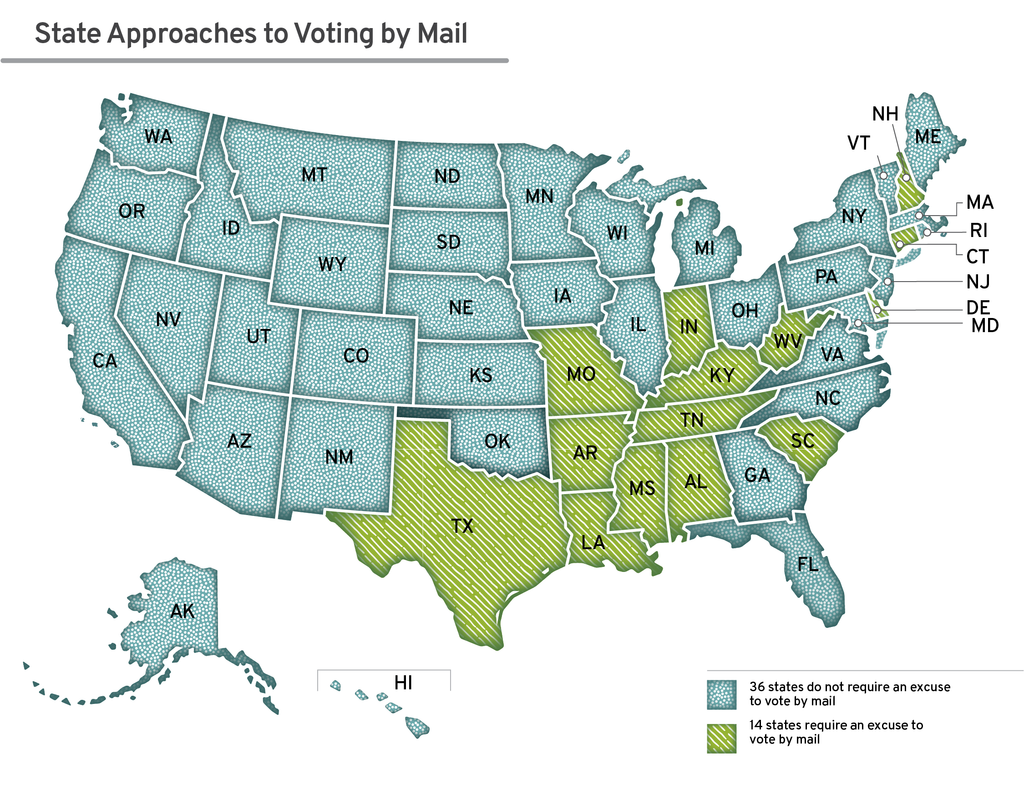
The central policy choice states face when it comes to mail voting is whether to give all voters the option to securely vote by mail. Historically, eligibility was limited to members of the military or others who had an acceptable reason preventing them from being physically present at the polls on Election Day. In the modern era, many states have expanded eligibility to all voters. Today, 36 states permit mail voting without an excuse while the rest require a government-approved excuse to vote by mail.
One federal action that stood to disrupt the administration of elections centered on the role of the United States Postal Service (USPS) in delivering ballots to voters’ homes. Under the current system, state and local election officials manage the process for determining which voters are eligible to receive a mail ballot. For example, while some states with mostly mail elections send ballots to every registered voter, others maintain a list of those who have opted in to receive a ballot in the mail. Both options subject voters to all of the registration and list maintenance procedures used to determine eligibility and maintain up-to-date registration lists. The USPS sets detailed format and design standards for election mail materials; however, they do not currently play a role in determining whether a voter is eligible to receive a mail ballot.
A rule issued in August by the USPS to implement Section 3 of Executive Order 14399 would have significantly changed how the USPS handles election mail had it not been blocked from going into effect for the 2026 midterms. The most consequential provision of the rule included a new requirement for the USPS to cross-reference the names of the intended mail ballot recipients with a state-provided list of eligible mail ballot voters. The USPS would be prohibited from delivering a ballot addressed to an individual who does not appear on the list of eligible voters.
The procedures outlined in the USPS rule would cause a major nationwide shift in the administration of mail voting by integrating the federal government even further into a process the U.S. Constitution explicitly reserves for states. Beyond the expanded role of the federal government in election administration, the rule was unworkable from a timing perspective as it would have dramatically altered the process mere weeks before Election Day 2026 (and, in some states, after mail ballots had already been sent). Ultimately, the policy has not gone into effect; however, legal proceedings are ongoing.
The other major change that could have disrupted November’s election relates to the deadline for voters to return mail ballots. Most states require ballots to arrive at election offices by Election Day, but 15 states will accept ballots that arrive later as long as they are postmarked on or before Election Day. A suit challenging the Mississippi law that allows absentee ballots to arrive late made its way to the U.S. Supreme Court earlier this year; the law was upheld in a 5-4 decision released in June.
Had the Court ruled differently, it could have resulted in a disruptive change to the voting process on a short implementation timeline. There are good reasons for states to adopt an Election Day ballot receipt deadline, as they can help ensure timely election results—particularly in close races. But those changes should be made with ample lead time for election officials to educate the public on the new deadlines and limit the potential for voter disenfranchisement.
Despite an elevated chance of federal policy changes impacting mail elections in 2026, the end result of the uncertainty in most states was a continuation of the policy status quo. This means mail voting remains a central piece of America’s voting system and continues to provide secure and convenient access to the ballot. Moving forward, improvements to the mail voting system should be driven by the states, implemented far enough in advance to ensure a smooth rollout that limits any disruptive impacts.