
Election Policy Landscape Stabilizes as Midterms Approach Part 2: Voter Identification
This is the second installment in a multipart series on the current election policy landscape as we approach the 2026 midterms. Read the introduction and see other posts here.
Ensuring that only eligible voters participate in American elections is a core function of election administration. States have policies in place to verify prospective voters’ registration eligibility requirements (e.g., U.S. citizenship) and identity. Part 1 of this series covered the different state approaches to citizenship verification during voter registration and the voter-list maintenance process. Here, we will discuss state requirements for verifying voter identity and how the federal SAVE America Act would have impacted current practices.
Every state requires potential voters to identify themselves by providing some form of personal information before casting a ballot. For in-person voting, this can range from a government-issued photo ID to a signature in a poll book. Meanwhile, all states require those who vote by mail to include a signature or other unique identifier (e.g., driver’s license number, partial Social Security number) on the ballot envelope. Eleven states also require the signature of a witness or notary.
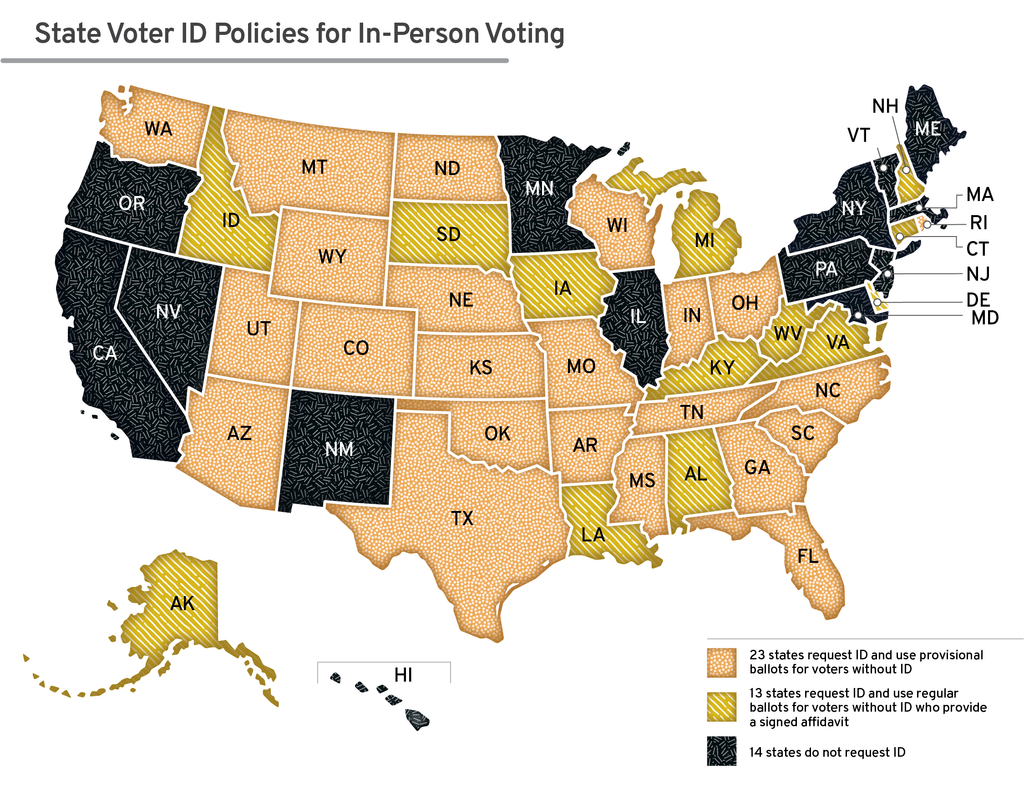
The stringency of voter ID requirements varies substantially from state to state, and these differences continue to drive the policy debate on the topic. For example, 36 states request identification from all in-person voters while the remaining 14 allow voters to identify themselves without presenting documentation. These states rely on voters to provide basic information (e.g., name, address) to election workers before signing the poll book.
Even states that request ID from all voters have meaningful differences in how they handle situations where a voter does not have an acceptable form of identification. For instance, 23 states provide these voters with provisional ballots that are not counted unless the voter returns to present ID or the election official is able to verify the person’s identity through some other means. In contrast, the other 13 states allow voters to cast regular ballots without showing ID if they (or in some states, an eligible third party) can provide an affidavit confirming the individual’s identity.
The SAVE America Act would have imposed a nationwide requirement for all voters to present specific forms of photo ID when voting at the polls and to include copies of such identification when voting by mail. Supporters of strict ID requirements argue that such policies are necessary to deter voter fraud, while opponents argue that voter fraud concerns are overstated and that the compliance burdens risk disenfranchising eligible voters. More than 80 percent of Americans support voter ID requirements; even so, opponents of the SAVE America Act prevailed during the current Congress, leaving the current mix of state laws in place.
While the SAVE America Act suffered from a variety of flaws, requiring voters to present ID is a reasonable policy that is popular and should be adopted nationwide—ideally on a state-by-state basis. However, if a future Congress pursues this legislation on the federal level, then it should include a reasonable implementation timeline and provide free voting IDs for any eligible voters who do not otherwise have an acceptable form of ID. Ample lead times will help election officials implement a smooth transition to the new policy, while free IDs can help address concerns around disenfranchisement of eligible voters.
Overall, the 23 states with well-designed voter ID policies that ensure both security and ballot access provide a model for other states and Congress to follow. By pursuing this in a balanced fashion and setting partisanship aside, lawmakers have a real opportunity to provide the public with even more confidence in the security of American elections while maintaining broad access to the democratic process for all eligible voters.