
Debt and National Security Part 3: National Security in an Era of Rising Debt
This is the final installment of a three-part series on how U.S. debt affects national security.
Parts 1 and 2 of this series established military strength, alliances and diplomacy, and economic resilience as complementary pillars of U.S. national security. As rising debt and interest costs constrain the federal budget, the central challenge is no longer simply how much to spend on any one pillar, but how to allocate scarce resources across all of them to maximize overall security. This final installment argues that national security should be viewed as a portfolio of investments operating under fiscal constraints, where every new commitment carries an opportunity cost.
Recent defense policy illustrates this challenge. For decades, Department of Defense (DOD) funding was almost entirely discretionary, requiring Congress to approve appropriations each year. That changed in FY2026, when the One Big Beautiful Bill Act (H.R.1) provided an additional $156 billion in mandatory defense funding through FY2029. The Trump administration has proposed expanding this approach in its FY2027 Budget with an additional $350 billion in mandatory funding—a 42 percent increase from the enacted budget of the previous year—alongside roughly $1.1 trillion in discretionary defense funding.
The case for defense spending itself should not be dismissed. Relative to historical levels, the United States currently devotes a smaller share of its economy to defense. At the same time, strategic challenges are evolving: China’s navy has surpassed the United States in total fleet size, and several allies in the North Atlantic Treaty Organization (NATO) now allocate a larger share of gross domestic product (GDP) to defense. In this context, it is important to ensure that new investments are sustainably financed and effectively translate into greater military capability.
Whether permanently shifting a portion of defense spending into the mandatory budget improves national security remains uncertain. What is clear is that financing additional defense commitments through borrowing increases federal debt and future interest costs, thereby reducing fiscal flexibility for future security priorities. If greater military investment is necessary, policymakers should fund it through deliberate reprioritization within the existing budget rather than adding new obligations to the national debt.
Improving the effectiveness of defense spending is just as important as increasing it. The DOD remains the only major federal agency that has never received a clean audit, and the Government Accountability Office (GAO) continues to designate DOD financial management as a high-risk area. Cost overruns and acquisition failures illustrate that additional spending does not automatically translate into greater military capability. For example, a 2025 case study shows how the F-22 Raptor program cost roughly twice its original acquisition estimate, while the F-35 Joint Strike Fighter program has grown nearly 90 percent above initial projections. It also shows how the program’s “concurrency” acquisition strategy (under which aircraft were produced before testing was complete) required costly retrofits and delays years beyond schedule.
Diplomacy and global influence form the second pillar of national security, enabling the United States to advance its interests and deter conflict without resorting to military force. However, U.S. policy has shifted away from these tools in recent years. Funding for the State Department, the U.S. Agency for International Development (USAID), and International Affairs has been significantly reduced. The Department of Government Efficiency canceled 83 percent of USAID programs in March 2025, and by June, the agency had been absorbed into the State Department. Together, these changes reflect a fundamental reorientation of how the United States pursues its security objectives.
Whether these changes strengthen national security is less clear. Just as higher defense spending does not automatically produce greater security, reducing diplomatic spending does not necessarily create a more efficient government. Large-scale organizational disruptions carry their own costs in loss of institutional knowledge and program interruptions. Unlike military readiness, diplomacy is a long-term investment with value that often lies in preventing crises before they require military intervention.
Foreign assistance programs are vulnerable to waste, fraud, and inefficiency; however, rather than eliminating programs altogether, the GAO consistently recommends improving oversight and accountability. As in the case of defense, the existence of waste is not itself evidence that a program lacks strategic value—the relevant question is whether reforms can sufficiently improve the return per dollar while preserving the national security benefits.
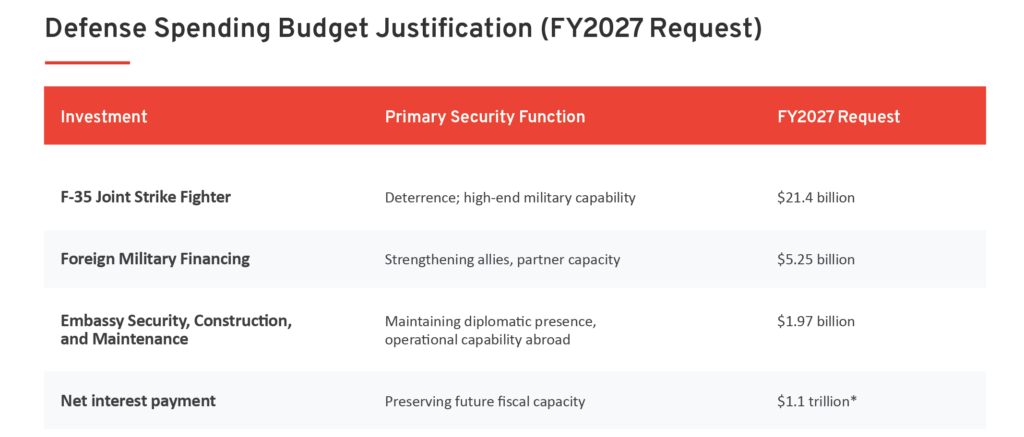
National security policy is often debated in silos. Though they generate different benefits, defense, diplomacy, and debt compete for the same fiscal resources and ultimately serve the same objective: to protect U.S. security interests. In an era of rising debt, policymakers should evaluate national security investments not only by whether individual programs are valuable, but also by whether they generate the greatest increase in security relative to the next-best alternative. A fighter aircraft cannot replace an embassy, and diplomatic engagement cannot replace military readiness. Instead, these tools should be viewed as components of a broader national security portfolio. The following table illustrates this challenge.
*Projection for 2027
Sources: FY2027 Defense Budget, FY2027 Department of State Budget, Peter G. Peterson Foundation
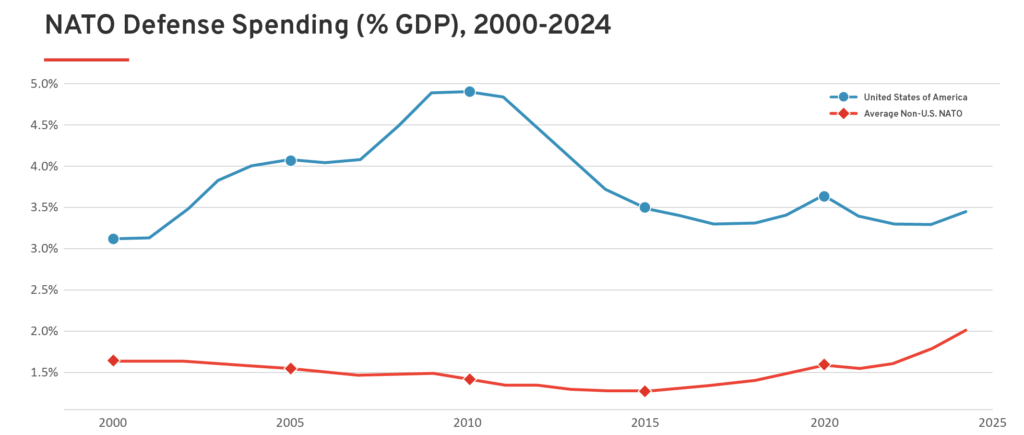
NATO burden sharing illustrates how security dollars can be allocated differently. The following chart shows U.S. and non-U.S. NATO members’ military expenditures as a percentage of GDP. U.S. military expenditures have remained consistently above average non-U.S. NATO; in fact, the United States carried a disproportionate share of the alliance’s defense burden for decades. But that pattern is beginning to change. At the 2025 NATO Summit, allies committed to investing 5 percent of GDP annually in defense and security-related spending by 2035, and European and Canadian defense spending increased by 20 percent in the past year alone. As allies assume greater responsibility for Europe’s defense, the United States gains greater flexibility to direct scarce resources toward other strategic priorities.
Source: Stockholm International Peace Research Institute
The United States need not choose between a strong military and a strong diplomatic presence, as both are essential components of national power. However, rising debt limits the resources available for future priorities, turning every new commitment into a decision about what to forgo. The question for policymakers is what combination of investments will generate the greatest security return for each taxpayer dollar.
Read other posts in this series:
Part 1: Borrowing Away Military Flexibility
Part 2: Borrowing Away American Global Influence