
Closing Ohio’s Justice Gap
Ohio is a relatively safe state. Its violent crime rate sits approximately 18 percent below the national average, and total crime in the state has fallen 16 percent since 2019. But Ohioans who do become victims are among the least likely Americans to see their case solved. In 2022, seven in 10 violent crimes reported to police in the Buckeye State went unsolved—placing Ohio at third worst in the nation behind Florida and New Mexico. The state’s violent crime clearance rate has consistently remained near 30 percent for more than a decade, and while 2024 data shows a modest increase, Ohio still falls well below the national rate of 43.8 percent. The impact of unsolved crime ripples through neighborhoods, leaving victims without answers and offenders at large.
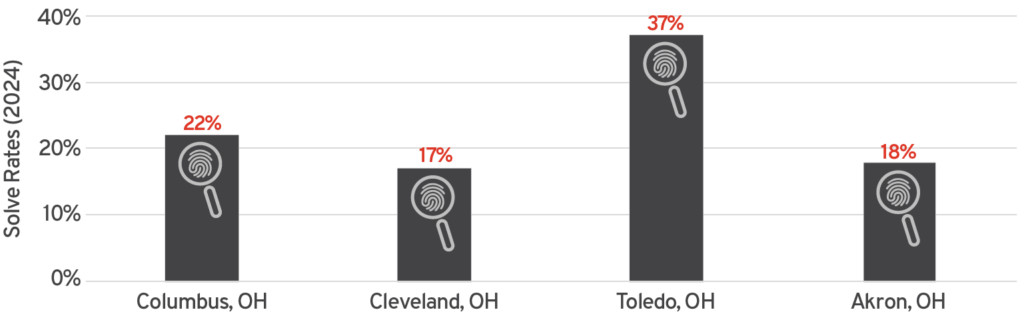
The failure is not uniform; rather, Ohio’s biggest cities bear the heaviest load:
Violent Crime Solve Rates (2024)
The picture by criminal offense category is similarly grim. In 2024, Ohio law enforcement agencies cleared roughly 44 percent of homicides, 41 percent of aggravated assaults, 23 percent of robberies, and only 14 percent of reported rapes—with the homicide figure sitting roughly 17 points below the national homicide clearance rate of 61 percent. The operational pressures driving these numbers are familiar to anyone paying attention to policing. Like their peers in other states, Ohio agencies contend with serious staffing shortages. Cleveland, Cincinnati, and Columbus have each reported hundreds of open positions. Investigative caseloads are far above what professional standards recommend, crime labs are experiencing significant forensic testing delays, and current record management systems are not designed to keep pace with modern caseload volume.
To its credit, the state has invested in this problem for years. Since its 2021 launch, the Ohio Violent Crime Reduction Grant Program has distributed more than $87 million to over 200 law enforcement agencies across 15 rounds of awards. Announced in April 2026, the most recent round distributed $3.4 million to 44 agencies across 28 counties for investigative overtime, technology, targeted patrols, and similar initiatives. But despite this sustained investment, Ohio’s statewide clearance rate held essentially flat through the program’s first three years. And although the state did see a decrease in violent crime from 2023 to 2024, the Ohio Legislative Budget Office noted it was not on pace with the national average. While that decrease is encouraging, a single year of progress does not prove that $87 million has bent the curve. The program has been generous, but it has not been structured around outcomes—until now.
Companion bills currently pending before the Ohio Legislature—SB 425 and HB 830—are designed to codify the Violent Crime Reduction Grant Program and add the accountability structure the current administrative program lacks.
The bills would:
- Preserve the existing grant framework by authorizing municipal police departments and county sheriff’s offices to (either individually or jointly) apply for funding for evidence-based violent crime reduction strategies including place network investigations, focused deterrence, hot spots policing, and crime gun intelligence centers.
- Dedicate 20 percent of annual grant funding to clearance-rate improvement projects (i.e., investigative staffing and overtime, ballistics and DNA capacity, real-time crime center support, National Integrated Ballistic Information Network, cold-case surge operations, record management system upgrades).
- Require incident-level reporting from every grantee on each violent crime during the grant period including offense type, date reported, location, weapon used, victim and offender demographics, and (if cleared) the date and method of clearance.
- Tighten the definition of “clearance by exceptional means” by requiring agencies to establish suspect identity, probable cause, and readiness to arrest before an external circumstance prevents the arrest.
- Contract a qualified research partner to evaluate program outcomes using experimental or quasi-experimental methods.
- Make scoring criteria public and require annual reports to the governor and legislature on awards, strategies funded, geographic distribution, and grantee-level performance metrics.
What sets this legislation apart is that Ohio is not starting from scratch—the bills are effectively an upgrade to a program already in its fifth year. The 20 percent clearance set-aside ensures that capital investments in the unglamorous aspects of case closure (e.g., forensics, ballistics, and case management) no longer compete on equal footing with higher-profile patrol and prevention proposals. The incident-level reporting requirement builds the data infrastructure Ohio has been missing, allowing policymakers and the public to tell which strategies are actually working. Additionally, the mandate for an external causal evaluation is a meaningful commitment to evidence-based governance and a departure from the common pattern of funding programs indefinitely without testing whether they produce promised outcomes.
One more provision worth flagging is that 20 percent set-aside can be waived if Ohio’s statewide clearance rate hits 75 percent. Because no state currently reaches that mark—including high-performing states like Vermont, Delaware, and Idaho—the waiver is unlikely to be triggered. The threshold functions as a durable floor, locking in the clearance-rate focus for the foreseeable future rather than allowing it to erode under future administrations.
Solving violent crime is not partisan work. Ohio’s existing grant program has enjoyed support across the aisle and through multiple operating budgets, and the new legislation reflects that same coalition: a Republican Senate sponsor and a bipartisan House pairing. National policy organizations have also lined up behind the effort, citing the bills as evidence-based investments that would equip law enforcement with the tools needed to solve more cases, apprehend more violent offenders, and deliver justice for victims. Ohio joins a growing wave of states including Illinois, Missouri, Michigan, Pennsylvania, Texas, and Utah that have introduced or moved recent legislation to fund clearance-focused investments, mandate routine clearance-rate reporting, or both. These bills build on that momentum by asking a reasonable next question: How do we know if the dollars are producing results? The combination of a dedicated funding stream for clearance capacity, rigorous incident-level data collection, and independent evaluation offers Ohio a template for turning five years of investment into measurable gains.
When violent crimes go unsolved, the cost is not just recorded in data tables; it is carried by families still waiting for answers, by neighborhoods where offenders walk free, and by communities whose trust in the justice system is drained by unsolved cases. While Ohio has already committed the money, SB 425 and HB 830 would finally commit the accountability and resources necessary to achieve results.