
President’s Fiscal Year ‘27 Budget Signals Turbulence Ahead for Annual Funding Process
If you thought the fiscal year (FY) 2026 government funding fight was bad—with two major shutdowns, one of historic duration, and the Department of Homeland Security (DHS) still in limbo—President Donald Trump’s FY 2027 budget signals that this year will be no better, and likely even worse. The budget pairs spending cuts with a massive 45 percent increase in total defense spending, leans heavily on overly optimistic numbers, and relies on reconciliation to out-maneuver appropriators. To borrow from Irving Kristol, the administration and its impractical budget are about to be mugged by the twin realities of financial and political challenges.
Financial Challenges
The financial challenges are significant, including iffy math and a total pass on addressing our entitlement spending crisis. According to Consumer.gov’s “Making a Budget” site, “A budget helps you make sure you’ll have enough money every month…a budget can also help you save for your goals or emergencies.” Based on these guidelines, the president’s request does not qualify as a workable budget.
- No attempt to balance: Though the FY27 budget includes some much-needed reductions and reforms, such as eliminating the ineffective Community Development Block Grant program, the total discretionary savings does not come close to offsetting the increase in defense-related spending “base” spending [see Figure 1 in orange]. That gap widens dramatically when the “mandatory defense resources supplementing base funding” is factored in [see Figure 1 in red].
Figure 1: Topline Discretionary Spending Request Overview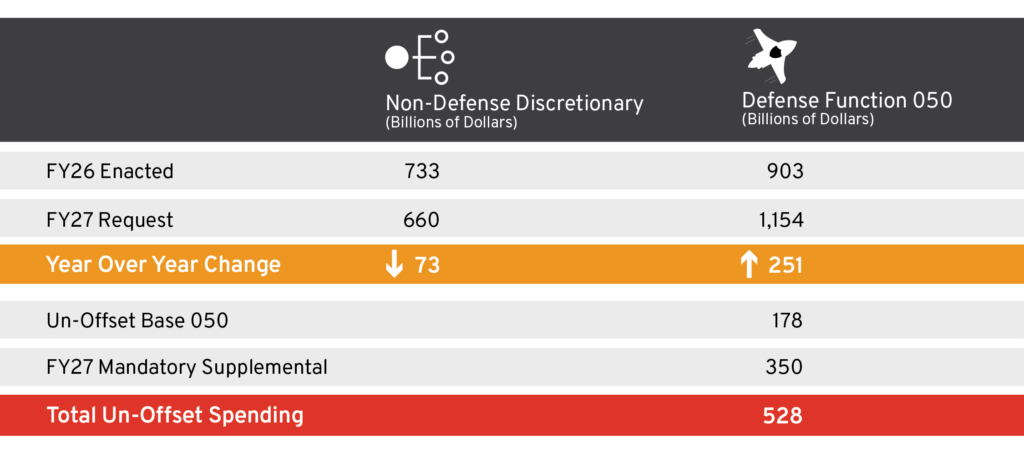
Source: White House FY27 Budget Request - Unreliable revenues: The FY27 request anticipates that tariffs will continue to be a significant source of federal revenue. But ongoing litigation and the president’s unpredictable trade threats make tariffs a source of deep uncertainty for federal finances, economic output, and families. The Committee for a Responsible Federal Budget (CRFB) notes that the budget includes $1.7 trillion in revenues from tariffs the Supreme Court deemed illegal.
- Hazy economic outlook: The gross domestic product (GDP) estimates from the White House’s Office of Management and Budget (OMB) differs greatly from the GDP assumptions underpinning the Congressional Budget Office’s (CBO) latest “Budget and Economic Outlook” [Figure 2]. The White House’s forecast may be far too sunny.
Economic growth plays a significant role in government revenues and outlays, as seen when recessions harm both the economy and federal balance sheets. When unanticipated events, such as a global pandemic, suddenly rain on the GDP parade, it can rapidly halt revenues, force new outlays, and add to the debt–further slowing economic growth. While no one can predict the future with 100 percent accuracy, conservative estimates in the present can firm up the fiscal foundation.
Figure 2: OMB vs CBO GDP Estimates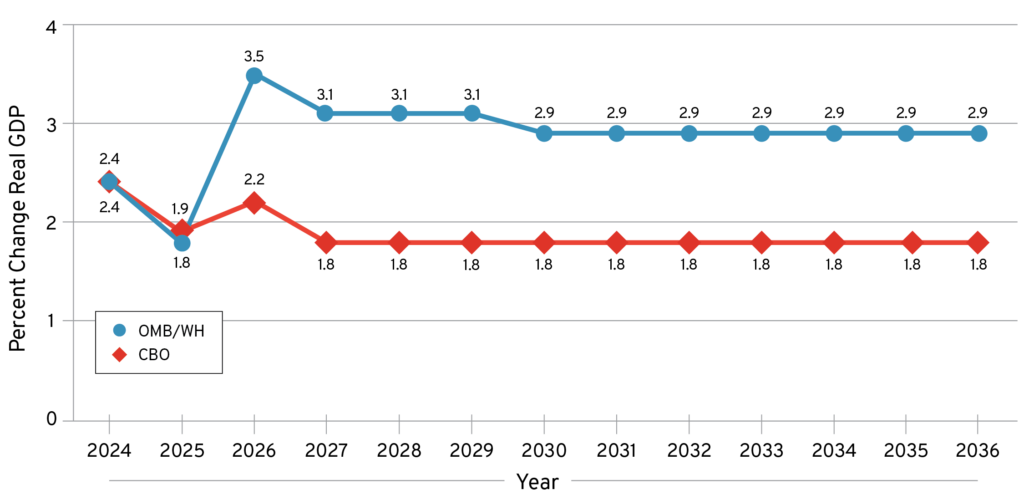
Sources: https://www.whitehouse.gov/wp-content/uploads/2026/04/ap_1_assumptions_fy2027.pdf; https://www.cbo.gov/system/files/2026-02/61882-data.xlsx - Mandatory spending reform no-show: Social Security and Medicare are the major drivers of our debt and require urgent reform as the window of opportunity shuts on the incremental changes that once could have prevented this imminent crisis. Unfortunately, the president’s budget does not mention entitlement spending, let alone offer remedies. According to the 2025 Social Security and Medicare Trustees report, both the Old Age and Survivor’s Insurance and Medicare’s Health Insurance (Part A) trust funds will be depleted by 2033, at which point Social Security beneficiaries will see a major cut of 28 percent per year, and Medicare payments to hospitals will be slashed by 11 percent. Medicare Part A payments are limited to the tax revenue they bring in, which could reduce access and lead to health service rationing.
But wait, it’s worse! Estimates from the CBO that are more recent bring Social Security’s crisis a year closer, to 2032. The 2025 Medicare trustees report notes that they had previously underestimated trust fund exhaustion by three years. We should not be surprised if this summer’s report is even more urgent.
The longer lawmakers hesitate to act the more our workforce ages and shrinks. In the coming years, as more and more retirees rely on the social safety net, tax receipts will dwindle, and the debt will rise, again exerting downward pressure on the economy. - Problematic Pentagon boost: The president’s budget calls for a gigantic hike in Pentagon spending (budget function 050, which also captures national security related spending in agencies outside the Department of Defense), split into two parts. The first is a “base discretionary request” of $1.15 trillion, then an additional $350 billion in “mandatory defense resources supplemental base funding.” [See Figure 3] This fiscally irresponsible increase is likely to exacerbate wasteful spending. Why fix or eliminate a problem program when you can just put a shiny new one on the taxpayers’ credit card?
Figure 3: President’s Pentagon Request vs. CBO Baseline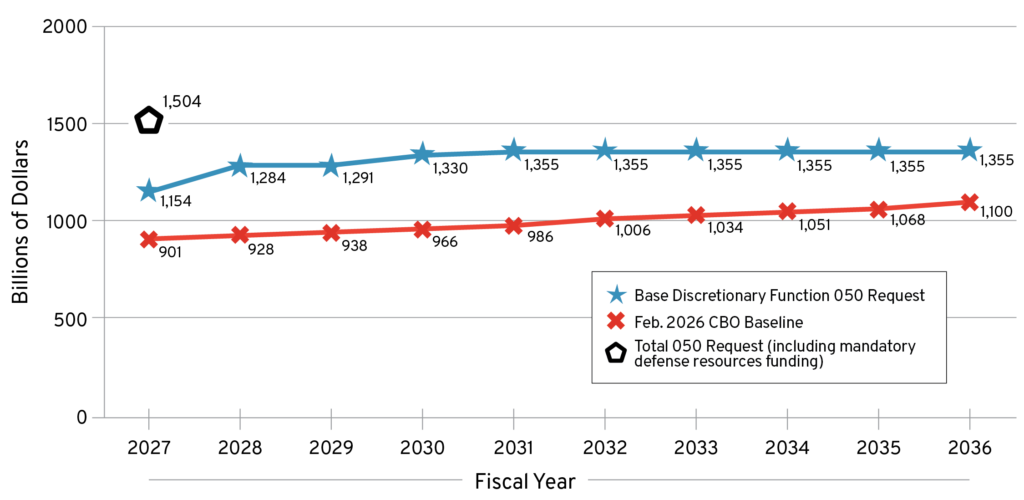
Sources: https://www.whitehouse.gov/wp-content/uploads/2026/04/ap_1_assumptions_fy2027.pdf; https://www.cbo.gov/system/files/2026-02/61882-Outlook-2026.pdf - National security threat: Ironically, though the administration claims this Pentagon budget boost is to “make sure our nation is safe in a dangerous world,” this and other provisions (or lack thereof in the case of entitlement reform) could make us less safe by exacerbating our crippling national debt. Senior analyst for the Economic Policy Innovation Center, David Ditch, explains, “If federal spending and debt are allowed to continue growing unchecked, defense capacity will be permanently imperiled. Patriots who value a secure homeland must recognize that irresponsible federal budgets are every bit as much of a threat as foreign adversaries.”
- Bleak fiscal facts: The CBO expects the U.S. debt-to-GDP ratio to slide across the 100 percent threshold this year and continue to progress upward. Image 1, from Brookings scholar, Jessica Riedl’s annual chart book, visualizes the trend. The president’s FY27 budget request does nothing to halt this alarming trend. Debt that is the same size or greater than the economy is an undesirable state for any country, crushing economic growth due to higher long term interest rates, reduced private investment, and higher inflation rates. The Mercatus Center’s Jack Salmon writes that the debt tipping point is “between 75 and 80 percent of GDP for advanced economies—a level that the United States has materially exceeded since 2020.”
Americans are already experiencing these effects in the higher cost of goods and services, slowing economic growth, and declining consumer confidence. The factors that feed these indicators are complex, especially since global events, like the Iran conflict and ongoing trade wars, have had a profound impact. When such challenges occur, a strong fiscal footing would make the economy more resilient.
Image 1: Historical Debt Held by the Public as a Percentage of GDP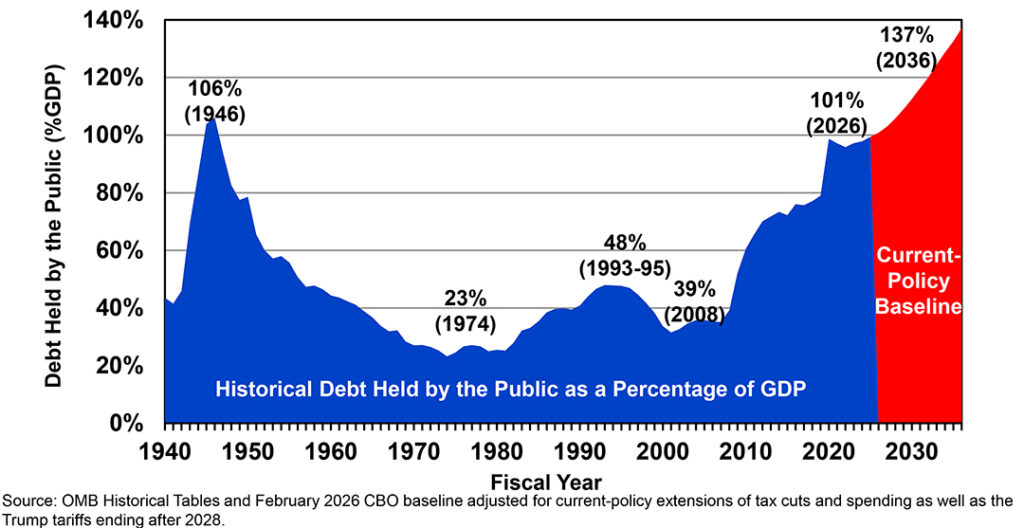
Image Source: https://www.brookings.edu/wp-content/uploads/2026/04/BudgetChartBook-2026.pdf
Political Challenges
Financial challenges are not the only rocks on the road to FY27 funding. A number of political realities and a bumpy budget process are likely to make this another rough year.
- No wiggle room: This may seem more like a financial challenge–it is certainly a bleak fiscal fact–but the lack of wiggle room in the federal budget is also a major political challenge. Payments for interest on the debt—money that was already borrowed and spent— eclipsed all non-defense discretionary spending in FY25 (and this is the “fastest growing part of the budget.)” As interest payments explode, they consume a greater percentage of federal revenues, crowding out other priorities like securing our nuclear weapons or the Artemis III mission, raising the stakes as legislators fight over dwindling scraps.
- Congressional limits: Though some midsession exits and one party defection have moved the needle slightly since the year began, both chambers of Congress remain narrowly divided between Republicans and Democrats. Republicans hold a vanishingly slim majority in the Senate, where 60 votes are necessary to invoke cloture and move to a vote on final passage on most legislation. Similarly, though the typical legislative process requires only a simple majority for passage in the House (218 when all 435 seats are filled) with only 217 Republicans to 212 Democrats, neither party can tolerate even a couple defections from the party line. This makes it extremely difficult to enact highly partisan legislation, particularly when many legislators have their own ideological or constituency-driven priorities that may compete with partisan policies. These warring motivations are only heightened during an election year, and further complicated by fewer days in session, which compresses available time to negotiate between legislators and chambers. To get around this obstacle, Republicans plan to move some key priorities through reconciliation, misusing what was intended to be a deficit reduction tool.
- Election-year limits: As mentioned, election years have a compressed legislative timeline and partisan conflicts are intensified. For example, sometimes legislators will not move advance a bill even where there is agreement to avoid the appearance of giving the other team a win. Election year politics also make it more difficult for members to support spending cuts that might affect their district. Cutting—though necessary—is hard to achieve outside of election years. Add re-election to the mix, and suddenly taxpayers are stuck with the worst of both worlds: more spending, no cuts. Hopefully the extra-large raft of retirees, who don’t need to buy votes with federal largess, can make real fiscal reforms their legacy.
- Broken budget process: Even before the administration dropped its FY27 budget request, funding the federal government was not going to be smooth sailing—though unrealistic assumptions and demands don’t help. The FY26 fiscal year is more than halfway over and appropriations for DHS are still incomplete. Lack of enacted data obscures spending numbers in the president’s budget, CBO estimates, and all associated commentary. This is more than a footnote in a summary chart. It is a dreadful reminder that annual appropriations is often a drawn out process and unfinished business is a dismal norm.
Since FY 1977, the first year the Congressional Budget and Impoundment Act of 1974 changes were fully implemented, Congress has passed all appropriations bills ahead of the September 30 deadline only three times. This is an indication of serious underlying problems with the federal government’s funding system.
To be sure, the outlook for the FY27 appropriations season was poor long before the Trump budget dropped—as it would be under any administration faced with dire fiscal straits and a practically inert Congress. This is not a uniquely Republican or Trumpian problem: the final fiscal year of the Biden administration also relied on continuing resolutions to fund the government. This should not be perceived as a vindication of the president’s budget request, but rather a painful reminder that extensive reforms are long overdue.
The president’s budget is often mocked as a “dead letter,” with little bearing on the appropriations outcome because Congress ultimately holds the power of the purse. Nonetheless, this budget should be taken seriously, particularly because the current chief executive wields outsized power and personality, unchecked by his party that holds both chambers of Congress.
The FY27 budget request is very revealing. It lays bare the fundamentally unworkable and unsustainable nature of the current process and our grave fiscal outlook. It also reflects a disheartening unwillingness to grapple with the severity of a deepening debt crisis at a moment when those who hold all the levers of power could make a concerted effort toward reform. Unfortunately, by ignoring basic realities, the president’s budget all but guarantees another stormy appropriations season ahead.