
Election Policy Landscape Stabilizes as Midterms Approach—Part 4: AI and Elections
This is the final installment in a multipart series on the current election policy landscape as we approach the 2026 midterms. Read the introduction and see other posts here.
The 2026 midterm election is the second major election cycle to take place since artificial intelligence (AI) entered the mainstream and AI tools became widely available to the public. Concerns regarding the technology’s potential to disrupt the 2024 presidential election were ultimately unfounded; however, questions remain about the role it will play in 2026.
The current environment is different due to rapid advances in technological capabilities, the increased use of AI tools in daily life, and the uptick in government regulation around deceptive uses of AI in election communications. In this final installment, we’ll discuss how candidates and voters are using AI during this election cycle and provide an update on some of the challenges states face as they attempt to enforce new laws regulating AI-generated deepfakes.
AI as Voter Information Source and Campaign Tool
In 2024, coverage of AI and elections focused primarily on the risks posed by deepfakes generated by bad actors. This year, other aspects of AI are receiving more attention, including the way AI chatbots are responding to election-related questions from voters and how candidates are integrating AI-generated videos and other AI-powered communication tools into their campaign operations.
A Pew survey conducted in mid-October found that only 8 percent of Americans currently turn to AI chatbots with questions about the election. However, a larger share is likely to receive election information from AI tools: As search engines like Google continue to integrate AI into their search products, 6 in 10 Americans report reading the AI-generated summary that appears at the top of the results. While the public increasingly uses AI in one form or another to obtain information about elections, questions regarding the reliability of its responses remain.
One recent study from the Institute for Strategic Dialogue found a 29 percent error rate in election-related responses from six popular chatbots, underscoring the need for voters to take precautionary steps like those recommended by Microsoft’s “Check. Recheck. Vote.” campaign. Meanwhile, the National Association of Secretaries of State’s #TrustedInfo2026 initiative encourages voters to seek election information directly from official election offices’ websites.
On the campaign front, there’s a clear uptick in the willingness of candidates and their consultants to integrate AI tools into their operations. According to one estimate, campaigns and political action committees have spent over $137 million on 220 advertisements created or enhanced by AI during this election cycle. Beyond AI-generated videos, campaigns are also tailoring websites and other content to maximize the chances that AI chatbots find relevant information and present it to users in the most favorable light possible.
While the impacts of these developments remain to be seen, the 2026 cycle clearly represents the embrace of AI as a powerful tool in the American electoral process.
Growing Court Scrutiny of Deepfake Disclosure Laws
In response to concerns about the potential for AI-generated deepfakes to cause chaos in the 2024 election, state lawmakers across the nation enacted laws aimed at regulating the use of AI in certain election-related communications. Congress and a number of federal agencies also considered new laws and regulations, though none were enacted. Most of the state laws require creators of misleading election-related deepfakes to label the videos as being AI-generated, with penalties for noncompliance ranging from civil fines to years in jail (depending on the state). Thirty-one states now regulate AI-generated election deepfakes; 29 of those laws were enacted in 2023 or later.
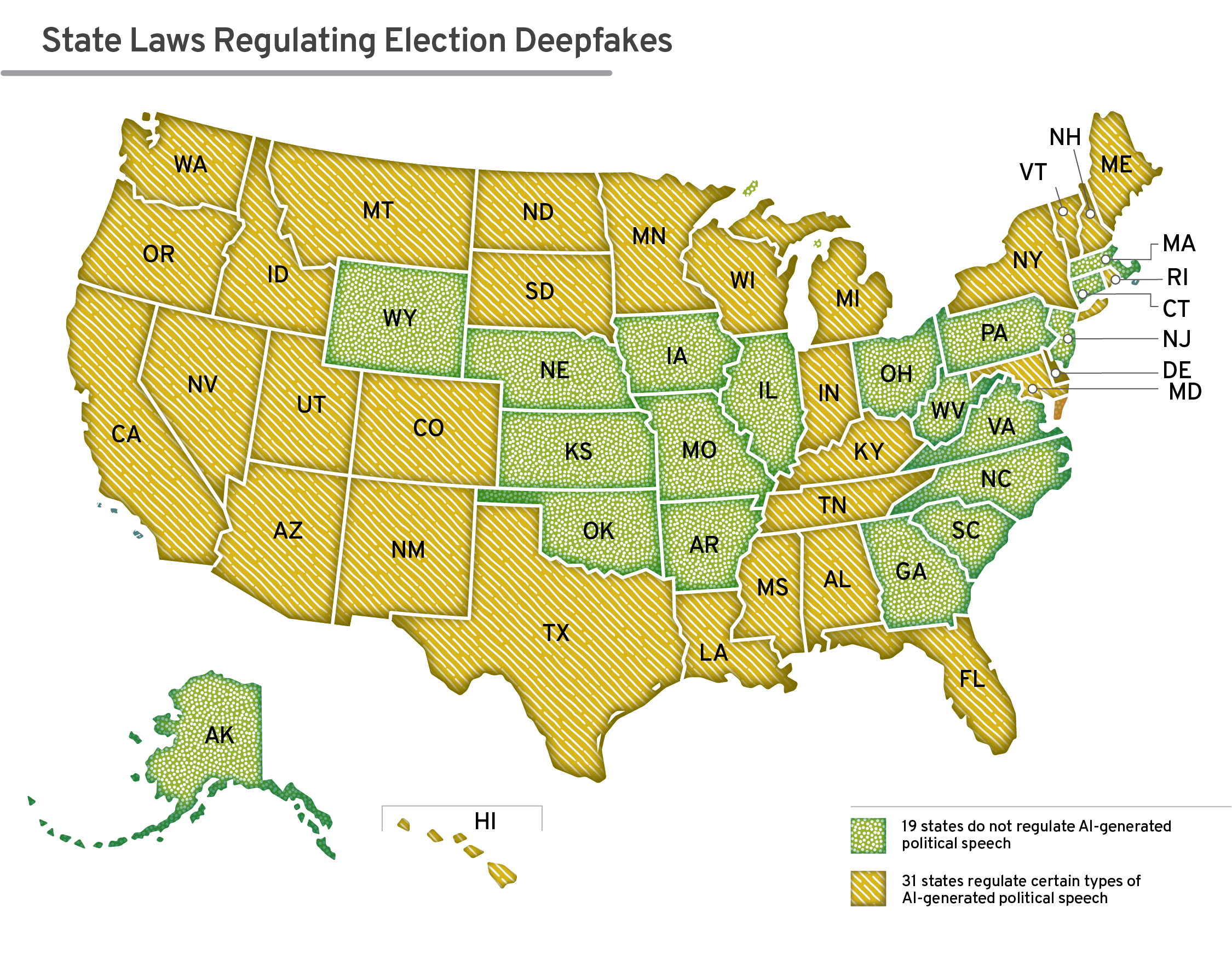
The 2026 election will be the first test for these laws in many states. Amid the growing use of AI by campaigns this cycle, there will likely be more opportunities for the subject of a deepfake to file a complaint or for the government to prosecute someone who violates the law. However, this approach to regulating AI-generated political speech appears to be on shaky constitutional footing: Legal challenges in California, Hawaii, Montana, and Vermont have already succeeded in blocking their implementation, with federal judges determining that they likely violate the First Amendment.
In addition to the likelihood that disclosure requirements are unconstitutional, they may not be effective in helping the public discern truth from fiction. In theory, a disclosure signals to the public that the content has been manipulated in some fashion and should therefore be viewed with a certain level of skepticism. Should that mindset take root, it could signal to voters that content without the disclosure is free of manipulation and can be trusted; yet the majority of political speech will remain beyond the reach of any government regulation. This sets the stage for truly false and unlabeled information—generated with or without AI—to gain additional traction. A better approach is for the government to let the public engage in free speech without imposing labeling requirements that could be unconstitutional and counterproductive.
Conclusion
AI’s role in the way voters, candidates, and election officials participate in America’s electoral process continues to grow. As with any technological innovation, there are (and will continue to be) concerns around potential harms and attempts to crack down through regulations. However, a better approach is to trust that Americans will adapt to the new technology and develop innovative solutions that will strengthen American democracy for years to come.