
Election Policy Landscape Stabilizes as Midterms Approach—Part 1: Citizenship Verification
This is the first installment in a multipart series on the current election policy landscape as we approach the 2026 midterms. Read the introduction and see other posts here.
One of the top legislative priorities for President Trump and House Republicans throughout the 119th Congress was to enact a federal law that mandates citizenship verification and voter ID nationwide. The primary legislative vehicles for these policies included the SAVE Act (2025) and the SAVE America Act (2026), both of which passed the House of Representatives but have not been considered in the Senate.
Despite strong support for these two policies among most Americans, the law faced significant opposition over concerns around potentially disenfranchising eligible voters as well as the practicality of implementing the change on short notice. With the Senate adjourned until after the elections, the prospects for enacting the SAVE America Act prior to November are now closed. Regardless of the legislative calendar, the practical deadline for implementing this change in time for the midterms passed months ago. For voters, this means that existing state policies regarding citizenship verification and voter ID remain in effect.
Focusing on the citizenship provisions, it’s already illegal under federal law for non-citizens to vote in federal elections. However, states subject to the National Voter Registration Act cannot require presentation of documentary proof of citizenship (DPOC), such as a passport or birth certificate, at the point of registration. Instead, applicants must attest to their citizenship on the voter registration form under the penalty of perjury. The SAVE America Act would change this by implementing a general requirement for voters to present DPOC at the point of registration and directing the Election Assistance Commission and states to develop new affidavit procedures for eligible applicants who lack DPOC.
Under the current system, 22 states rely on the attestation from the registration form for sufficient evidence of eligibility. However, states do have the authority to require DPOC for state or local elections and can conduct back-end citizenship verification using existing federal- and state-government data sources. In fact, 28 states follow one of more of these procedures.
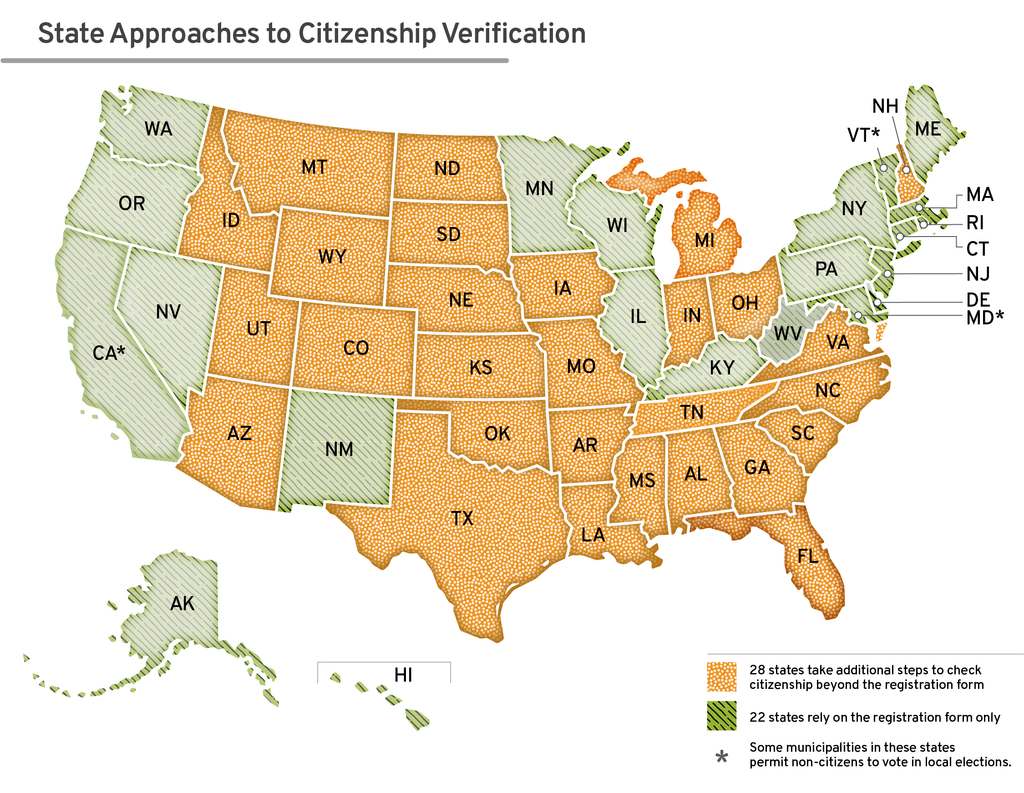
For example, while Arizona law requires DPOC for all elections, a 2013 U.S. Supreme Court decision limited its application to state and local elections only. As a result, Arizona uses a bifurcated registration list that distinguishes between individuals who present DPOC and are therefore eligible to receive a full ballot and those without DPOC but who check the citizenship box under the penalty of perjury and receive a ballot with federal races only. This introduces some administrative complexities, but for perspective on the size of each list, 99 percent of Arizona’s 4.4 million voters in 2024 were eligible to cast a full ballot compared to 1 percent who were limited to the federal ballot only.
At the same time, Arizona election officials engage in back-end verification by seeking out evidence that an applicant who did not present DPOC with the registration form had proven citizenship during a prior interaction with state government, such as the Department of Motor Vehicles. The federal SAVE data system can be used for the same purpose. States like Idaho, Florida, and Georgia follow similar procedures for checking citizenship status via existing state and federal data sources, thereby placing the initial compliance burden on the government rather than eligible American citizens. Only after the state confirms that proof of citizenship is missing is there a follow-up request for the applicant to provide more documentation.
Ensuring that only citizens vote in American elections is an important feature of a well-structured election system. Moving forward, a nationwide DPOC requirement—paired with a narrowly tailored affidavit option for eligible individuals who truly lack access to DPOC and reasonable implementation timelines—is a worthy policy that warrants serious consideration. That said, even with the current limitations on checking DPOC at registration, states have demonstrated how the effective use of existing government data sources helps ensure that only eligible American citizens can register while minimizing the administrative burden on eligible American voters.