

Custody to Community: Expanding MOUD Access Across the Criminal Justice System
Author

Media Contact
For general and media inquiries and to book our experts, please contact: pr@rstreet.org
Reducing the overregulation of MOUD, allowing for more flexible care provisions, developing better data collection and record-sharing systems, and making use of diverse funding opportunities would all make it easier to provide MOUD within correctional environments and communities. Such efforts would translate into healthier individuals, safer facilities, improved continuity of care, and stronger communities.
Introduction
More than 500,000 people with an opioid use disorder (OUD) cycle through the U.S. correctional system each year. Recent estimates suggest that 40 percent of people entering the prison system meet the criteria for a drug use disorder and nearly one-third of currently incarcerated individuals have an OUD or are opioid dependent. Given these statistics, OUD is not an ancillary issue, but rather an ongoing concern that impacts a substantial portion of the criminal justice system and its responsibilities.
In addition to preserving public safety, a primary goal of the criminal justice system is to “help former offenders return to society.” Achieving that goal requires keeping individuals as safe as possible during incarceration and—where possible—addressing the factors that make successful reentry more difficult, including OUD. Medications for opioid use disorder (MOUD) are among the most effective tools for improving the health and well-being of people living with an OUD while increasing their ability to reintegrate positively into society. Yet many correctional facilities in the United States do not offer this gold-standard treatment, and those that do typically supply only one of the three approved medication options and/or only treat specific populations.
This gap between evidence-based treatment options and actual practice raises important questions about why MOUD access remains so inconsistent—and what policymakers can do to address those barriers to care. This policy paper explains the impact of OUD in correctional facilities, why MOUD is an essential treatment tool, the actual availability of MOUD in correctional facilities and how policy affects their provision, and key implications for policymakers who want to improve outcomes by expanding access.
Understanding OUD in the Correctional System
Untreated OUD increases the risk of infectious disease, overdose, all-cause mortality, arrest, and incarceration. For many, entry into the criminal justice system—where an abstinence-based approach to substance use disorder (SUD) dominates—complicates and amplifies these potential harms. Incarceration can also abruptly interrupt substance or medication access among those who are in active addiction or taking MOUD, which may trigger cravings or severe withdrawal symptoms.
As a result, about half of justice-involved individuals who are opioid dependent use illicit drugs—mostly opioids—while in custody. Nonmedical opioid use in jail or prison causes more than 1,000 in-custody overdose deaths annually across the nation’s criminal justice system. In addition, contraband substances in correctional facilities fuel illicit markets, are associated with violence, and create accidental-exposure concerns among correctional officers.
Furthermore, leaving OUD untreated during incarceration endangers individuals and hinders their ability to rebuild a positive life within their community upon release. Those who have been imprisoned face an increased risk of overdose upon reentry. One study found that almost 22,000 people released from U.S. jails and prisons in 2022 died of an opioid overdose within the year, accounting for more than one-quarter of the nation’s total opioid overdose deaths that year. Continued substance use (and especially OUD) upon release can also increase the likelihood of recidivism: Approximately 40 percent of people convicted of property crimes, 30 percent of those convicted of drug offenses, and 15 percent of individuals convicted of violent crimes reported committing their offense to support an SUD.
Providing individuals who enter the criminal justice system with access to MOUD could prevent many of these harms to individuals and communities. However, less than half of the correctional facilities nationwide offer all qualified patients a choice among the three Food and Drug Administration (FDA)-approved medications. However, expanding access is not always straightforward. Correctional systems must navigate a complex web of medication regulations, persistent staffing shortages, stigma and misunderstanding about OUD and MOUD, and resistance to investing limited resources in people accused or convicted of crimes.
Why Treat OUD with Medications
The FDA has approved three medications for the treatment of opioid use disorder: naltrexone, buprenorphine, and methadone. All three bind to opioid receptors in the brain, reducing cravings and blocking other opioids (like heroin, oxycodone, or fentanyl) from causing euphoria or respiratory depression. However, their actions at those receptors differ relative to one another and relative to recreational or nonmedical opioids. Consequently, each medication is appropriate for different patients, making the provision of all three essential to offering optimal, individualized MOUD care. Table 1 summarizes key characteristics of each medication.
Table 1: MOUD Characteristics and Effects
| Medication | Activates mu Opioid Receptors? | Stops Other Opioids from Binding? | Reduces Cravings? | Reduces Overdose Risk? | Causes Respiratory Depression? | Requires Abstinence to Initiate? |
|---|---|---|---|---|---|---|
| Naltrexone | Activates mu Opioid Receptors?No (antagonist) | Stops Other Opioids from Binding?Yes | Reduces Cravings?Yes | Reduces Overdose Risk?No | Causes Respiratory Depression?No | Requires Abstinence to Initiate?Yes – 7+ days |
| Buprenorphine | Activates mu Opioid Receptors?Partially (partial agonist) | Stops Other Opioids from Binding?Yes | Reduces Cravings?Yes | Reduces Overdose Risk?Yes | Causes Respiratory Depression?Limited | Requires Abstinence to Initiate?Yes – 12-24 hours |
| Methadone | Activates mu Opioid Receptors?Yes (full agonist) | Stops Other Opioids from Binding?Yes | Reduces Cravings?Yes | Reduces Overdose Risk?Yes | Causes Respiratory Depression?Yes | Requires Abstinence to Initiate?No |
Although all three medications bind to mu opioid receptors, naltrexone is an antagonist, meaning it does not activate them at all. Consequently, it requires a lengthy withdrawal period before a patient can start taking it, and because it does not maintain opioid tolerance, it offers no protection against overdose. As partial and full opioid agonists, buprenorphine and methadone do “turn the receptors on” when they bind. This has the benefit of maintaining opioid tolerance, which helps protect against overdose. Because these medications do not require extended abstinence to induce, they are more acceptable to many people than naltrexone (although patients must be in early withdrawal to start buprenorphine).
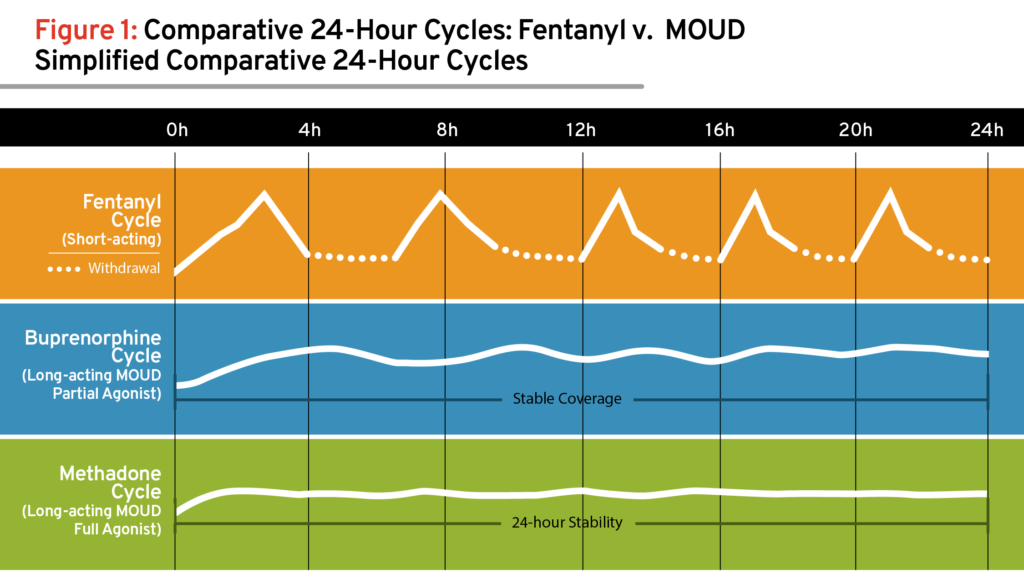
Even though buprenorphine and methadone both activate the mu receptors, they behave differently than heroin, fentanyl, and other opioids in two key ways. First, they are slow-acting, so they do not produce a euphoric rush. Second, they are long lasting and do not require frequent dosing to avoid withdrawal. This cycle of withdrawal/dosing that accompanies illicit opioid (especially fentanyl) use drives a range of potentially harmful behaviors, including committing property crimes, engaging in exchange sex, sharing needles, and hesitating to use overdose-avoidance strategies like drug checking. By preventing this cycle, MOUD reduce the likelihood of criminal activity, rearrest, infectious disease transmission, and overdose. In addition, the stable experience provided by MOUD allows patients to focus on their broader recovery and daily lives, including repairing relationships and meeting social, work, and family obligations. Figure 1 provides a visual comparison between the cycles of fentanyl versus those of buprenorphine and methadone.
MOUD Outcomes
Because MOUD help people with an OUD find stability, they are associated with improved recovery outcomes compared to non-medication treatment. All three of the FDA-approved medications have been shown to improve treatment retention and reduce non-medical opioid use, while buprenorphine and methadone reduce overdose risk by as much as 60 to 80 percent. MOUD also reduce health issues associated with injection drug use, lead to less criminal activity, lower arrest rates, and increase positive social engagement. These benefits extend to incarcerated individuals with OUD who receive MOUD. For example, research has found that receiving MOUD in jail reduced the risk of fatal overdose by 52 percent, nonfatal overdose by 24 percent, and death for any reason by 56 percent.
Furthermore, facilitating access to MOUD throughout the correctional continuum can translate into benefits that extend beyond the individual with an OUD, contributing to safer facility environments. For example, providing MOUD has been shown to reduce contraband and illicit drug markets in facilities, countering the popular belief that expanding access would fuel diversion and increase such markets.
In addition, taking MOUD during incarceration is associated with increased treatment engagement after release, which reduces overall overdose risk. One study estimated that if all U.S. jails and prisons provided comprehensive OUD treatment, they could prevent 13,000 overdose deaths annually. Furthermore, people who received MOUD while incarcerated are 12 percent less likely to reoffend after release compared to individuals who did not receive the medications, benefiting communities. Finally, MOUD are cost-effective, especially when all three medications are available: Naltrexone costs approximately $14,000 per patient annually, compared to roughly $6,000 per year per patient for buprenorphine or methadone. A recent model of MOUD provision in Massachusetts correctional facilities estimated a cost of under $7,500 per life-year gained, noting that although overall expenditures did go up slightly, they shifted from overdose response to investment in therapeutic care. Given the additional benefits to facilities and staff, as well as the community benefits resulting from increased treatment engagement, this study likely underestimates the full cost-benefit of providing these medications to incarcerated individuals.
Despite the numerous benefits to individuals, facilities, and communities, the vast majority of people with an OUD who are incarcerated in the United States lack access to MOUD. The following section describes real-world access to MOUD in correctional settings and barriers to providing these medications.
Providing MOUD in Correctional Facilities
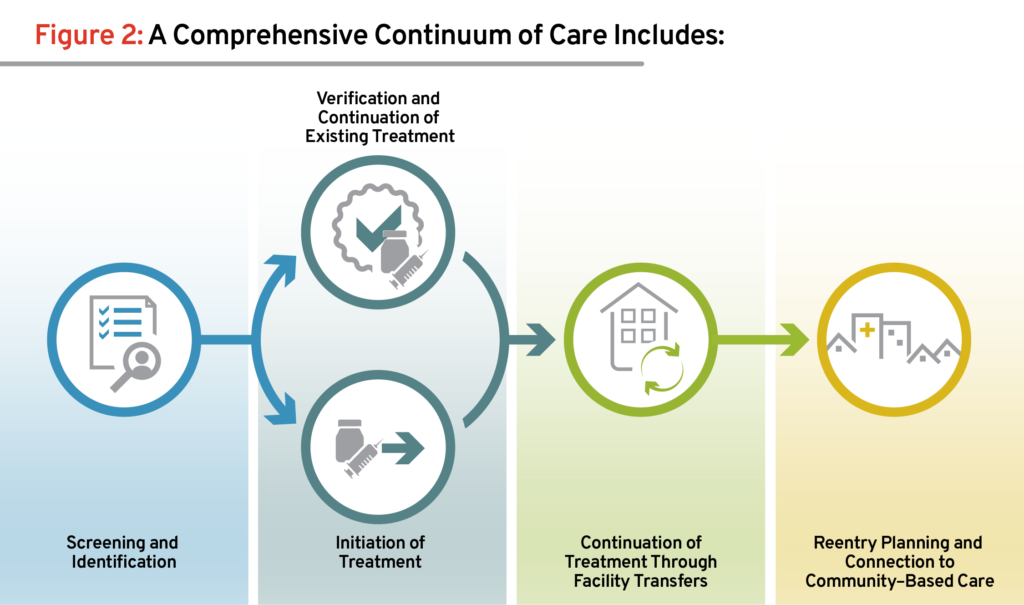
To optimize the benefits of MOUD, facility-based access should be treated as a care continuum that begins when a person enters custody and continues through their return to the community upon release, as illustrated in Figure 2. A breakdown at any one of these points can disrupt care, prompting a return to using illicit drugs and undermining treatment provided at other stages of the process.
Understanding Correctional Settings: Jails vs. Prisons
Understanding MOUD provision across the criminal justice system requires understanding the system itself and how people move through it. While both jails and prisons house people who are incarcerated, they differ in their purpose and function. Jails are generally locally operated, short-term facilities that hold people awaiting trial or those serving short sentences. Prisons are state or federal facilities that hold people serving fixed sentences of more than one year. Jails see faster turnover and less predictable stays than prisons, as more than two-thirds of detained individuals are awaiting trial and may be temporarily released on bail, released on probation or under diversionary parameters, or transferred to a different facility upon conviction and sentencing. As people move through the criminal justice system, data collection and sharing among facilities is limited. This hinders program evaluation as well as healthcare professional’s abilities to provide thorough and continuous care both across the criminal justice system and between correctional facilities and the community.
Both systems currently face staffing shortages. In the federal system, 21 percent of authorized correctional officer positions are unfilled, and the Bureau of Prisons is closing six institutions because of “extreme staffing challenges.” One survey of correctional administrators found that many systems lose 20 to 30 percent of their officers each year.
Transitions in and out of the system, movement across facilities, and lack of stability in staffing can affect MOUD access as well as continuity of care for incarcerated individuals across the criminal justice system.
MOUD Access Across the Criminal Justice System
Individuals and communities benefit when incarcerated people with an OUD can access the medication most suitable for their needs while in jail or prison. However, many facilities in these systems do not provide any MOUD to incarcerated individuals, and even fewer offer comprehensive options.
Recognizing the benefits and cost-effectiveness of MOUD provision, the Federal Bureau of Prisons is the one part of the correctional system that requires all facilities to screen individuals at intake and offer all three medications—either initiating new or continuing existing treatment—to all qualified individuals. However, significant gaps remain in state prison and local jail systems, which account for the majority of the facilities across the criminal justice system.
As of March 7, 2025, only 12 state prison systems offer both MOUD continuation and initiation at all of their facilities. Furthermore, only 16 state systems offer all three medications, and six states do not offer any MOUD in their prisons. Jails follow a similar pattern. Surveys indicate that between 32 percent and 44 percent of jails provide at least one type of MOUD to at least some people, with 12.8 percent offering the medications to all individuals with an OUD, and about 13 percent both initiating and continuing treatment. Among the jails that do provide MOUD, only 27.6 percent offer all three medications. Roughly two-thirds offer buprenorphine (a substantial increase since the relaxation of federal regulations that expanded the prescriber pool), just over half offer naltrexone, and slightly under half report making methadone available.
These gaps in access within and across systems present two challenges. First, failure to provide MOUD during incarceration is a missed opportunity to improve the health and safety of individuals within the facility and set them up for reentry success. Second, the disparities in access create a risk of dangerous care disruptions when individuals are moved between facilities, leading to potential withdrawal and overdose while undermining confidence in treatment itself.
Barriers to MOUD Provision in Correctional Facilities
Correctional staff report a number of reasons for not providing MOUD—or not providing MOUD as recommended—in their facilities. These include, but are not limited to, funding limitations, staffing shortages, beliefs about the medications, fears of diversion, facility policy or layout, recordkeeping and sharing, medication-specific regulations, and community resources.
These barriers are often interconnected. For example, the common but inaccurate belief that MOUD simply “replaces one drug with another” may lead jail or prison administrators to worry about buprenorphine and methadone diversion, even though expanding treatment tends to reduce that issue. These fears are perpetuated by a regulatory landscape that, until recently, allowed only certain providers to prescribe buprenorphine and continues to restrict methadone to specialized clinics known as opioid treatment programs (OTPs). At the same time, opening an OTP in a jail or prison is expensive and difficult because of staffing and medication storage requirements that exceed standard mandates for controlled substances. Together, these factors reinforce one another and help explain why most facilities do not provide methadone even though it has the best treatment retention and overdose prevention record of any MOUD.
Policy Recommendations
Some states have adopted laws requiring all correctional facilities to provide comprehensive access to MOUD. This typically means offering all three FDA-approved medications, screening all individuals at intake, and providing both treatment initiation and continuation to qualified individuals. Such laws set an important standard of care, but they do not overcome the logistical, regulatory, or funding barriers many correctional facilities continue to face. The following policies can help make MOUD provision feasible and more effective across the criminal justice system:

Reduce regulatory burdens on methadone. Allowing specialist providers to prescribe methadone and pharmacists to dispense it could expand the number of providers in a community or allow some correctional facilities to take on these duties without navigating the financial, institutional, and regulatory hurdles of opening an OTP. Expanding satellite and mobile clinics, which could deliver medications directly to facilities under an existing OTP’s license, would likewise bring methadone into correctional settings without overburdening low-resource facilities.

Authorize pharmacist prescribing of buprenorphine and naltrexone. States can expand pharmacists’ scope of practice to allow them to prescribe medications, including controlled substances like buprenorphine. Given that a majority of Americans live within 5 miles of a pharmacy, this action would substantially increase the prescriber pool both within correctional facilities and in communities, potentially addressing staffing shortages within the system and improving access to care upon release.

Maintain and expand telehealth options. Telehealth treatment for MOUD—including behavioral therapy, buprenorphine induction, and remote dosing supervision—has proven to be an effective and versatile tool for improving access. It can connect justice-involved individuals to community-based service providers and provide enhanced continuity of care for individuals both as they transfer facilities during incarceration and when they return to their communities.

Improve data collection, transparency, and accountability. By requiring correctional systems to collect and publicly report standardized data on MOUD availability and utilization, lawmakers can identify gaps in access, evaluate whether policies are being implemented as intended, and hold systems accountable for outcomes. Helpful data would include the number of people screened for OUD, the number of people who receive each type of MOUD, the rate of treatment disruptions, and the percentage of individuals successfully connected to care upon release.

Strengthen reentry planning before release. Policies that allow eligible individuals to enroll in or reactivate health coverage before leaving custody enable them to smoothly access and continue treatment immediately upon release. For example, allowing Medicaid to cover certain health care services for a defined period before release can help correctional systems initiate treatment, connect individuals with community-based providers, and reduce gaps in MOUD access during a period of particularly high overdose risk.

Develop systems for medical recordkeeping and sharing. Ensuring that medical records are easily shared between correctional facilities as well as between the criminal justice system and community providers will support continuity of care. In addition to consistent recordkeeping, this will require building shareable systems such as electronic databases.

Leverage diverse funding streams. Identifying multiple funding streams for MOUD provision can help facilities with limited budgets build sustainability and tailor programing to local needs. Opioid settlement dollars, often distributed through local governments, can be used to bolster MOUD treatment by establishing needed infrastructure or addressing service gaps. Facilities located in jurisdictions with Medicaid expansion are better positioned to help justice-involved individuals access continued care upon release. In addition, Medicaid 1115 reentry waivers can support the infrastructure expansion, staffing, and training needed to grow MOUD programs.
Conclusion
The justice system in the United States is tasked with keeping communities safe and preparing incarcerated individuals to succeed upon reentry. Roughly half a million individuals who are struggling with opioid dependence and addiction pass through U.S. correctional facilities each year. Providing access to evidence-based treatment is therefore essential to meeting that goal. MOUD, the gold-standard treatment for OUD, reduce overdose risk in correctional settings and the community, improve facility safety, reduce reoffending and rearrest, increase the likelihood that people will remain in recovery, and are affordable. Yet, most U.S. jails and prisons do not offer any, let alone sufficient, access to MOUD. This results in insufficient access within facilities and creates dangerous opportunities for treatment interruptions during transitions to other facilities or the community.
Policymakers can help encourage the expansion of MOUD in jails and prisons by mandating evidence-based standards of care and adopting complementary policies that will facilitate this level of care. Reducing the overregulation of MOUD, allowing for more flexible care provisions, developing better data collection and record-sharing systems, and making use of diverse funding opportunities would all make it easier to provide MOUD within correctional environments and communities. Such efforts would translate into healthier individuals, safer facilities, improved continuity of care, and stronger communities.