
Debt and National Security Part 2: Borrowing Away American Global Influence
This is the second installment in a three-part series on how U.S. debt affects national security. Read Part 1 here.
Discussions of national security often focus on military strength, but lasting security also requires strong alliances, effective diplomacy, and a resilient economic foundation that allows the United States to sustain its global leadership. For decades, the United States has advanced its national security through nonmilitary tools including alliances, development assistance, and economic statecraft; however, skyrocketing federal debt increasingly constrains the ability to invest in these tools, which expand American influence, deter adversaries, and allow policymakers to address threats before they require military action.
Alliances can effectively reduce the likelihood of conflict. As of 2012, the United States maintained formal alliance commitments with more than 50 countries, ranging from mutual defense treaties to consultation agreements in times of crises or armed attack. Together, these commitments strengthen collective deterrence by raising the expected costs of aggression against U.S. partners. The following chart shows a composition of alliance commitments the United States has made over time.
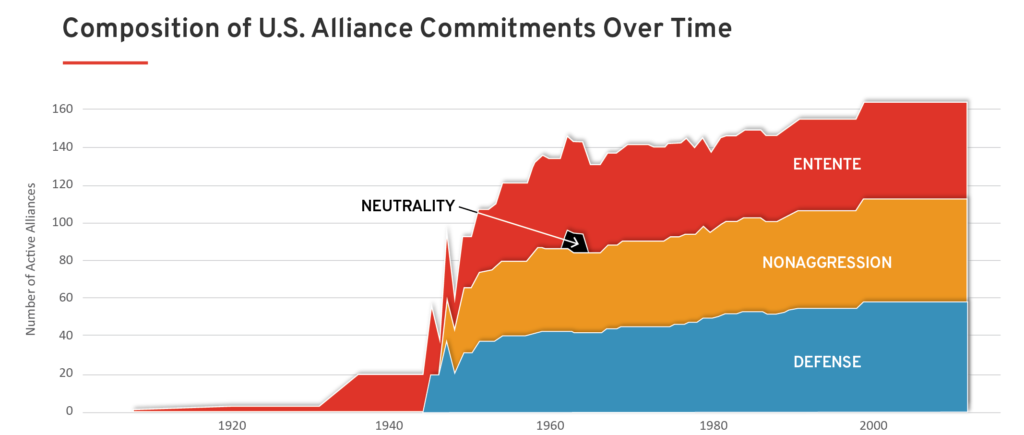
Note: A defense pact (blue) is the highest level of military commitment; an entente (red) is the lowest.
Source: Correlates of War Formal Interstate Alliance Dataset (Version 4.1)
Rather than acting alone, the United States can rely on a network of allies to share intelligence, coordinate military planning, and provide logistical support during crises.
Diplomacy allows the United States to project influence without resorting to military force. Trade relationships, foreign assistance, sanctions, and multilateral negotiations give policymakers tools to shape international behavior while avoiding the far higher costs of armed conflict. Trade occupies a unique place among national security tools: Rather than relying primarily on federal spending, it can strengthen strategic partnerships while expanding the economic resources that ultimately finance American security. For example, multilateral economic cooperation helps diversify supply chains for critical minerals—a key U.S. national security priority—thereby reducing dependence on geopolitical rivals like China. A strong diplomatic presence also increases favorable views of the United States (often against its principal rivals), which makes cooperation with allies more effective and economic pressure on adversaries more persuasive.
Diplomacy also serves as preventive security. Investments in development, humanitarian assistance, and governance can reduce instability before it evolves into armed conflict or crises that ultimately require more costly responses. Yet as federal debt continues to rise, America’s capacity to lead abroad may be one of the first casualties.
Measured as a share of gross domestic product (GDP), International Affairs spending—including development assistance, humanitarian aid, diplomacy, and international organizations—has fallen substantially since the 1960s, as reflected by the following chart.
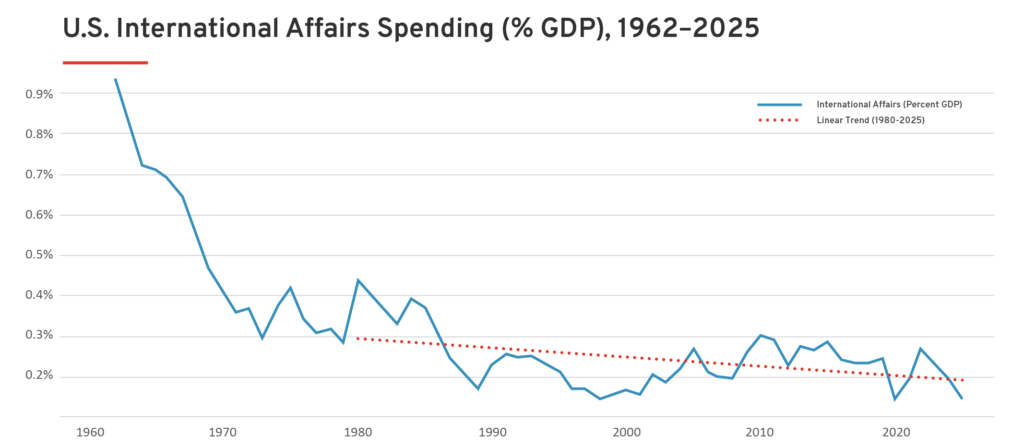
Source: Historical Tables, Office of Management and Budget
Unlike Social Security, Medicare, or interest payments, International Affairs spending is discretionary. And unlike defense, it often lacks a large domestic political constituency. As debt increases and lawmakers search for savings, diplomatic programs become relatively easy targets despite representing only a small share of the federal budget (about 1 percent of total spending in 2025).
As interest payments consume a growing share of the federal budget, lawmakers face greater pressures to constrain discretionary spending. Because diplomacy falls within that category, prolonged fiscal pressure can limit America’s ability to maintain embassies, provide development assistance, participate in international institutions, and sustain long-term partnerships abroad. Over time, these constraints will weaken tools that help the United States advance its security interests without relying exclusively on military force.
The United States’ ability to shape global events ultimately relies on the credibility of its economy. Investors have long considered U.S. Treasury securities among the world’s safest assets, as they allow the federal government to borrow at low cost. This fiscal credibility is itself a source of national power, giving the United States the flexibility to respond to threats, support allies, and sustain commitments during wars, recessions, and international crises. However, rising federal debt is beginning to erode that fiscal credibility.
Over the past decade, each of the three major credit rating agencies has downgraded U.S. sovereign debt from its highest rating. In 2011, Standard & Poor’s lowered the U.S. long-term credit rating from AAA to AA+, citing concerns about the country’s fiscal trajectory and political inability to stabilize debt. Fitch followed suit in 2023, pointing to rising deficits, a growing debt burden, and repeated fiscal brinkmanship. In 2025, Moody’s—the last agency to downgrade the United States’ rating—cited persistent deficits and rising interest costs as reasons behind their decision. These downgrades send an unmistakable signal that confidence in U.S. fiscal management is weakening.
Credit rating agencies have also emphasized the dollar’s unique role in the global economy, which allows the United States to borrow at relatively low costs, maintain deep and liquid financial markets, and exercise extraordinary influence through the international financial system. These advantages have transformed economic tools (e.g., sanctions) into powerful complements to military force.
While the dollar remains the world’s dominant currency, the following chart illustrates how the decline in the dollar’s share of foreign reserves has coincided with a substantial rise in federal debt. The Congressional Budget Office has warned that persistently rising debt could contribute to higher inflation expectations, gradually eroding confidence in the dollar’s role as the world’s primary reserve currency. As debt continues to grow, foreign governments and investors have greater incentives to diversify toward other reserve assets, which increasingly weakens one of the key economic pillars of American influence.
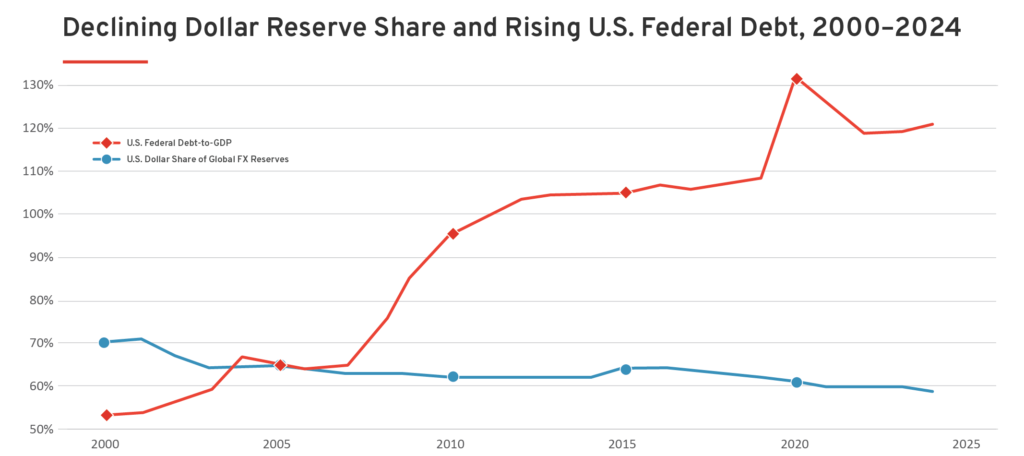
Sources: Federal Reserve Bank of St. Louis; International Monetary Fund
Taken together, these effects illustrate that debt is more than just a budgetary concern—it is a constraint on national power. Rising debt threatens the diplomatic and economic tools that allow the United States to achieve security objectives without relying solely on military force. America’s global influence rests on a combination of military capability, alliances, diplomatic engagement, and financial credibility. Preserving that foundation is a strategic imperative for preserving long-term national security.