

How Occupational Licensing Requirements Affect Access to Middle-Skills Pathways
Authors


Table of Contents
- An Overview of Occupational Licensing
- The Effects of Occupational Licensing
- Implications for Policy
- Conclusion
Media Contact
For general and media inquiries and to book our experts, please contact: pr@rstreet.org
Introduction
In recent years, U.S. lawmakers at both state and federal levels have increased investment in pathways to “middle-skills” jobs. These occupations require credentials beyond high school but not a four-year degree, and they represent more than half of the United States labor market. Middle-skills jobs also span a range of industries and can offer competitive wages, making them an accessible economic pathway for many who are unable or unwilling to obtain a bachelor’s degree or higher. However, many middle-skills occupations face ongoing and projected shortages, and these shortages threaten industries critical to well-being, like healthcare and education. Middle-skills jobs provide a key pathway to economic mobility for many Americans, especially women, who hold a majority of these positions.
Given that middle-skills jobs face shortages and lawmakers are actively considering ways to spur labor market entry, the regulatory landscape affecting entry to these professions warrants discussion. Growing investment in middle-skills pathways can offer returns, but only if people can reasonably access these jobs. Notably, estimates indicate that more than half of all middle-skills jobs require a government-issued license, compared to just 20 to 30 percent of other occupations. However, research suggests that occupational licensing may prevent aspiring workers from entering licensed jobs without producing meaningful benefits to consumers or the public. This paper examines the existing literature to explain the benefits and drawbacks of occupational licensing, with particular attention to its effects on middle-skills occupations.
An Overview of Occupational Licensing
Occupational licensing is the practice of requiring a government-issued license to work in a given occupation. To obtain a license, workers typically must meet a range of education and training requirements and may also have to pay application and renewal fees, meet certain “character” standards, or pass background checks. While all levels of government may license a profession, and federal law shapes licensing practices to an extent, in this paper, we focus on state-level occupational licensing, which is the most common form.
States license occupations very differently from one another, giving rise to a wide range of practices across the nation and across professions. For example, some occupations (like heating, ventilation, and air conditioning [HVAC] technicians and interior designers) are licensed in just a handful of states, whereas others, like cosmetologists and emergency medical technicians (EMTs), are licensed in every state. In addition, states vary considerably in their overall propensity toward licensing, with California, Louisiana, Nevada, and Washington licensing at least 75 occupations each versus Montana, South Dakota, Vermont, and Wyoming each licensing fewer than half as many.
The average license requires 362 days of education, one state exam, and almost $300 in fees. Low- to middle-income jobs can have disproportionately burdensome requirements, typically requiring more than $200 in fees, nine months to almost two years of training or experience, one to two exams, at least an 11th-grade education, and a minimum age of 18 years.
The Rise of Occupational Licensing in the United States
Since the introduction of licensing as labor regulation in the United States in the late 1800s, the proportion of the U.S. workforce required to hold an occupational license has steadily grown. Five percent of U.S. workers held a license in the 1950s; now, more than 20 percent do.
Many observers inherently sense that this increase is partly related to workforce growth within highly visible, service-oriented professions that have long required a license. Nursing is a case in point. The field has been licensed since the early 1900s, and more nursing licenses are issued today than ever before. But nursing’s expansion reflects trends specific to healthcare—an aging population and rising demand for medical services—rather than broader dynamics. The bigger driver, as explained in the 2015 White House report Occupational Licensing: A Framework for Policymakers, is the growing number of occupations that now require a license.
Another important facet of increased licensing is that the related burdens on workers are not spread evenly across the labor market. Restrictive licensing requirements, which have roughly tripled since 2019, tend to be concentrated among occupations with lower wages and higher income inequality. In addition, licensing now disproportionately affects middle-skills jobs, with more than half of such jobs requiring a license.
Finally, like regulatory practices in general, licensing practices experience scope creep over time. Once a state requires a license for an occupation, it is extremely rare for the state to later remove that requirement. Furthermore, licensing boards tend to increase requirements for occupations over time, making the regulatory burden larger for licensed workers throughout their working life. For example, occupations licensed in Maryland since 2012 or earlier have seen 3 percent increases in fees and 6 percent increases in education time needed since initial licensure requirements were established. Similarly, West Virginia has increased fees by 4 percent and educational requirements by 5 percent for long-licensed occupations. New occupational licenses spread from state to state, too; once a state licenses a new occupation, neighboring states tend to subsequently adopt similar practices. These patterns suggest a ratcheting effect of regulatory burden once licensing is initiated, which has important implications for middle-skills jobs that already struggle to meet demand and may not receive proportional wages in return.
Licensing and Middle-Skills Jobs
Federal and state governments have recently introduced a range of investments to support aspiring middle-skills workers, including Workforce Pell Grants, state Reconnect programs, and other initiatives. These investments have the potential to bolster economies, drive economic mobility, and fill workforce gaps. However, many of these career paths require lengthy training, a license, or both. Table 1 highlights the overlap of education/training, licensing, and shortages for several middle-skills pathways that could be funded by these programs.
Table 1: Middle-Skills Jobs Requirements
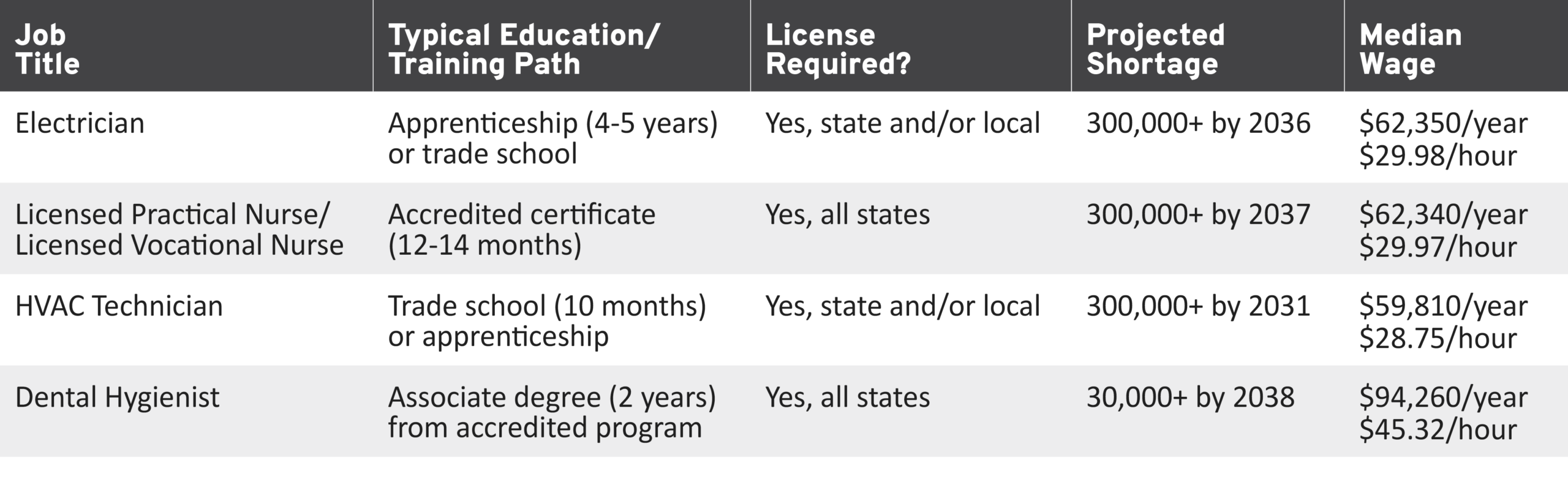
This table highlights just a handful of examples of middle-skills jobs that are currently experiencing or are projected to experience shortages. The reasonable training times and costs associated with these jobs, coupled with their competitive wages, make them potential vehicles for improving economic well-being for many Americans. This is why many lawmakers have implemented programs to improve access to these pathways. However, because all of these jobs (and many others) require licenses, policymakers seeking to optimize returns on middle-skills investments must consider the effects of regulating these professions.
The Effects of Occupational Licensing
Occupational licensing is often intended to reduce information asymmetries between consumers and workers, which theoretically produce higher-quality services and safer occupational practices. This is based on the idea that consumers have few ways of knowing whether someone is competent to perform a job, and state-issued licenses can weed out bad actors and signal competency. This is most evident in the origin of licensing practices, which were initially concentrated in medicine and law, given the clear public-protection concerns. In these early and limited iterations, occupational licensing did lead to better service provision by doctors, midwives, and other relevant professionals.
However, as states have expanded occupational licensing, the connections to health and safety have become less clear. This is reflected in the varied licensing requirements different states place on the same occupations. One study found that the states with the strictest licensing regulations had minimum education requirements for 62 separate occupations that were at least 700 days longer than those with the most lenient licensing regulations. In addition, states do not always license occupations in ways that logically align with worker responsibilities or job-related risks to the public. For example, a shampooer in Texas must have 70 days of education or experience and pass two exams, which is double the educational requirement for an EMT.
These inconsistencies suggest that states may have motivations beyond protecting public health and promoting safety for regulating professions, making it important to assess occupational licensing’s impact on consumers, the labor force, and aspiring workers.
Impacts on Consumers
The primary asserted purpose of occupational licensing is to improve the customer experience, including safeguarding their health and safety and enhancing the quality of service they receive. However, for many occupations, restrictive or overly burdensome licensing does not actually improve these outcomes.
When it comes to public health and safety, appropriate education or experience requirements can be effective elements of occupational licensing. But for many professions, only a fraction of mandated hours cover true safety issues like preventing the transmission of blood-borne pathogens, avoiding chemical burns, or mitigating fire risk. For example, California law requires that barbers undergo 1,000 hours of training for licensure, but only 200 of those hours address public health or safety concerns.
In addition, despite all the certification hours allotted to skills-building (as opposed to health and safety), licensing generally does not improve service quality. Research comparing unlicensed/lightly licensed to licensed/heavily licensed states consistently finds no significant difference in consumer-reported satisfaction. In fact, in some occupations, less-restrictive licensing has been associated with better customer reviews. In dentistry, specifically, after controlling for socioeconomic factors, the spread of occupational licensing did not reduce adverse patient outcomes such as chipped teeth or number of cavities. Additionally, research from the healthcare sector found that increasing licensing restrictions beyond those that preserve basic public health and safety did not appear to improve patient outcomes.
Another important point is that modern consumers face fewer informational barriers than pre-internet-era consumers now that online reviews and verification systems provide easily accessible information for most industries. In fact, growing evidence indicates that online reviews play a larger role in customers’ hiring decisions than credentials.
Licensing also increases the economic cost of obtaining a job, and this cost is often passed to consumers in the form of higher prices. For example, one study found that tightening restrictions on healthcare professionals had no impact on care quality but increased the cost of a well-child visit by 3 to 16 percent. Another found that limiting scope of practice for licensed dental hygienists was associated with a 12 percent increase in the cost of basic dental care.
Effects on Wages
Although public health and safety—not economic mobility—are the historic and currently stated goals of licensing, the practice does affect middle-skills workers’ earnings. Many workers receive higher wages and experience greater job stability when licensed. For example, compared to the general labor force, individuals with a certificate or license are unemployed at about half the rate of those lacking such credentials. On average, licensing produces a wage increase of about 6 percent in the public sector and 9 percent in the private sector.
The wage premiums that come with licensed credentials also appear to affect income inequality, although the precise mechanism remains unclear. Some research suggests that licensing-related income gains are most pronounced in high-paying jobs, increasing wage inequality within occupations. But other research finds that the increased earnings resulting from new licensing laws tend to be greatest in low- and medium-wage jobs. If the latter is proven to be true, licensing could potentially help close wage gaps.
What is clear is that unlicensed workers may be harmed by increased licensing requirements. For example, one study found that after accounting for occupational differences, wage inequality within licensed sectors was roughly 6 percent higher than it was in unlicensed sectors. This same body of research found that licensing resulted in increasing wage premiums throughout one’s career, meaning that the pay gap between licensed and unlicensed workers in similar professions grew over time and with experience. Other research has found that as licensing rises in some occupations, average earnings in other professions with similar skill requirements fall. These gaps between earnings among licensed and unlicensed workers disproportionately harm women, Black Americans, and foreign-born Hispanic workers.
Preventing Job Access
Even if licensing consistently translated to wage premiums and job security, the barriers to obtaining a license can be problematic for those seeking to enter licensed fields. Specifically, the time and money required to earn a license disproportionately affects those who would have the most to gain. As mentioned previously, more than half of middle-skills jobs—occupations frequently touted as accessible pathways to economic mobility for individuals who have historically struggled to access four-year degrees and high-paying jobs—are licensed by states. For example, 80 percent of hair stylists report needing a certificate, but acquiring the necessary training costs roughly $10,000, and the hourly wage in this profession averages $12.50 for someone working full-time. The economic barriers associated with licensing also affect women disproportionately, as they hold about 83 percent of low-paying middle-skills jobs (but only about one-third of the nation’s high-paying middle-skills jobs) and are more likely than men to work in a profession that requires a license. The single largest barrier for aspiring workers is time to license acquisition. Research has shown that the negative impact of licensing on occupation entry doubles when it takes one month or more to earn a license. This is likely because of the time invested, earnings lost, and the cost of necessary hours of training or experience.
Non-financial requirements can serve as significant barriers to job entry as well. Many state licensing boards historically banned individuals with a criminal record from entering certain occupations. Such restrictions disproportionately affect people of color, especially Black and Hispanic men, and often have little bearing on the job or on public health and safety. “Barrier laws,” which prevent people with a past substance-related conviction from working as substance use disorder counselors, are a particularly relevant example of how these restrictions can be counterproductive, as individuals with such a history often have directly relevant experience. Many states have eliminated these and other “character” requirements in recent years, although some persist and continue to affect job entry.
Not only does licensing serve as a barrier to entering certain occupations, but it has also been shown to restrict opportunities for unlicensed individuals, shrink the available labor supply, obstruct workforce entry, and reduce competition. Some research has found that occupational licensing reduces the supply of workers in relevant fields by as much as 27 percent. This can reduce the quality of services and may drive some to engage in “underground,” unlicensed work, which can expose workers to exploitative conditions, wage theft, and unsafe labor practices. Moreover, because such positions are typically paid in cash and evade taxation, they also cost states revenue.
Finally, substantial between-state differences in licensing requirements, along with varying application waiting times, often translate into lower interstate mobility for workers. Individuals who work in state-licensed jobs are more than 30 percent less likely to move between states than individuals in nationally regulated occupations. Some research has found that occupational licensing can be associated with reductions in job mobility more broadly, including job-to-job moves. Related modeling suggests that relaxing licensing requirements, when appropriate, may have economic benefits like improving hiring rates and employment opportunities.
Implications for Policy
State licensing is a form of occupational regulation that, while well-intended, has complex effects on workers and the workforce. Licensing is meant to provide a minimum quality standard for occupations that pose significant health or safety risk to consumers, yet research continues to suggest that the practice, when applied beyond this original scope, has negligible effects on outcomes. Although licensing can offer some benefits to already-licensed workers, the pathways to obtaining a license can restrict job access and may even increase inequality for the very types of workers the United States will need to address future shortages. These middle-skills worker shortages are worth preventing, as they tend to reduce consumer access, safety, and satisfaction. To optimize the benefits and minimize the unintended negative consequences of licensing, state lawmakers should approach licensing policy more cautiously and strategically by:
- 1. Aligning licensing requirements like educational hours and exams to the knowledge and skills needed to protect public health and safety
- 2. Authorizing new licensure only sparingly and protecting existing licensed middle-skills workers from requirement creep
- 3. Adopting license-reciprocity agreements to reduce labor-mobility barriers
- 4. Avoiding criminal history restrictions or vague “character” requirements on licensing
Conclusion
With the growth of efforts to improve access to middle-skills job pathways, occupational licensing represents an important yet often overlooked point of consideration. Middle-skills occupations are key to addressing workforce shortages and can enhance workers’ economic opportunities, especially for women and individuals without four-year degrees. However, when overly broad or restrictive, occupational licensing often benefits current workers while keeping aspiring workers from entering their field of choice. The specific requirements of state licensing, such as fees, education, experience, and character specifications, are often disconnected from public health or safety risks and do little to improve the consumer experience. Thus, as government investment in middle-skills pathways continues to expand access to job-specific training and education, lawmakers should consider how their state licensing laws facilitate or hinder entry into these professions and whether they are protecting the public or exacerbating labor supply shortages.
This report was made possible through the support of Lumina Foundation. The views expressed are those of the authors and do not necessarily reflect those of Lumina.